Financing Land Is the Hardest Money to Borrow
Published 4/16/2026 · 15 min read · Real-estate calculators

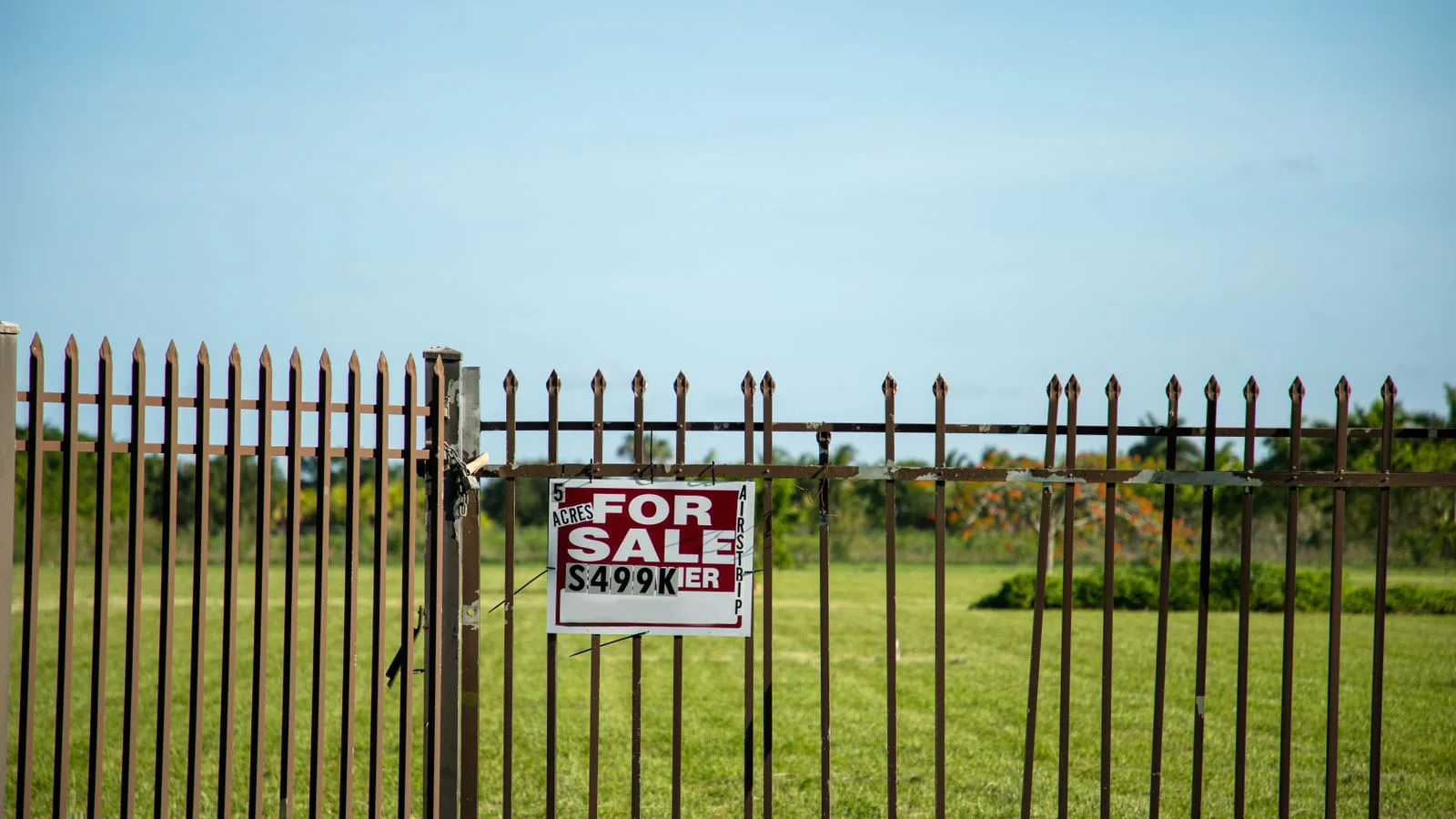
Raw land generates no rent, offers no depreciation shelter, cannot be insured against much, and sells slowly to a thin pool of buyers. Every one of those facts is a reason a lender recovers less if you stop paying, so land is priced accordingly. Compare two ways of borrowing against the same $120,000 plot. A land loan at 35 percent down leaves $78,000 borrowed, amortised over fifteen years at 8.5 percent with a balloon at year five: the payment is $768.10 and $42,000 is due at closing. A conventional mortgage on the same value at 20 percent down leaves $96,000 borrowed over thirty years at 6.5 percent: the payment is $606.79 and $24,000 is due at closing. So the land loan costs $161.31 more each month — 126.58 percent of the mortgage payment — on a loan that is $18,000 smaller, and it demands $18,000 more cash on the day. Measured properly, per unit borrowed, five years of the land loan costs $30,036.26 of interest on $78,000, or 38.51 percent, against $30,273.66 on $96,000, or 31.54 percent. And at month sixty the balloon falls due: $61,950.44, which you must refinance, repay or sell to meet.
Larger deposit, shorter term, higher rate, and a balloon at year five. On the same $120,000 plot, the land loan costs $768.10 a month against a mortgage's $606.79 — and demands $18,000 more at closing.
Four missing things, and each of them is a reason for the price
Start from what a lender is actually underwriting. A let flat produces rent that services the loan even if the borrower's circumstances change; land produces nothing at all, so every payment must come from income earned elsewhere. A building can be depreciated against income in most tax systems, giving the owner a reason to hold it in a bad year; land generally cannot. A house can be insured against fire and storm, so the collateral survives most catastrophes; a plot of land has very little to insure and its value can be destroyed by a planning decision no policy covers. And a finished home has a large, liquid pool of buyers financed by an entire mortgage industry; a plot has a small pool of buyers who mostly have to pay cash or arrange the same difficult financing you are arranging.
There is a fifth, structural reason that operates behind the other four in the American market and explains a great deal about pricing: raw land is not eligible security for the mortgages that the secondary market buys. A lender writing a conventional home loan can sell it on and recycle the capital; a lender writing a land loan generally keeps it on its own balance sheet for the whole term. A loan a bank must hold is priced against that bank's own cost of capital and its own appetite, which is why land lending is dominated by local banks and credit unions who know the parcels, and why terms vary so much more between institutions than mortgage terms do. Shopping matters more here than almost anywhere else in property finance.
Raw, unimproved, improved — and what moves a plot between them
Lenders sort land into tiers and price each differently, and the vocabulary is worth knowing because it maps directly onto the deposit you will be asked for. Raw land is untouched: no legal access, no road, no services, no survey, and often no evidence that anything can lawfully be built on it. Unimproved land has some of those things — usually access and perhaps one service — but not the set required to build. Improved land has road frontage, utilities available at or near the boundary, a completed survey and, where the drainage is not mains, a passed soil percolation test. Each step up moves the plot closer to being a house, and lenders price it as such.
What moves a plot up a tier is generally a document rather than a bulldozer, which is the most useful thing in this section. A recorded easement granting legal access across a neighbour's land can convert a landlocked parcel into a buildable one. A utility company's written confirmation that a connection is available at the boundary, and at what cost, changes the tier. A passed percolation test changes it. A subdivision approval or a change of designation in the local plan changes it more than anything else. If you are buying at the bottom of the ladder, the practical route to financing is often to obtain one or two of those documents before completing rather than after, because the tier is assessed at the moment the lender writes the loan.
The comparison, done per unit borrowed rather than per month
The monthly payments tell a misleading story on their own, and it is worth seeing why. The land loan's $768.10 against the mortgage's $606.79 looks like a punitive difference — 126.58 percent of the mortgage payment — but the two loans are not the same size and do not run for the same term, so the comparison is not like for like. Over five years the land loan actually pays slightly less interest in absolute terms, $30,036.26 against $30,273.66, simply because it is an $78,000 loan and the mortgage is a $96,000 one.
Divide by the amount borrowed and the real picture appears. Five years of the land loan costs 38.51 percent of its principal in interest; five years of the mortgage costs 31.54 percent of its principal. That seven-point gap, not the monthly payment, is the price of the rate and the term. The shorter term does one thing in your favour: it amortises much faster, repaying $16,049.56 of principal in five years against the mortgage's $6,133.46. You are paying more per unit borrowed and getting equity faster in exchange, which is a real trade rather than a pure penalty — though it is a trade made on the lender's terms, not yours.
The balloon, and what signing one obliges you to do
Most land loans amortise over one term and mature over a much shorter one, and the difference between those two numbers is the balloon. Our loan amortises as though it will run fifteen years — which is what produces the $768.10 payment — but it matures at five, so on the sixtieth payment the entire remaining balance of $61,950.44 falls due at once. That figure is not a penalty and it is not a surprise: it is simply the principal you have not yet repaid, and it is calculable from the day you sign. What makes it dangerous is that people budget for the payment and not for the maturity.
Signing a balloon commits you to doing one of three things by a fixed date, and it is worth being honest with yourself about which one you are planning. You can refinance, which means finding a lender willing to write a new loan on the plot in five years' time, on terms nobody can know today and subject to your circumstances then. You can repay, from savings or from the proceeds of something else. Or you can sell, which is the option the thin resale market makes least reliable. The fourth possibility — building, so that the plot becomes a house and the loan becomes an ordinary mortgage — is the one most land buyers actually intend, and it deserves a plan with dates on it rather than an intention. A balloon is a deadline attached to money, and deadlines with no plan behind them are how people lose plots they could have kept.
Zoning and utility access are most of what you are buying
Two plots of identical size, soil and outlook can differ in value by a multiple, and the difference is almost always in what may lawfully be built and what it will cost to connect. Zoning determines whether the answer to the first question is a house, four houses, a barn or nothing, and that answer is set by an authority that can change its mind. Utility access determines the second: a connection running past the boundary is a modest cost, a connection half a kilometre away is a large one, and a plot that cannot be economically connected has a ceiling on its value regardless of how attractive it is.
For a buyer this converts into a short and unromantic list of things to establish before committing money, and the order matters. Confirm the designation in the local plan in writing, from the authority rather than from the seller's particulars. Establish legal access and see it recorded, not merely pointed at across a field. Obtain written costs from each utility for a connection to the boundary. Where drainage is not to a public sewer, commission the soil test and make the purchase conditional on it passing. Every one of these is cheaper to discover before completion than after, and any of them can be the reason a plot that looked like a bargain was priced correctly all along.
Seller financing, and whether this is a distinct product at all
Where institutional lending is difficult, the seller often becomes the lender. In a seller-financed purchase the buyer pays a deposit and then instalments directly to the seller, who retains a security interest until the balance is paid. The attraction is obvious on both sides: the buyer obtains financing that a bank would not write, and the seller obtains a price and an income stream on an asset that was hard to sell. The risks are equally obvious and worth stating plainly. The terms are whatever the two parties agree, which means no external underwriting is protecting either of you from a bad structure; the seller's own title and any mortgage over the plot need checking, because a seller who stops paying their own lender can lose the land you are buying; and the documentation has to be drawn by a professional and properly registered, or the buyer's interest may be unenforceable against third parties.
Whether any of this looks familiar depends heavily on where you are, because the standalone land loan is much more of a North American product than a European one. In the United States it is a recognised category with its own tiers, its own pricing and its own lenders. Across much of continental Europe the purchase of a building plot is more often financed inside a wider operation — the plot and the construction arranged together as one facility for a project that already has drawings — or simply paid for from savings, with banks reluctant to lend against undeveloped land on its own and, where they do, applying markedly lower loan-to-value ratios. If you are buying a plot in a European market and expecting to find the product described in this article, the more useful question to put to a lender is not what their land loan rate is but whether they write one at all, and on what conditions they would finance the plot as part of a construction project instead.
| What is being compared | Land loan | Comparable mortgage |
|---|---|---|
| Deposit required, and cash at closing | 35% — 42,000 | 20% — 24,000 |
| Amount borrowed | 78,000 | 96,000 |
| Rate and amortisation term | 8.5% over 15 years | 6.5% over 30 years |
| Monthly payment | 768.10 | 606.79 |
| Interest paid over the first five years | 30,036.26 — 38.51% of the amount borrowed | 30,273.66 — 31.54% of the amount borrowed |
| Principal repaid over the first five years | 16,049.56 — the shorter term amortises faster | 6,133.46 |
| What happens at the end of year five | Balloon of 61,950.44 falls due — refinance, repay or sell | Nothing — 89,866.54 still outstanding, twenty-five years to run |
Worked with our own calculator
Land loan calculator
Given
- Land price
- $60,000.00
- Down payment as
- Percent of price
- Down payment value
- 10
- Interest rate (APR)
- 8.1%
- Loan term (years)
- 10
- Balloon due after (years, 0 = none)
- 3
- Land type
- Raw / undeveloped
Result
- Down payment
- $6,000.00
- Loan amount
- $54,000.00
- Monthly payment
- $658.03
- Total interest (full term)
- $24,963.10
- Balloon balance due
- $42,083.81
These figures are produced by the calculator below, not typed in by hand — they are recomputed whenever the tool changes.
Run it on your own figures →Frequently asked questions
- Why is the deposit so much larger than on a mortgage?
- Because the deposit is the lender's margin of safety and land needs a wider one. If a lender has to take possession, the sale will be slow, the buyer pool small and the price achieved uncertain, so a larger cushion is required before the loan is safely below the eventual recovery. There is a second, less discussed reason: the deposit is also a test of commitment. A borrower who has put 35 percent of a plot's value into it is materially less likely to walk away when a planning application is refused than one who has put in 5 percent, and land is unusually exposed to exactly that kind of disappointment. Both reasons point the same way, which is why the requirement is so consistent across otherwise different lenders.
- Does the land loan really cost less interest than the mortgage?
- Over five years, in absolute terms, marginally — and the comparison is a trap. The land loan pays $30,036.26 of interest against the mortgage's $30,273.66, but only because it is an $78,000 loan and the mortgage is a $96,000 one. Per unit borrowed the land loan costs 38.51 percent against 31.54 percent, which is the honest measure of the rate you were charged. This is a general lesson worth carrying beyond this article: absolute interest totals are almost never comparable between loans of different sizes, and the moment two loans differ in principal, term or both, only a ratio tells you anything. If you want a single number for comparing borrowing costs across dissimilar loans, use interest paid as a percentage of principal over the period you actually intend to hold the debt.
- What is a percolation test and why does it change the price so much?
- It measures how fast water drains through the soil, and it decides whether a plot beyond the reach of a public sewer can take a private drainage system at all. Dig a hole, fill it with water and time the fall: soil that drains too slowly cannot disperse effluent, and soil that drains too fast sends it into the groundwater. Either result can mean no conventional system may be installed, and the alternatives — an engineered treatment plant, or a connection to a distant sewer — can cost a substantial fraction of the plot's price. That is why a passed test moves a plot up a tier and why the sensible way to buy an untested plot is with the purchase conditional on a test you commission yourself, so the cost of a bad result is a survey fee rather than a plot you cannot build on.
- What are my realistic options when the balloon falls due?
- Four, and they are worth ranking honestly before you need them. Building is the best outcome, because a completed house converts an awkward land loan into an ordinary mortgage that any lender will write; if that is the plan, the construction financing needs to be arranged well before the balloon date, not at it. Refinancing the land loan itself is the common fallback and it depends on your circumstances and the lender's appetite at that future date, neither of which you control. Repaying from savings is the safest and the least available. Selling is the option people assume is always there and it is the one the thin market undermines, particularly if you are selling under time pressure that a buyer can see. The practical advice is to start on the first or second of these at least twelve months before the maturity date, because every one of them takes longer than people expect and the one thing you cannot buy at that point is time.
- Is seller financing a good idea or a warning sign?
- Both are possible and the way to tell them apart is to ask why no bank is in the picture. Sometimes the answer is benign: the plot is perfectly good but sits in a category no institution has a product for, or the seller simply prefers an income stream to a lump sum for tax or estate reasons. Sometimes the answer is that professional underwriters have looked at this land and declined, which is information you are being offered for free and should not ignore. The way to find out is to do the underwriting yourself, in the same order a lender would: title, legal access, planning designation, utility connection costs and drainage. If the plot survives that, seller financing may be a genuinely good route to owning it. If you would rather not do that work, seller financing is not a way to avoid it — it is a way to pay for skipping it later. In every case, have a professional draw and register the documents; the informality that makes seller financing attractive is the same informality that makes it dangerous.
Articles you may find interesting
All guides →Related tools
This article is explanatory. It shows how a calculation works and what changes the answer; it is not financial, tax, legal or investment advice, it knows nothing about your income, your lease, your plot or your builder, and it cannot tell you what to sign. Transfer taxes, deposit ceilings, benefit rates, parking standards and lending rules differ by country and change — often at each annual budget — so every rule described below must be checked against the current text before you rely on it. Every monetary input is a stated assumption, not a forecast or a quotation. Put your own figures into the calculator, and take regulated advice before committing money.
Sources
- Consumer Financial Protection Bureau — Regulation Z, 12 CFR § 1026.43 — Minimum standards for transactions secured by a dwelling, including balloon-payment qualified mortgages
- Consumer Financial Protection Bureau — Regulation Z, 12 CFR § 1026.4 — Finance charge (the treatment of costs in a secured transaction)
- Fannie Mae — Selling Guide — eligible property types and eligible mortgage products (raw land is not an eligible security)
- Légifrance — Code de la construction et de l'habitation — ventes de terrains à bâtir et contrat de construction de maison individuelle
- Service-Public.fr — Crédit immobilier : objet du prêt, terrain à bâtir et opérations de construction
Spotted a mistake in this article?