What Breastfeeding Actually Costs in Energy — and Why the Published Number Is Smaller Than the Milk
Published 4/20/2026 · 12 min read · Health calculators

The cost of milk is not quoted, it is derived. FAO/WHO/UNU take an average milk output of 807 g a day in the first six months, multiply by the energy density of human milk — 2.8 kJ per gram, or 0.67 kcal per gram — and divide by an 80% efficiency of conversion from food energy to milk energy. That gives 2,825 kJ a day, or 675 kcal. The number usually quoted is around 500, and the gap is not an error: the guidelines assume that roughly 0.8 kg of tissue laid down in pregnancy is mobilised each month, which at 27.2 MJ per kilogram supplies about 173 kcal a day. Subtract it and the published net increment is 505 kcal a day. EFSA lands independently on 2.1 MJ, which is 500 kcal. The 2023 US reference intakes come out lower, at about 400 kcal, mostly because they assume a smaller milk volume. After six months, with partial feeding at around 550 g a day, the same arithmetic gives 460 kcal. And measured milk volumes vary about threefold between mothers, so any single figure is the middle of a wide distribution rather than a personal requirement.
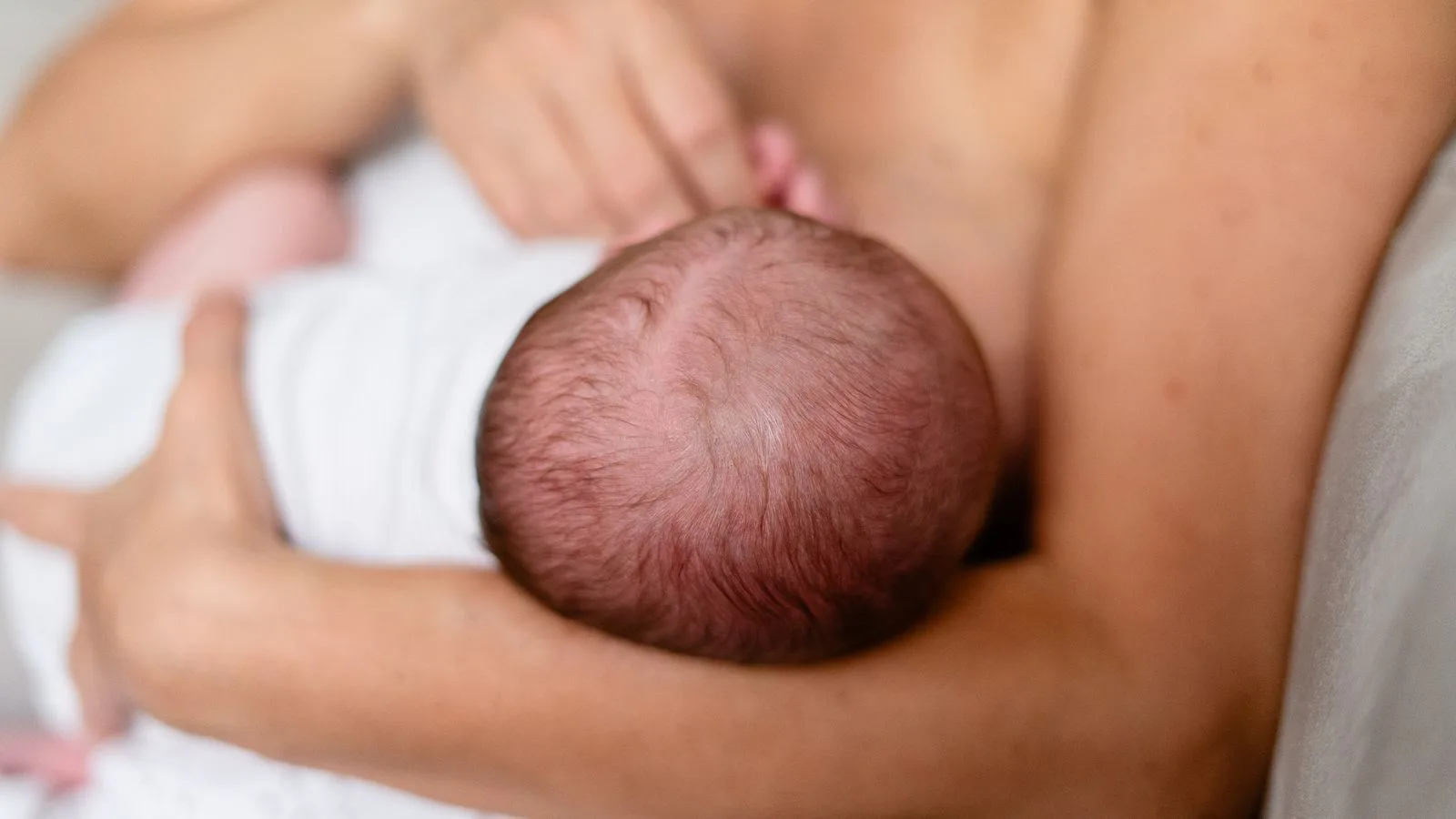
Milk production has a computable cost: volume times energy density divided by the efficiency of conversion. Do the sum and you get about 675 kcal a day, not the 500 that gets quoted. Here is the derivation, why the published increment is deliberately lower, how much the real spread is between mothers, what the water requirement actually rests on, and why cutting calories while feeding is a clinical question.
Milk has a price, and the price is a multiplication
Three quantities settle it. How much milk is produced. How much energy is in a gram of it. And how efficiently food energy is turned into milk energy, because the conversion is not free. FAO/WHO/UNU write the calculation out in one line: 807 g of milk a day, times 2.8 kJ per gram, divided by 0.80 efficiency, equals 2.8 MJ a day. In kilocalories that is 675. Everything else in this article is a correction to that number.
It is worth pausing on the efficiency term because it is the part people skip. Producing 2,260 kJ of milk energy does not cost 2,260 kJ of food energy; it costs about a quarter more, because synthesis, transport and secretion all have a metabolic overhead. Dividing by 0.80 rather than multiplying by 0.80 is the difference between a cost and a yield, and getting it backwards would understate the requirement by about 360 kcal a day.
Why the published figure is smaller than the milk
The gross cost is 675 kcal a day; the figure almost everyone quotes is around 500. The difference is deliberate and it is written into the guideline. Pregnancy lays down fat, and the reference values assume that some of it is meant to come back out during feeding: FAO/WHO/UNU assume the mobilisation of about 0.8 kg of tissue a month, and at the report's own 27.2 MJ per kilogram of that tissue, 0.8 kg spread over a month supplies 0.72 MJ a day — about 173 kcal. Take that off 675 and you get the published 505 kcal a day. In other words the recommended intake is deliberately set below the cost of the milk, and the gap is intended to be filled from the body.
The 2023 US reference intakes make the same move with different constants: a cost of milk production of 540 kcal a day, a mobilisation of 140 kcal a day, and a net of about 400 kcal for the first six months and 380 for months seven to twelve. Their mobilisation assumption is stated as a gradual weight loss of 0.64 kg a month — and at the same 27.2 MJ per kilogram that comes to 139 kcal a day, which is where their 140 comes from. The remaining gap between 505 and 400 is mostly the assumed milk volume: 540 kcal at the same energy density and efficiency implies about 645 g of milk a day rather than 807.
The average hides a threefold spread
Kent and colleagues test-weighed 71 exclusively breastfed infants aged four to twenty-six weeks before and after every feed for a full twenty-four hours. Mean intake was 788 g, standard deviation 169 g — and the range ran from 478 g to 1,356 g. Run those three volumes through the same arithmetic, at 0.67 kcal per gram and 80% efficiency, and the daily energy cost of milk comes to 400 kcal at the bottom of the range, 660 in the middle, and 1,136 at the top. The published increment is the middle of a distribution nearly three times as wide as itself.
The same study is worth remembering for a second reason. Infants fed 11 times in 24 hours on average, with a range from 6 to 18, and there was no relationship between how often they fed and how much milk the mother produced over the day. Feed counts are not a supply measurement, and neither is a calorie figure.
Exclusive, partial, and the rest of the first year
Everything above is for exclusive feeding in the first six months. Once solid food starts, milk volume falls, and the energy cost falls with it in direct proportion — there is no separate mechanism, just less milk. FAO/WHO/UNU use an average of 550 g a day for partial feeding after six months, which through the same multiplication gives 1,925 kJ, or 460 kcal a day, and this time with no mobilisation term subtracted: the gestational stores are assumed to be gone. The 2023 US figure for months seven to twelve is 380 kcal, again with no mobilisation.
There is one more asymmetry in the reports that is easy to miss and worth stating. FAO/WHO/UNU give a second, higher figure — the full 675 kcal a day — for women who were undernourished or whose gestational weight gain was insufficient, precisely because the subtraction assumes stores that may not be there. That is the clearest statement in any of these documents that the published increment is not a universal constant but a conditional one.
Water: real, and widely overstated
Human milk is about 87% water, so a mother producing 788 g of milk a day is exporting roughly 686 mL of water with it. That is almost exactly the extra water EFSA sets for lactation: the adequate intake rises from 2.0 to 2.7 litres a day, an increase of 700 mL, and it includes water from food as well as drink. The US adequate intake is more generous, going from 2.7 to 3.8 litres, a rise of 1.1 litres. Either way, the requirement is the milk, and the milk is not enormous.
What the evidence does not support is the further step, the idea that drinking more increases supply. A Cochrane review looked for randomised trials of extra fluids for breastfeeding mothers and found none; the single quasi-randomised study it could include, 210 women, was of low quality and did not report the outcomes that mattered. The reviewers concluded that there is insufficient evidence to support increasing fluid intake beyond what a mother needs to meet her physiological needs. Thirst is the instrument here; a target in litres is not.
The nutrients that rise more than the energy does
As in pregnancy, the calorie figure is the least interesting number on the page. Against EFSA's baseline for a woman of 60 kg, lactation adds 19 g of protein a day in the first six months — a 38% rise against a 23% rise in energy — and 13 g a day thereafter. Folate goes from 330 to 500 µg of dietary folate equivalents, up 52%. Vitamin A doubles, from 650 to 1,300 µg of retinol equivalents. Vitamin C rises 63%, from 95 to 155 mg. Iodine goes from 150 to 200 µg on EFSA's numbers and to 290 µg on the US reference intake, which is a 93% rise. Iron, by contrast, is left at 16 mg in the EFSA tables, unchanged.
The vitamin A figure is the one worth dwelling on because it is a doubling, and because it is a fat-soluble vitamin with a real upper limit — so it is exactly the nutrient where taking a supplement without advice is a bad idea rather than a neutral one. Every one of these numbers belongs in a conversation with a dietitian or doctor if your diet is restricted for any reason at all.
Eating less while feeding is a clinical question, not a calculator one
The whole design of the reference values already builds in a slow loss: FAO/WHO/UNU assume 0.8 kg a month, the 2023 US report 0.64 kg a month. That is the deficit the guidelines have already spent. Adding another one on top is a different decision, and it has been studied. Lovelady and colleagues randomised overweight women who were exclusively breastfeeding to an energy deficit plus exercise for ten weeks; the intervention group lost about 0.5 kg a week and their infants grew no differently from the controls'. Dewey and colleagues had earlier shown that twelve weeks of supervised aerobic exercise had no effect on milk volume or composition.
Those are reassuring results and they are also narrow ones: specific populations, supervised, for a defined number of weeks, with a defined rate of loss. They do not license an arbitrary deficit chosen from a web page, and none of them was conducted in women whose intake was already marginal. If you want to lose weight while breastfeeding, that is a reasonable thing to want and a reasonable thing to raise with your doctor or a dietitian, who can look at how feeding is going and at what you are actually eating. It is not a thing a calculator can decide.
| Step | Value used | Where it comes from | Running result |
|---|---|---|---|
| Milk output, 0–6 months, exclusive | 807 g/day | FAO/WHO/UNU 2004, chapter 7 | — |
| Energy density of human milk | 2.8 kJ/g (0.67 kcal/g) | Same report, months 1–24 of lactation | 2,260 kJ/day of milk energy |
| Efficiency of conversion | 80% | Same report | 2,825 kJ/day = 675 kcal/day gross |
| Drawn from gestational stores | 0.8 kg/month of tissue at 27.2 MJ/kg | Same report | −0.72 MJ/day = −173 kcal/day |
| Published net increment, 0–6 months | +505 kcal/day (2.1 MJ) | FAO/WHO/UNU, well-nourished women | 675 − 170, rounded |
| The same question, EFSA | +2.1 MJ/day = +500 kcal/day | EFSA Dietary Reference Values, Table 1 | Agrees with FAO within 1% |
| The same question, NASEM 2023 | 540 − 140 ≈ +400 kcal/day | Dietary Reference Intakes for Energy (2023) | Lower: 540 kcal implies about 645 g of milk |
| After 6 months, partial feeding | 550 g/day | FAO/WHO/UNU 2004 | 1,925 kJ = 460 kcal/day, no mobilisation |
Frequently asked questions
- Is it 500 extra calories or 675?
- Both, for different things. 675 kcal a day is what the milk costs to make. 505 is what FAO/WHO/UNU recommend eating, because they assume the remaining 170 comes from tissue laid down in pregnancy. If those stores are not there — undernutrition, or an insufficient gestational weight gain — the same report recommends the full 675. EFSA's 500 and the 2023 US figure of about 400 are the same idea with slightly different constants.
- Does eating more make more milk?
- No — the direction of causation runs the other way. Milk removal drives production, which is why the energy figures are derived from measured milk volumes rather than the reverse. Eating more when supply is low does not raise it; the things that do are removal frequency and effectiveness, and if supply is a real concern that belongs with a midwife, health visitor or lactation consultant who can watch a feed. Kent's data reinforce the point from another angle: there was no relationship between the number of feeds a day and the mother's 24-hour output.
- How much water should I actually drink?
- Enough to satisfy thirst. The published increment is 700 mL a day on EFSA's numbers and 1.1 litres on the US ones, and both figures include water from food, not just from drinks. That extra is essentially the water leaving in the milk — about 686 mL a day at an average output. Drinking beyond thirst has not been shown to increase supply, and a Cochrane review found no adequate trial supporting it.
- I am exclusively pumping. Do the same numbers apply?
- The arithmetic applies, because it is driven by the volume produced and not by how the milk leaves. If you are expressing, you have something most mothers do not: a measured volume. Multiply your daily total in grams by 0.67 and divide by 0.8 and you have your own gross cost in kilocalories, which is a far better estimate than any population average. What that number should mean for what you eat is still a question for a clinician.
- Does the cost change when the baby starts solid food?
- Yes, and in direct proportion to the milk. FAO/WHO/UNU model partial feeding after six months at around 550 g of milk a day, which comes to 460 kcal; the 2023 US figure for months seven to twelve is 380 kcal. Neither subtracts a mobilisation term, on the assumption that the gestational stores are gone by then. The practical shape is a gradual decline that follows however much milk your baby is still taking, which is not something a fixed number can track.
Articles you may find interesting
All guides →Related tools
This article explains how the energy cost of milk production is calculated. It is general information, not medical or dietary advice, and it cannot tell you whether you are eating enough or feeding enough. The published increments are population averages built on assumed milk volumes; measured volumes vary about threefold between mothers, and being above or below an average says nothing about you or your baby. Do not restrict your intake while breastfeeding on the strength of a web page. If your baby is not gaining weight, is feeding poorly, has fewer wet nappies than usual or is unusually sleepy, or if feeding hurts, if you are worried about your supply, or if you feel persistently low, contact your midwife, health visitor, lactation consultant or doctor — those are questions for someone who can see you both.
Sources
- FAO/WHO/UNU (2004) — Human energy requirements — chapter 7, energy requirements of lactation
- EFSA — Summary of Dietary Reference Values, version 4 — energy, protein, water and micronutrients during lactation
- National Academies (NASEM, 2023) — Dietary Reference Intakes for Energy — lactation EER, milk energy output and mobilisation
- Pediatrics (Kent JC et al., 2006;117:e387–95) — Volume and frequency of breastfeedings and fat content of breast milk throughout the day
- Cochrane Database of Systematic Reviews (Ndikom CM, Fawole B, Ilesanmi RE, 2014) — Extra fluids for breastfeeding mothers for increasing milk production
- New England Journal of Medicine (Lovelady CA et al., 2000;342:449–53) — The effect of weight loss in overweight, lactating women on the growth of their infants
Spotted a mistake in this article?