Compression Ratio, and What Actually Limits It
Published 3/12/2026 · 18 min read · Car calculators

Marco Bianchi — Home, DIY & motoring writer at OneKitly
Renovation · Materials
Checked against 5 sources
The limit on a petrol engine's compression ratio is not strength and not friction — it is knock, the spontaneous ignition of the unburnt charge ahead of the flame front. Compression is what puts it within reach. Compressing a gas without letting heat escape raises its temperature by the factor r to the power of gamma minus one, where gamma is the ratio of specific heats, about 1.35 for a real fuel-air charge. Starting from 350 K after the intake stroke, a compression ratio of 8:1 ends at 725 K, 10:1 at 784 K, 12:1 at 835 K and 14:1 at 882 K. Every point of compression ratio buys efficiency and spends temperature margin, and once the end gas is hot enough for long enough, it autoignites before the flame arrives — a pressure spike that hammers bearings and can hole a piston. Everything engineers do about it is a way of buying that margin back. Octane raises the temperature and time the fuel tolerates. Retarding the spark moves the pressure peak later and costs efficiency. Direct injection vaporises the fuel inside the cylinder, and the latent heat of petrol — 350 kJ/kg at a 14.7:1 air-fuel ratio — cools the charge by 23.7 K, which by the same power law is worth about two and a quarter points of compression ratio. And late intake valve closing lowers the effective ratio below the geometric one: a 13:1 engine closing its intake 70 degrees after bottom dead centre compresses as if it were 9.9:1 while still expanding as 13:1.
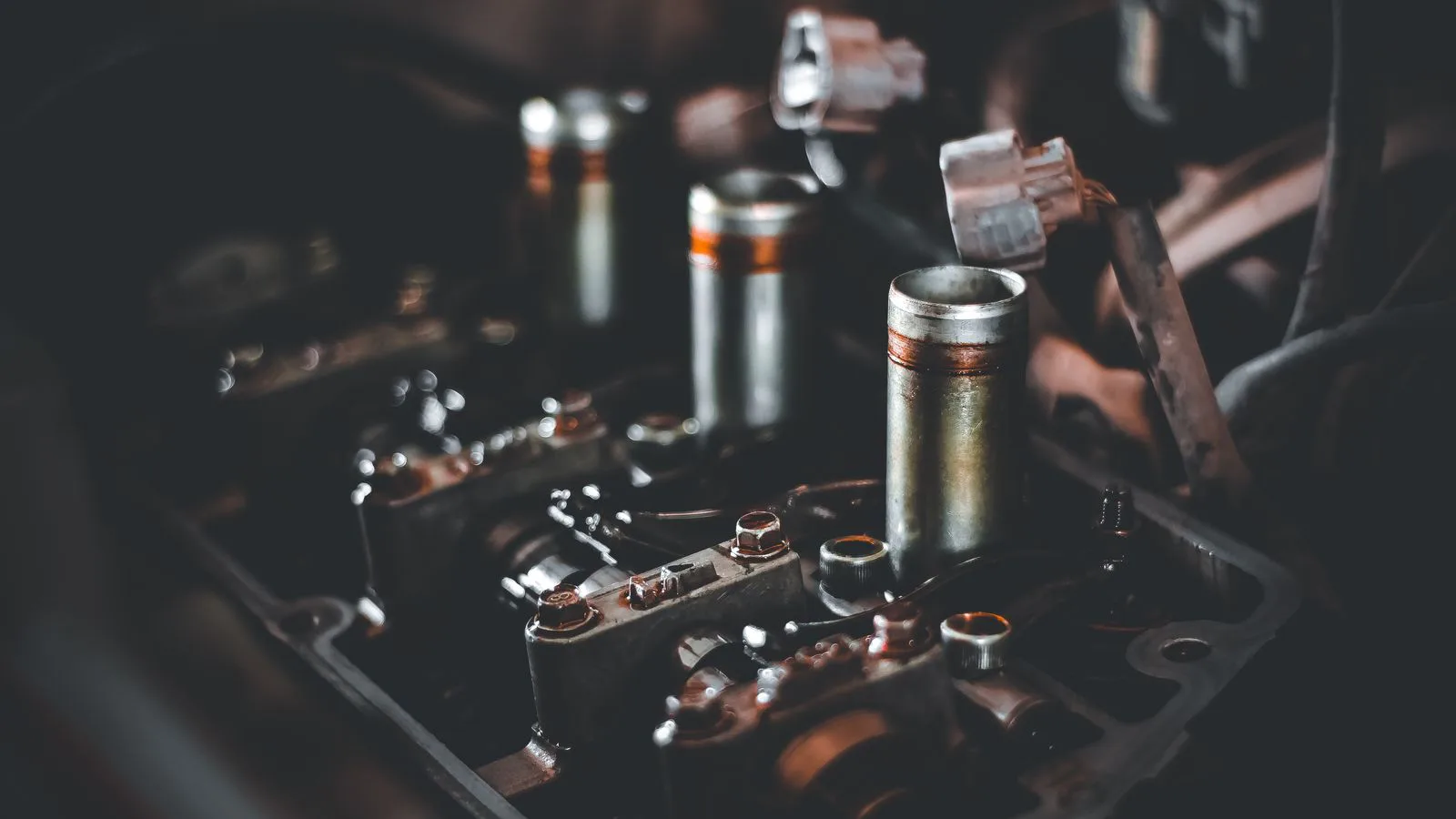
Efficiency rises with compression ratio, so why do petrol engines stop around 12:1? Because compressing a charge heats it — r to the power of gamma minus one — and above a certain temperature the unburnt end gas lights itself.
Knock is not the spark going wrong
In a healthy petrol engine the spark starts a flame at one point and the flame travels outward through the charge, consuming it over a millisecond or two. Ahead of that flame sits unburnt mixture, and it is being squeezed twice: once by the piston still rising, and again by the expanding burnt gas behind the flame. That unburnt remainder is called the end gas, and it is under more pressure and at a higher temperature than anything else in the cylinder.
Knock is what happens when the end gas runs out of patience. Given enough temperature for enough time, a fuel-air mixture will ignite without a spark, everywhere at once, through chemical chain reactions that need no flame to propagate. Instead of a controlled burn moving at tens of metres per second, a large fraction of the charge releases its energy almost instantaneously. The pressure rise is so abrupt that it rings the cylinder like a bell — that is the audible knock — and the accompanying pressure waves scrub the boundary layer off the piston crown and the head, taking away the thin insulating film of gas that normally protects them. Sustained, it destroys pistons, head gaskets and bearings.
This is the constraint that stops the compression ratio rising. The geometric definition and the reason efficiency climbs with r were covered in our article on displacement and compression ratio, so take those as given: efficiency wants r as large as possible. What follows is the argument on the other side of the ledger.
Compression heats the charge, and the exponent is unforgiving
Compress a gas quickly and it gets hot, because the work you do on it has nowhere to go except into its internal energy. Over the few milliseconds of a compression stroke there is very little time for heat to escape into the walls, so the process is close to adiabatic, and for an ideal gas that gives T2 ÷ T1 = (V1 ÷ V2) raised to the power of γ − 1, with pressure following P2 ÷ P1 = (V1 ÷ V2) to the power γ. The volume ratio V1 ÷ V2 is exactly the compression ratio. So the temperature multiplier is r to the power γ − 1, and nothing else.
Put numbers in. Dry air has γ = 1.40, but a real charge carries fuel vapour and residual exhaust gas, whose larger molecules store energy in vibration and rotation, so γ falls to roughly 1.30 to 1.35. Take γ = 1.35 and an initial temperature of 350 K — a plausible figure once ambient air has been warmed by the intake port and mixed with hot residuals. Then 8:1 gives 350 × 8^0.35 = 725 K; 10:1 gives 784 K; 12:1 gives 835 K; 14:1 gives 882 K; 18:1 gives 963 K. The exponent is less than one, so the curve bends over — but it never stops climbing, and the region where petrol misbehaves is right where the useful ratios are.
Two things make the real picture worse than the table. First, the end gas is compressed a second time by the burnt gas expanding behind the flame, so its final temperature exceeds the value computed from piston motion alone. Second, boost. A turbocharger raises T1 as well as P1, and since the multiplier is applied to T1, every kelvin added before compression becomes 2.2 kelvin at top dead centre on a 10:1 engine. That is why intercooling matters so much and why boosted engines historically ran lower compression ratios than naturally aspirated ones.
Temperature buys time, and time is what runs out
Autoignition is not a threshold you cross instantly. A hot fuel-air mixture goes through a sequence of slow pre-reactions before it ignites, and the delay between reaching a condition and igniting at it is called the ignition delay. It falls steeply with temperature — chemical rates follow an exponential of minus activation energy over temperature — so a modest temperature rise can shorten the delay by a large factor. Knock happens when the ignition delay of the end gas becomes shorter than the time the flame still needs to reach it.
Two consequences follow, and both are counterintuitive until the delay is in the picture. The first is that anything which speeds the flame up helps: a compact combustion chamber, a centrally placed spark plug, in-cylinder turbulence, a mixture close to stoichiometric. The end gas is not made cooler, it is simply reached sooner. The second is that engine speed helps. At 6,000 rpm a crank degree lasts a third as long as at 2,000 rpm, so the end gas has a third of the real time in which to make up its mind — which is why an engine knocks at low speed and full throttle, labouring up a hill in too high a gear, rather than at the top of the rev range.
The levers: octane, timing, injection, cam phasing
Octane number is a property of the fuel, measured on a standard variable-compression engine against reference blends of iso-octane and n-heptane. ASTM D2699 defines the Research Octane Number, run at 600 rpm and a mild intake temperature; ASTM D2700 defines the Motor Octane Number, run at 900 rpm with a hot mixture, which is a harsher test and always gives a lower figure. Europe posts the RON on the pump, which is why 95 and 98 are the familiar numbers under EN 228; the United States posts the average of the two under the Federal Trade Commission's fuel rating rule, which is why 87 and 91 look lower without being worse. Higher octane does not add energy — it buys ignition delay, which is exactly the currency the end gas is spending.
Retarding the spark is the lever the engine itself pulls, in milliseconds, when a knock sensor hears trouble. Firing later means the piston has already started down before peak pressure arrives, so both the pressure and the temperature of the end gas are lower and the flame has less of the compression stroke working against it. The cost is efficiency: the pressure peak now acts on a crank that has already passed its best mechanical advantage, and less of the released energy becomes work. There is an optimum spark timing for maximum torque, and a knock-limited engine spends its life at low speed and full load sitting deliberately on the retarded side of it. That is one of the reasons an engine designed for high-octane fuel genuinely loses power on low-octane fuel rather than simply being noisier.
Direct injection attacks the temperature itself. Spraying fuel into the cylinder rather than into the port means the latent heat of vaporisation is taken out of the trapped charge instead of out of the intake manifold. Compute it: petrol needs roughly 350 kJ per kilogram to vaporise, and a stoichiometric mixture carries one kilogram of fuel per 14.7 kilograms of air, so each kilogram of air gives up 350 ÷ 14.7 = 23.8 kJ. Divide by the specific heat of air at constant pressure, 1.005 kJ per kilogram-kelvin, and the charge cools by 23.7 K. Push that through the same power law: on a 10:1 engine it removes 23.7 × 10^0.35 = 53 K from the end-of-compression temperature, or equivalently allows the compression ratio to rise from 10:1 to 12.2:1 for the same peak charge temperature. That single mechanism is most of why modern direct-injection petrol engines sit around 12:1 where port-injected ones sat around 10:1.
The same calculation explains ethanol. Its latent heat is roughly 840 kJ per kilogram and it burns stoichiometrically at about 9 parts air to 1 of fuel, so each kilogram of air gives up 93 kJ and the charge cools by 93 K — four times the petrol figure. Arithmetically that would license an enormous compression ratio, and the honest caveat is that it does not, because temperature is only one input to the ignition delay and because the engine still has to start, idle and run cold on the same fuel. What the number does explain is why flex-fuel and high-ethanol race engines can carry compression ratios and boost levels that would destroy the same hardware on petrol.
Effective ratio: compressing less than you expand
The geometric compression ratio is set by the piston and the chamber, but the engine only begins compressing when the intake valve shuts. Close it late — well after bottom dead centre — and part of the charge is pushed back out into the port before the door closes, so the volume actually trapped is smaller than the full cylinder and the effective compression ratio drops below the geometric one. The expansion ratio, however, still runs from the chamber to full cylinder volume, because the exhaust valve does not open early. You compress like a low-compression engine and expand like a high-compression one, which is precisely where the efficiency lives.
The arithmetic is a slider-crank calculation. Take a 13:1 geometric engine with a connecting-rod-to-crank-throw ratio of 3.2 and a clearance volume of one twelfth of the swept volume. With the intake closing 10 degrees after bottom dead centre the trapped volume gives an effective ratio of 12.9:1; at 30 degrees, 12.4:1; at 50 degrees, 11.4:1; at 70 degrees, 9.9:1; at 90 degrees, 8.0:1. Feed those into the temperature law and the 13:1 engine that would have reached 859 K reaches 781 K instead when it closes at 70 degrees — a 78 K reduction bought purely with camshaft timing, while every expansion stroke still uses the full 13:1.
The price is trapped mass. Pushing charge back out of the cylinder means less air per cycle, so torque per litre falls, which is why engines built this way are often paired with an electric motor that fills the resulting hole in the low-speed torque curve, and why variable valve timing is the enabling technology: the cam can hold the late-closing, high-efficiency timing at cruise and return to a conventional timing when full torque is asked for. This is why quoting a single compression ratio for a modern engine is slightly dishonest — the geometric number is fixed, but the number the charge actually experiences moves with load and speed.
A diesel's 18:1 is a different problem entirely
A diesel runs 16:1 to 18:1 or more, comfortably above every ratio at which a petrol engine destroys itself, and the reason is that it never has an end gas. It compresses air alone. There is nothing in the cylinder to autoignite during the compression stroke, so the temperature the table gives — 963 K at 18:1 from a 350 K start, and higher still with the γ of dry air — is not a hazard but the design goal. Fuel is injected near top dead centre into air already hot enough to light it, and combustion begins where the spray is, spreading as more fuel arrives. Autoignition is the ignition system.
The problems simply move. Peak pressure is enormous — the table gives 718 psi at the end of compression before any fuel has burnt, and combustion adds far more on top — so the block, the head bolts, the bearings and the crank are all heavier for the same displacement. Ignition delay becomes a noise and stress problem rather than a destruction problem: fuel injected during the delay accumulates and then burns all at once, which is diesel knock, the hard clatter of an older engine on a cold morning, and the reason modern common-rail systems inject a small pilot dose to start a flame before the main event. And the trade-off between compression ratio and emissions runs the other way: very high ratios raise peak temperature, and peak temperature is what makes nitrogen oxides, which is one reason modern diesels have drifted down from the ratios of thirty years ago.
Measuring the ratio on a real engine
The swept volume is easy: bore, stroke and a bit of geometry. The clearance volume is the whole difficulty, because it is not one cavity but four contributions, and three of them are easy to forget. Take a four-cylinder engine with an 82.5 mm bore and a 92.8 mm stroke. The bore area is π ÷ 4 × 82.5² = 5,345.6 mm², so the swept volume per cylinder is 5,345.6 × 92.8 = 496.07 cm³ and the engine is 1,984 cm³.
Now the clearance volume, part by part. The combustion chamber in the head is measured, not calculated: seal it with a flat plate, level the head, and run fluid in from a graduated burette until it is full — 38.0 cm³ on our engine. The head gasket contributes its own bore: a 84.0 mm opening 1.2 mm thick is π ÷ 4 × 84² × 1.2 = 6.65 cm³. The deck clearance, the gap left because the piston does not quite reach the top of the block, adds bore area times that gap: 0.5 mm gives 2.67 cm³. And the piston crown itself, dished by 4.0 cm³ in this example, adds its dish or subtracts its dome. Total 51.32 cm³, so the ratio is (496.07 + 51.32) ÷ 51.32 = 10.67:1.
The sensitivity is the useful part. Skim 0.5 mm off the head and you remove roughly bore area times that depth, 2.67 cm³, taking the clearance volume to 48.65 cm³ and the ratio to 11.20:1 — half a millimetre of metal worth half a point. Fit a 1.5 mm gasket instead of a 1.2 mm one and the ratio falls to 10.36:1. And an error of one cubic centimetre in the measured chamber, which is easy to make with a badly levelled head or a trapped bubble, moves the answer between 10.48 and 10.86. That is why the chamber is measured with a burette rather than estimated, and why anyone quoting a compression ratio to three decimal places without a burette in the story should be read with suspicion.
| Compression ratio | Charge temperature, γ = 1.35 | Same with γ = 1.40 (dry air) | Pressure, γ = 1.35 (psi) | Where this sits |
|---|---|---|---|---|
| 8 : 1 | 725 K (845°F) | 804 K (988°F) | 241 psi | Older engines, or a heavily boosted one |
| 10 : 1 | 784 K (951°F) | 879 K (1,123°F) | 325 psi | Typical port-injected petrol engine |
| 12 : 1 | 835 K (1,044°F) | 946 K (1,243°F) | 415 psi | Direct injection, naturally aspirated |
| 14 : 1 | 882 K (1,127°F) | 1,006 K (1,351°F) | 512 psi | Only with a lower effective ratio or an exotic fuel |
| 16 : 1 | 924 K (1,203°F) | 1,061 K (1,450°F) | 612 psi | Diesel territory — autoignition is now the goal |
| 18 : 1 | 963 K (1,273°F) | 1,112 K (1,542°F) | 718 psi | Common diesel figure — hot enough to light the spray |
Frequently asked questions
- Will higher-octane fuel make my car faster?
- Only if the engine was being held back. A modern engine listens for knock and retards its spark when it hears it, so an engine calibrated for high-octane fuel and fed low-octane fuel really does make less power — and giving it back the fuel it wants restores what it lost. An engine calibrated for regular fuel and already running its optimum spark timing has nothing to gain: the extra octane buys ignition delay it was not short of. Read the fuel requirement in the handbook, note whether it says required or recommended, and let that decide.
- Why do turbocharged engines run lower compression ratios?
- Because boosting raises both the pressure and the temperature at the start of compression, and the compression ratio then multiplies the temperature. Every kelvin added by the compressor becomes r to the power γ − 1 kelvin at top dead centre — a factor of 2.2 on a 10:1 engine. Lowering the geometric ratio is the crude way of buying that margin back; intercooling, direct injection and late intake valve closing are the modern ways, which is why current boosted petrol engines have crept back up towards 10:1 and beyond rather than sitting at the 8:1 that turbocharging used to demand.
- Is pre-ignition the same thing as knock?
- No, and the difference matters because one is far more destructive. Knock happens after the spark, when the end gas autoignites ahead of a flame that has already started. Pre-ignition happens before the spark, when something in the chamber — a glowing deposit, an overheated valve edge, a sharp corner on a piston — lights the mixture early. The whole charge then burns against a rising piston, pressures climb far above design, and damage arrives in seconds rather than minutes. Low-speed pre-ignition in heavily boosted direct-injection engines is a distinct phenomenon again, and it is one of the reasons those engines are so particular about oil specification.
- Can I raise my engine's compression ratio by skimming the head?
- Mechanically yes, and the arithmetic in this article shows how much: half a millimetre off our example head is worth roughly half a point of ratio. Whether it is a good idea is a different question. It moves the engine towards the knock limit it was calibrated away from, it changes camshaft timing relative to the crank on a belt-driven engine, it can compromise valve-to-piston clearance, and it does nothing about the fuel you will actually put in. On a modern engine with knock control the likely result is that the management system simply retards the ignition and gives back what the compression gained. It is a tuning operation, not a maintenance one, and it belongs with a matched calibration.
- Why does my engine only knock going uphill in a high gear?
- Because that is the operating point where the end gas gets the most heat and the most time. Full throttle at low engine speed fills the cylinder completely, so the pressure and temperature at the end of compression are at their highest, while the crank turns slowly enough that each degree of rotation lasts a long time in milliseconds. The flame therefore needs many milliseconds to cross the chamber, and the end gas gets all of them to complete its pre-reactions. Change down a gear and the same power comes at a higher engine speed with a partly closed throttle — less charge, less time, no knock.
Articles you may find interesting
All guides →Related tools
Sources
- ASTM International — ASTM D2699 — Standard Test Method for Research Octane Number of Spark-Ignition Engine Fuel
- ASTM International — ASTM D2700 — Standard Test Method for Motor Octane Number of Spark-Ignition Engine Fuel
- European Committee for Standardization — EN 228 — Automotive fuels, unleaded petrol: requirements and test methods, including minimum research octane number
- US Federal Trade Commission — 16 CFR Part 306 — Automotive Fuel Ratings, Certification and Posting (the (R+M)/2 antiknock index shown on US pumps)
- SAE International — SAE technical literature on knock, autoignition delay, MBT spark timing and the charge-cooling effect of direct injection
Spotted a mistake in this article?