IVF Dating Is the One Case Where the Date Is Actually Known
Published 4/23/2026 · 12 min read · Health calculators

In a spontaneous pregnancy, nobody knows the day of fertilisation: the date is inferred from a period, which is inferred from a cycle, which varies. After IVF none of that inference is needed. Fertilisation happens in a laboratory on a recorded day, so the pregnancy has a start time and gestational age becomes arithmetic rather than estimate. The convention still runs from a notional last period, and 280 days minus the 14 days from period to ovulation leaves 266 days from fertilisation to the estimated due date. Subtract the developmental age of the embryo on the day it was put back and you have the number of days to add to the transfer date. ACOG states the two standard cases directly: a day-5 blastocyst gives an estimated due date 261 days from transfer, and a day-3 embryo gives 263. A day-6 blastocyst gives 260 by the same subtraction. All of them land on the same date for the same retrieval, because all of them are anchored to the same moment of fertilisation. Frozen transfers use the embryo's age at freezing, so time in storage does not enter the calculation at all. And ACOG says that where a pregnancy results from assisted reproduction, the assisted-reproduction date should be used — a scan confirms it rather than replacing it.
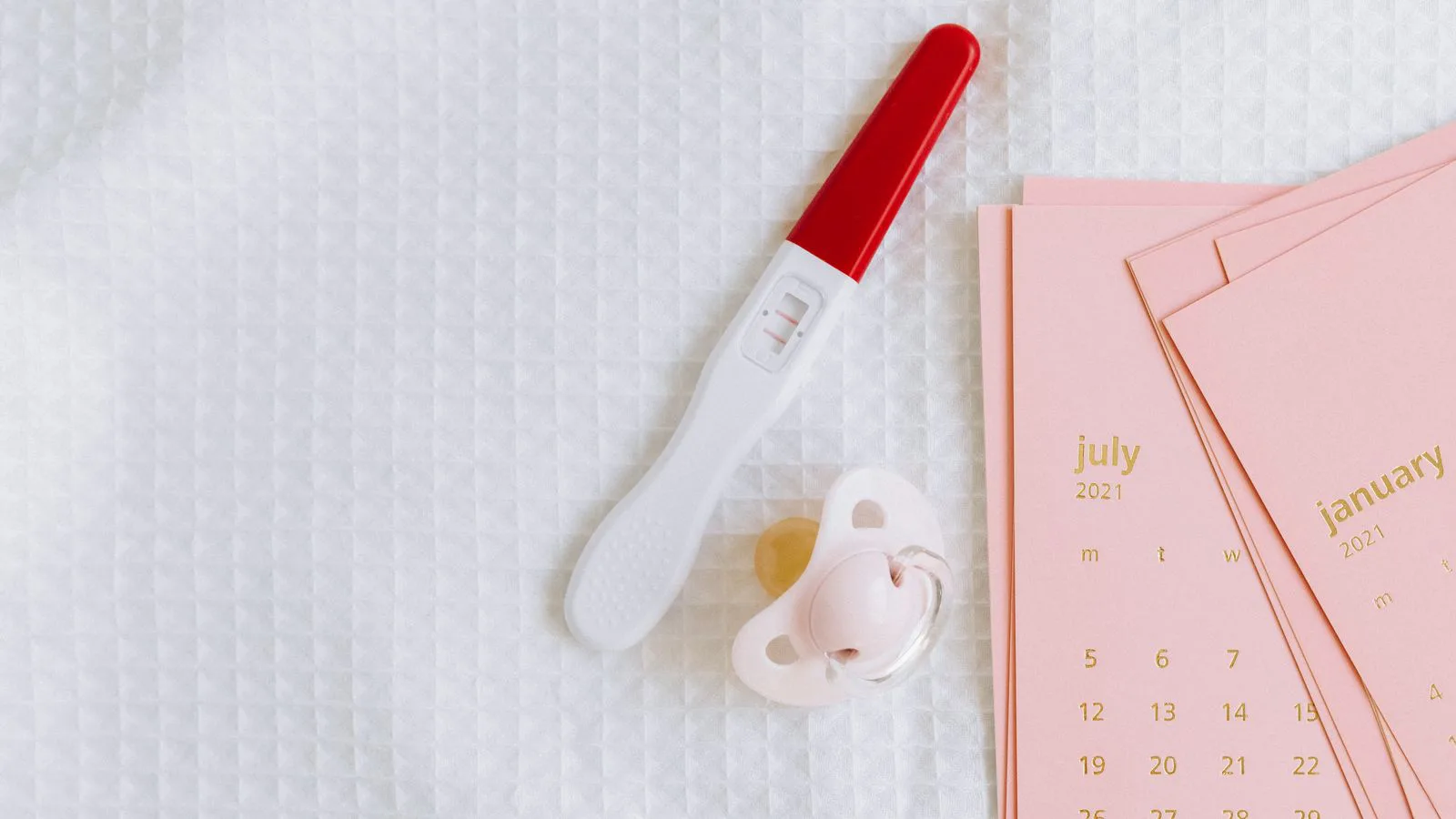
Every other pregnancy is dated from an estimate. After IVF, fertilisation is timed to the hour, so gestational age is arithmetic: 266 days from fertilisation, minus the embryo's age at transfer. Here is the derivation for day-3, day-5 and day-6 embryos, why frozen and fresh transfers use the same rule, why an early scan rarely moves an IVF date, and what the two-week offset on a scan report means.
Every other pregnancy is dated from a guess
The menstrual convention counts from the first day of the last period, which is roughly two weeks before the event it is standing in for. That is not sloppiness; it is the only landmark a person can reliably observe. But it means the number depends on when ovulation happened, and ovulation does not happen on a fixed day. We have a separate article on how that convention works and where its error comes from. This article is about the one situation in which none of that applies.
In a treatment cycle the laboratory records the hour of insemination or injection. Development is then counted in days from that moment: day 1 for the check on fertilisation, day 3 for a cleavage-stage embryo, day 5 or 6 for a blastocyst. Nothing has to be inferred, so nothing carries the inference's error. That is what people mean when they say IVF dating is exact — not that the birth is predictable, but that the gestational age is a count rather than an estimate.
The transfer-day rules, and why they all agree
Start from 280 days, the number the menstrual convention adds to a last period. Subtract the 14 days between that period and ovulation and 266 days remain, running from fertilisation to the estimated due date. An embryo transferred on day 5 has already used 5 of them, so 261 remain: add 261 to the transfer date. A day-3 embryo has used 3, leaving 263. A day-6 blastocyst has used 6, leaving 260. ACOG writes the first two out explicitly; the third follows from the same subtraction.
The reason all three give the same answer is worth seeing on a calendar, because it is the thing that makes the whole scheme trustworthy. Take a retrieval on 2 March 2026. Adding 266 days gives 23 November 2026. A day-3 embryo would be transferred on 5 March, and 5 March plus 263 days is 23 November. A day-5 blastocyst goes back on 7 March, and 7 March plus 261 is 23 November. A day-6 blastocyst on 8 March plus 260 is, again, 23 November. The transfer date is not really an input; it is a way of writing down the retrieval date, and the arithmetic just puts the two back together.
Frozen or fresh, the rule is the same — and storage time does not count
This is the part that surprises people, and it falls out of the same logic. What the calculation needs is the embryo's developmental age on the day it was transferred. Vitrification stops development, so a blastocyst frozen on day 5 is still a day-5 blastocyst when it is thawed, whether that happens six weeks or six years later. The rule therefore does not change: add 261 days to the transfer date. Take the same day-5 blastocyst from the example above, freeze it, and transfer it on 14 January 2027 — the estimated due date becomes 2 October 2027, and the months spent in storage appear nowhere in the sum.
Two practical consequences follow. First, if genetic testing was done on the embryo, the biopsy almost always means the embryo was frozen and transferred in a later cycle — so the date comes from the frozen-transfer rule, and the day of the biopsy is irrelevant to it. Second, where donated eggs or donated embryos are used, the anchor is the developmental age of the embryo and the date it was transferred, not the recipient's cycle at all. In every one of these variants the number your clinic uses is the one to trust, because they hold the laboratory record.
Why an early scan rarely moves an IVF date
In a pregnancy dated from a period, an early scan often wins. ACOG sets out when: up to 8 weeks and 6 days the estimated due date is changed if the scan differs by more than 5 days, from 9 weeks to 15 weeks 6 days by more than 7 days, from 16 weeks to 21 weeks 6 days by more than 10 days, from 22 weeks to 27 weeks 6 days by more than 14 days, and from 28 weeks by more than 21 days. The same document says that where the pregnancy resulted from assisted reproduction, the assisted-reproduction date should be used to assign the due date. The scan is still done — a pregnancy without an ultrasound confirming or revising the date before 22 weeks is considered suboptimally dated — but its role is confirmation.
There is also an empirical reason, and it is the more interesting one. When crown-rump-length charts are checked against pregnancies whose fertilisation date is genuinely known, the charts themselves turn out to be slightly off. One study compared routine first-trimester screening measurements in IVF pregnancies against the known fertilisation date and found that the reference chart in local use overestimated gestational age by a mean of 3.0 days, with a 95% confidence interval of 2.70 to 3.36 days and limits of agreement running from −7.34 to +1.31 days. A systematic three-day bias sits comfortably inside the five-day threshold that would trigger redating before nine weeks — so on an ART-dated pregnancy the scan usually agrees, and where it does not, the chart is at least as likely to be the reason as the embryo.
The two weeks between embryo age and gestational age
This is the part that reads strangely on a scan report, and it is worth stating cleanly. Gestational age counts from the notional last period; embryo age counts from fertilisation. The offset between them is exactly 14 days, at every point in the pregnancy and forever. At 6 weeks of gestational age the embryo is 4 weeks old. At 8 weeks it is 6. At 12 weeks it is 10. At 40 weeks — 280 days — it is 38 weeks, or 266 days, which is the number this whole calculation started from.
The practical consequence lands on the day of transfer itself. A day-5 blastocyst put back on 7 March is 5 days old, so the pregnancy is 5 plus 14 = 19 days along: 2 weeks and 5 days of gestational age, on the day of the transfer. A day-3 embryo transferred on 5 March is at 2 weeks and 3 days. Ten days after a day-5 transfer, when many clinics take the first blood test, the gestational age is 29 days — 4 weeks and 1 day, which is roughly when a period would have been missed. That is why a scan report or an app can say four weeks when the embryo has existed for a fortnight, and why the discrepancy is a convention rather than an error.
What is exact, and what is still an estimate
The gestational age is exact. The date of birth is not, and no dating method has ever claimed otherwise: the estimated due date is the middle of a distribution of spontaneous labour, not an appointment. What precise dating buys is not a better guess at the birthday but better timing for everything that has a window — first-trimester screening, the anomaly scan, decisions about steroids if labour threatens early, and the point at which a pregnancy is considered post-term. On those, being right to the day genuinely matters, and after IVF you are right to the day.
One last note, offered gently. This calculator does arithmetic on dates, and arithmetic is indifferent to how the days between a transfer and a blood test feel. If you are in that fortnight, a date on a screen is not a prediction of anything, and nothing about it is under your control. Your clinic holds the numbers, they know which convention they used, and they are the people to ask when a figure does not match what you expected.
| What happened | Date | Days added | Estimated due date |
|---|---|---|---|
| Egg retrieval and fertilisation (embryo day 0) | 2 March 2026 | 266 | 23 November 2026 |
| Day-3 embryo transferred | 5 March 2026 | 263 (266 − 3) | 23 November 2026 |
| Day-5 blastocyst transferred | 7 March 2026 | 261 (266 − 5) | 23 November 2026 |
| Day-6 blastocyst transferred | 8 March 2026 | 260 (266 − 6) | 23 November 2026 |
| Cross-check: the notional last period | 16 February 2026 (retrieval − 14 days) | 280 | 23 November 2026 — the two conventions are one convention |
| The same day-5 blastocyst, frozen and transferred later | 14 January 2027 | 261 — the age at freezing, not the time in storage | 2 October 2027 |
Frequently asked questions
- My clinic gave a date and an app gave another. Which is right?
- Almost always the clinic's, because they know which convention was used and the app has to guess. The commonest cause of a mismatch is the embryo day: an app that assumes a day-5 blastocyst when a day-3 embryo was transferred will be two days out, and one that assumes day 5 for a day-6 blastocyst will be one day out. The second commonest is a fresh-versus-frozen mix-up. Neither is a large discrepancy, and neither is worth worrying about — but ask the clinic rather than recalculating.
- Why does the pregnancy start two weeks before the embryo existed?
- It does not, but the count does. Gestational age is a convention anchored to the first day of the last period, which in a spontaneous cycle precedes fertilisation by about fourteen days. Keeping that anchor after IVF means an IVF pregnancy is described in the same weeks as every other pregnancy, so every chart, every screening window and every guideline applies unchanged. The price is that the count starts from a period that never happened. It is odd, but it is consistent, and consistency is what makes the rest of maternity care work.
- Does a long time in the freezer shift the due date?
- No, and this is the cleanest demonstration that the calculation depends only on developmental age. Vitrification halts development: an embryo frozen on day 5 resumes as a day-5 blastocyst whenever it is thawed. So the rule stays add 261 days to the transfer date, whether the embryo was stored for a month or for years. The transfer date changes, and with it the due date; the storage duration itself never enters the sum.
- The scan measured a few days behind. Should the date be changed?
- That is a decision for the team looking after you, and the guidance is that an assisted-reproduction date should be used to assign the due date rather than being overridden by a scan. It is also worth knowing that the reference charts themselves carry a small bias: measured against pregnancies with a known fertilisation date, one widely used crown-rump-length chart overestimated gestational age by a mean of 3.0 days. A small discrepancy at an early scan is therefore an expected feature of the measurement rather than a finding — but any question about what a scan showed belongs with the person who performed it.
- How pregnant am I on the day of the transfer?
- Add fourteen days to the embryo's age. A day-5 blastocyst put back today makes the gestational age 19 days, which is 2 weeks and 5 days. A day-3 embryo makes it 17 days, 2 weeks and 3 days. Ten days later, around the time of a first blood test after a day-5 transfer, the count reads 29 days — 4 weeks and 1 day, roughly when a period would have been due. None of that says anything about whether the transfer will work; it is only how the weeks are numbered.
Articles you may find interesting
All guides →Related tools
This article explains how a due date is calculated after IVF. It is general information, not medical advice, and it says nothing about whether any particular pregnancy will continue — the arithmetic is exact, the outcome is not, and the two have nothing to do with each other. Your clinic holds the dates that matter: the day of retrieval or insemination, the developmental day of the embryo, whether the transfer was fresh or frozen. If a date on a scan report, a discharge letter or an app does not match what you expected, ask them rather than recalculating it yourself; a discrepancy is usually a difference in convention and they can say which one was used. Any bleeding, pain or symptom that worries you belongs with your clinic or your maternity unit today, not with a calculator.
Sources
- American College of Obstetricians and Gynecologists (Committee Opinion 700, 2017) — Methods for Estimating the Due Date — the ART rule: a day-5 embryo gives an EDD 261 days from transfer, a day-3 embryo 263
- Obstetrics & Gynecology (Committee Opinion No. 700, 2017;129:e150–4) — Methods for Estimating the Due Date — full text, including the ultrasound redating thresholds by gestational age
- Society for Maternal-Fetal Medicine — Summary of ACOG Committee Opinion 700 — a pregnancy without an ultrasound confirming or revising the EDD before 22 0/7 weeks is suboptimally dated
- PMC (Aviram A et al.; accuracy study in IVF pregnancies) — Assessing the accuracy of ultrasound estimation of gestational age during routine antenatal care in IVF pregnancies — CRL charts overestimate by a mean of 3.0 days
Spotted a mistake in this article?