Cycle Length, Ovulation, and What a Fertile Window Really Is
Published 2/18/2026 · 12 min read · Health calculators

A menstrual cycle has two phases and they are not equally variable. The follicular phase, from the first day of bleeding until ovulation, is the one that stretches and shrinks; the luteal phase, from ovulation until the next period, is comparatively stable. Bull and colleagues measured both across 612,613 ovulatory cycles and found a mean follicular phase of 16.9 days with a 95% range of 10 to 30 days, against a mean luteal phase of 12.4 days with a 95% range of 7 to 17. That asymmetry is the whole argument for counting backwards. If you assume ovulation on day 14 of every cycle, you are right only for a 28-day cycle; if you assume it falls about 14 days before the next period, you track cycle length correctly. The error of the forward method is exactly 28 minus your cycle length: four days at a 24-day cycle, four days the other way at 32, seven days at 21 or 35. Wilcox and colleagues showed in 1995 that conception follows intercourse only within a six-day window ending on the day of ovulation, so those errors move the window as a block. At a 24-day cycle the true window is cycle days 5 to 10 while the forward method points at 9 to 14 — two days of overlap. At a 21-day or a 35-day cycle the two windows do not overlap at all. None of this is contraception, and it is not precise enough to be used as any.
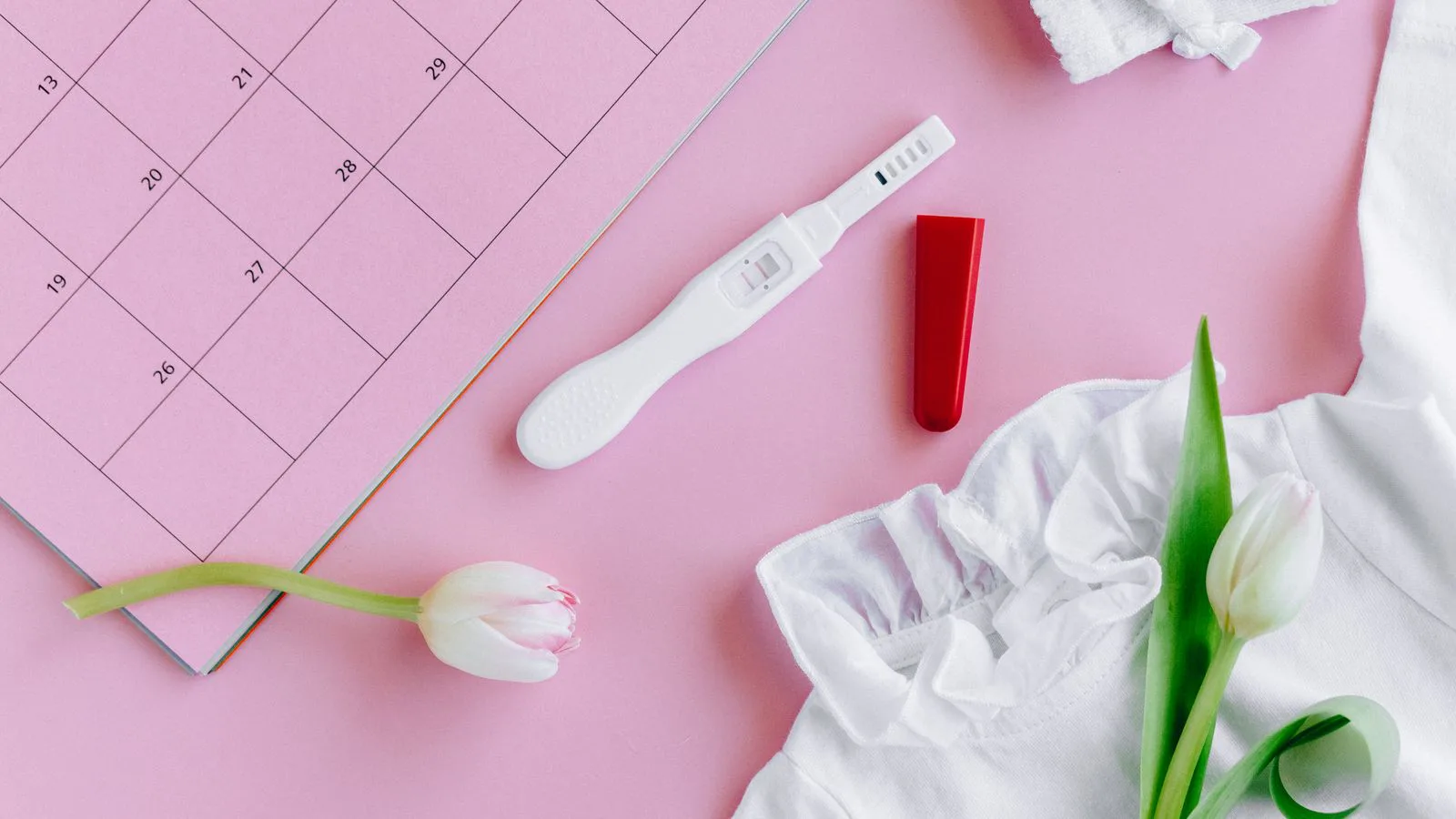
Ovulation is estimated far better by counting backwards from the next period than forwards from the last one, because the phase after ovulation is the stable one. Here is the inversion worked for every cycle length, the fertile window from the study that defined it, and the failure rates that make this unusable as contraception.
One phase stretches, the other does not
The follicular phase runs from the first day of bleeding to ovulation and depends on how long a follicle takes to mature — which stress, illness, travel, weight change and age all influence. The luteal phase runs from ovulation to the next period and depends on how long the corpus luteum keeps producing progesterone, which is a much more constrained biological process. Bull and colleagues put numbers on the difference across 612,613 ovulatory cycles from 124,648 users: the follicular phase averaged 16.9 days with a 95% range of 10 to 30 days, a spread of twenty days, while the luteal phase averaged 12.4 days with a standard deviation of 2.4 and a 95% range of 7 to 17, a spread of ten.
It is worth being exact about the familiar figure. Textbooks and calculators use a fixed luteal phase of 14 days; the measured mean in the largest dataset available is 12.4. The textbook number is a convention rounded to half a cycle, not a measurement, and using it shifts your ovulation estimate about a day and a half earlier than the population average would. It also is not fixed: a 95% range of 7 to 17 days means that in a 28-day cycle, ovulation could genuinely have fallen anywhere from day 11 to day 21. Calling the luteal phase stable is a statement about it being more stable than the follicular phase, not about it being constant.
Count backwards, not forwards
The forward method takes the first day of your last period and adds 14. The backward method takes the expected first day of your next period and subtracts 14. For a 28-day cycle they give the same answer, day 14, which is why the two get confused. For every other cycle length they diverge, and the size of the divergence is exactly 28 minus your cycle length. A 24-day cycle: backwards gives day 10, forwards gives day 14, so the forward method is four days late. A 32-day cycle: backwards gives day 18, forwards still says 14, four days early. A 21-day cycle: day 7 against day 14, seven days late. A 35-day cycle: day 21 against day 14, seven days early.
The backward method has a weakness of its own, and it is honest to name it: it needs the date of a period that has not happened yet. You are predicting the future from your own history, so it is only as good as the regularity of your cycles. The practical compromise is to use your shortest and longest recent cycles rather than an average, which widens the estimate into a range instead of pretending to a single day, and to combine it with a sign you can actually observe — cervical mucus, basal temperature or a urinary luteinising hormone test, which detects the surge one to two days before ovulation rather than predicting it from a calendar.
Where the six-day window comes from
The window is bounded by two very different lifespans. Sperm can survive in the reproductive tract for up to about five days, so intercourse days before ovulation can still result in conception. The egg, once released, is viable for only about 12 to 24 hours, so intercourse a day or two after ovulation generally cannot. Wilcox, Weinberg and Baird demonstrated the consequence directly in the New England Journal of Medicine in 1995: following 221 women with daily urine samples, they found that conception occurred only when intercourse fell within a six-day interval ending on the estimated day of ovulation. The probability of conception rose across that interval from 0.10 five days before ovulation to 0.33 on the day itself.
Two consequences follow that are worth stating separately. The first is that the window opens before ovulation and closes on it, not after — waiting for a temperature rise or any other sign that ovulation has already happened means the useful days are behind you. The second is that the window moves as a block with the ovulation estimate. Get the ovulation day wrong by four days and every one of the six days is wrong by four days. That is why the forward and backward methods produce windows that barely touch: at a 24-day cycle the real window is days 5 to 10 and the fixed textbook window is days 9 to 14, sharing only days 9 and 10.
Your own cycle is not one number
Every calculation above takes your cycle length as a fixed input, and it is not one. Bull and colleagues found that only about 13% of the cycles in their dataset lasted exactly 28 days, with a mean of 29.3. Fehring, Schneider and Raviele tracked 1,060 cycles in 141 women and found a mean of 28.9 days with 95% of cycles falling between 22 and 36 — and, more to the point here, more than 7 days of variation within the same woman in 42.5% of their participants. Nearly half the women in that study had a personal range wide enough to move their ovulation estimate by a week.
The honest way to use a calendar estimate is therefore as a range rather than a date. If your recent cycles have run from 26 to 32 days, your ovulation estimate is not day 14 or day 18 but somewhere between day 12 and day 18, and your fertile window stretches from day 7 to day 18. That is a wide answer, and it is the correct one. It is also the reason clinicians recommend regular intercourse across the likely window rather than trying to hit a single day: NICE fertility guidance suggests intercourse every two to three days for couples trying to conceive, which covers the window without requiring anyone to predict it exactly.
Why this cannot be used as contraception
Everything above is an estimate built on an estimate, and the failure rate has been measured rather than argued about. Trussell's review of contraceptive failure in the United States puts the calendar rhythm method at 24 pregnancies per 100 women in the first year of typical use. The Guttmacher Institute, drawing on the 21st edition of Contraceptive Technology, gives fertility awareness-based methods as a family a typical-use range of 2% to 34% and a perfect-use range of under 1% to 5%. That enormous spread is itself informative: the methods that perform best are the ones that add an observed sign — mucus, temperature, a hormone test — and require daily discipline, while the pure calendar methods sit at the bad end.
This article is written for people trying to conceive, and for that purpose an approximate window is genuinely useful: it tells you which fortnight to concentrate on and it explains why waiting for a temperature rise is too late. Used the other way round, the same arithmetic is not safe. If you are trying to avoid pregnancy, the numbers above are the argument for talking to a clinician or a family planning service about a method whose effectiveness does not depend on last month's cycle behaving like next month's.
| Cycle length | Ovulation day, counting back 14 | Fertile window (cycle days) | Error of the forward method | Days shared with the fixed window of days 9 to 14 |
|---|---|---|---|---|
| 21 days | Day 7 | Days 2 to 7 | 7 days too late | None |
| 24 days | Day 10 | Days 5 to 10 | 4 days too late | 2 days |
| 26 days | Day 12 | Days 7 to 12 | 2 days too late | 4 days |
| 28 days | Day 14 | Days 9 to 14 | None — the only cycle it fits | All 6 days |
| 30 days | Day 16 | Days 11 to 16 | 2 days too early | 4 days |
| 32 days | Day 18 | Days 13 to 18 | 4 days too early | 2 days |
| 35 days | Day 21 | Days 16 to 21 | 7 days too early | None |
Frequently asked questions
- Is the luteal phase really always 14 days?
- No. Fourteen days is a textbook convention — half of a 28-day cycle — not a measurement. In the largest dataset available, Bull and colleagues found a mean luteal phase of 12.4 days with a standard deviation of 2.4 and a 95% range of 7 to 17 days. It is more stable than the follicular phase, which had a 95% range of 10 to 30 days, and that relative stability is what makes counting backwards better than counting forwards. But it is not a constant, and a calculation that treats it as one is giving you a point estimate where the honest answer is a range.
- I have a 35-day cycle. When do I ovulate?
- Around day 21, not day 14. Counting back 14 days from day 35 gives day 21, and the fertile window becomes days 16 to 21. The forward method's answer of day 14 is a full week early, and its window of days 9 to 14 does not overlap yours at all — every day it points at is outside your fertile period, and every day of your fertile period is outside its window. This is the clearest case for the inversion in this article, and also the case where a urinary luteinising hormone test earns its cost, because you have a wide interval to search.
- Can I still conceive from intercourse after ovulation?
- Very unlikely, and this is the asymmetry that surprises people. The egg is viable for roughly 12 to 24 hours after release, so the window effectively closes on the day of ovulation. In the Wilcox study, conception was observed only from intercourse in the six days ending on the estimated ovulation day, with none attributed to intercourse afterwards. The practical implication is that any sign confirming ovulation has already happened — a sustained temperature rise, for example — is telling you the window has closed, not that it is opening.
- My cycles are irregular. Is a calendar estimate worth anything?
- It is worth something as a range and nothing as a date. Take your shortest and longest recent cycles, subtract 14 from each, and you have the interval your ovulation is likely to fall in; the fertile window then runs from five days before the earliest of those to the latest. If your cycles run 26 to 34 days, that is days 7 to 20 — a wide but truthful answer. Fehring and colleagues found more than 7 days of within-person variation in 42.5% of the women they tracked, so this is common rather than unusual. If your cycles are shorter than 21 days, longer than 35, or have changed noticeably, that is worth raising with a clinician independently of any calculation.
- Can I use a fertile-window calculation to avoid pregnancy?
- No. The measured typical-use failure rate of the calendar rhythm method is about 24 pregnancies per 100 women in the first year, and fertility awareness-based methods as a group range from 2% to 34% with typical use, depending heavily on which signs are tracked and how consistently. A calculation that starts from a variable cycle length, applies a luteal phase that itself varies by ten days across the population, and produces a window that has to be right within a day or two is not a contraceptive. If avoiding pregnancy is the goal, that is a conversation to have with a clinician or a family planning service.
Articles you may find interesting
All guides →Related tools
This article explains how a fertile window is estimated. It is not contraception advice and must never be used as birth control. Calendar-based methods have a published typical-use failure rate of around 24 pregnancies per 100 women in the first year (Trussell, Contraception 2011), and fertility awareness-based methods as a family range from 2% to 34% with typical use (Contraceptive Technology, 21st edition). If you are trying to avoid pregnancy, talk to a clinician or a family planning service about a method whose effectiveness you can rely on.
Sources
- New England Journal of Medicine (Wilcox AJ, Weinberg CR, Baird DD, 1995) — Timing of sexual intercourse in relation to ovulation — the six-day fertile window
- npj Digital Medicine (Bull JR et al., 2019) — Real-world menstrual cycle characteristics of more than 600,000 menstrual cycles
- JOGNN (Fehring MJ, Schneider M, Raviele K, 2006) — Variability in the phases of the menstrual cycle
- Contraception (Trussell J, 2011) — Contraceptive failure in the United States
- Guttmacher Institute / Contraceptive Technology, 21st edition — Contraceptive effectiveness in the United States
- American College of Obstetricians and Gynecologists — Fertility Awareness-Based Methods of Family Planning
Spotted a mistake in this article?