The Calories in a Drink Are Mostly the Alcohol
Published 4/3/2026 · 12 min read · Health calculators

Ethanol carries about 7 kcal per gram, between carbohydrate at 4 and fat at 9, and that factor is fixed in EU labelling law. The arithmetic that follows is exact rather than estimated. Ethanol's density at 20 °C is 0.789 g/mL, so a drink's alcohol calories are volume in millilitres × alcohol by volume as a fraction × 0.789 × 7 — which collapses to volume × ABV × 5.52. A 1.5 fl oz measure of 40% spirit holds 14.0 g of ethanol and 98 kcal, and since it contains no sugar, that is the whole drink. A 5 fl oz glass of dry white wine at 12% holds the same 14.0 g and about 1 kcal of residual sugar, so 99% of it is alcohol. Beer is the first real departure: a 12 fl oz regular lager carries the same 14.0 g of ethanol but around 12.6 g of carbohydrate too, so alcohol is 98 of about 148 kcal — two-thirds. Sweeten the drink and the balance tips further. A coffee liqueur is roughly 45% alcohol calories and the rest sugar. In practice, though, the biggest lever is not the drink but what you put with it: the same measure of gin is 98 kcal with soda water and about 160 with regular tonic.
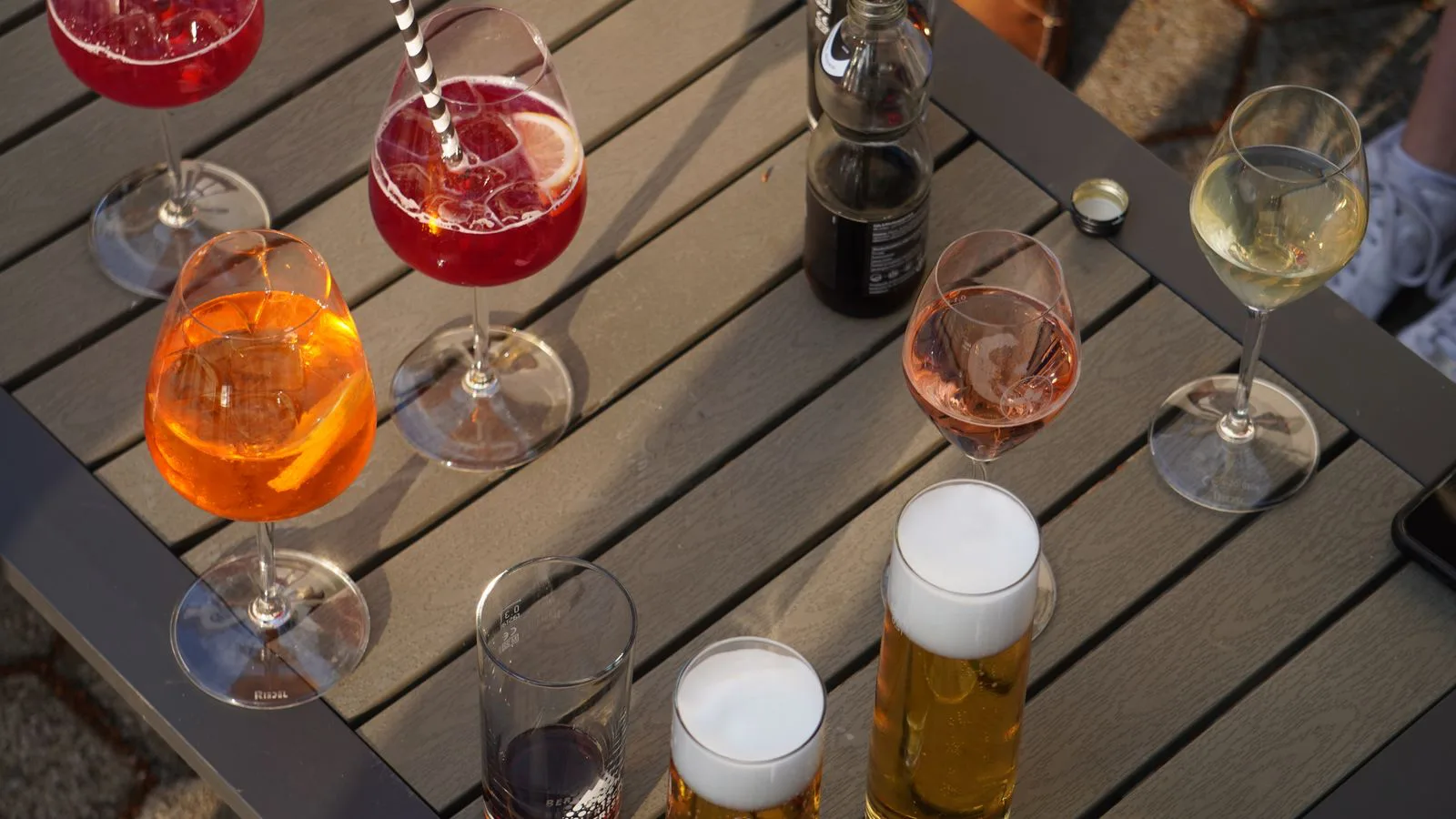
Ethanol carries 7 kcal per gram and the arithmetic is exact: volume × ABV × 0.789 × 7. A dry spirit is almost pure alcohol calories; a liqueur is nearly half sugar. Here is the derivation, the table, and the metabolic caveat stated without overclaiming.
One line of arithmetic, and where each piece comes from
Three constants do all the work. Ethanol's energy value is 7 kcal per gram — 29 kJ — which is not an estimate but a labelling factor written into Annex XIV of Regulation (EU) No 1169/2011, sitting between carbohydrate at 4 and fat at 9. Ethanol's density at 20 °C is 0.789 grams per millilitre, so a volume of pure alcohol converts to a mass. And alcohol by volume, the number on the bottle, is exactly what it says: the fraction of the liquid that is ethanol, measured as volume.
Put them together and the alcohol calories in any drink are volume in millilitres, times ABV as a fraction, times 0.789, times 7. The two constants multiply to 5.523, so the whole thing collapses to volume × ABV × 5.52. That is the entire model for the alcohol half of a drink. Check it against a unit you already know: a US standard drink is defined as 14 g of ethanol, and 14 × 7 = 98 kcal, whichever beverage delivers it. The 10 g unit used in France, Spain and Portugal is 70 kcal; the 8 g British unit is 56. Our companion article on what a standard drink actually is works through those definitions and why they disagree; this page assumes them.
The other half of the drink is whatever is dissolved in it, and that is simple food arithmetic: sugar and other carbohydrate at 4 kcal per gram, and in a few cream-based liqueurs a little fat at 9. A dry spirit has essentially none of it. A dry wine has a gram or so of residual sugar in a glass. A beer has real carbohydrate — the USDA's generic regular beer carries 3.55 g per 100 g. A liqueur or a dessert wine carries a great deal.
Reading the table: from almost pure alcohol to almost half sugar
The top of the table is the cleanest case. A measure of vodka with soda water contains no carbohydrate at all, so 100% of its energy is ethanol. A glass of dry white wine is barely different — the residual sugar in a dry wine is on the order of 2 g per litre, which is under a gram in a glass and about 1 kcal. If you have ever wondered why dry spirits and dry wine come out so close per unit of alcohol, this is why: for both, the alcohol is essentially the entire calorie count.
Beer is the first real departure and it is a bigger one than most people expect. A 12 fl oz regular lager at 5% carries 14.0 g of ethanol, worth 98 kcal, but also close to 12.6 g of carbohydrate, worth another 50 — a total around 148 kcal of which alcohol is two-thirds. A dessert wine tips further: at roughly 15.3 g of ethanol and 13.7 g of sugar per 100 g, a small 3 fl oz glass is about 144 kcal, alcohol two-thirds again but on a much smaller pour. And a coffee liqueur reverses the intuition entirely — the USDA composition puts it at 21.7 g of alcohol and 46.8 g of carbohydrate per 100 g, so a 1.5 fl oz measure is roughly 165 kcal with only 45% of it alcohol. That is the whole span: from 100% alcohol to 45%, without leaving the drinks trolley.
In practice the mixer decides
Nothing in the table moves a total as far as what goes in the glass alongside the spirit. The same measure of gin is 98 kcal with soda water and 160 with regular tonic, because tonic water carries 8.8 g of carbohydrate per 100 g and a 6 fl oz pour therefore adds 62 kcal of sugar. Swap to a low-sugar tonic and the drink returns to 98. The same trick applies to cola: 8 fl oz of regular cola adds about 98 kcal, doubling a spirit measure, and a zero-sugar version adds essentially none.
This is worth stating plainly because it inverts the usual advice. Choosing a lighter spirit does almost nothing — vodka, gin, rum and whisky at the same strength and the same measure are the same number, because they are all essentially ethanol and water. Choosing a lighter mixer does a great deal. A cocktail built on syrup and juice can be more than half sugar before any spirit is added, which is why a generic canned piña colada in the USDA database comes out at 237 kcal per 100 g with only 9 g of alcohol in it.
Is a calorie from ethanol the same as a calorie from food?
Not exactly, and the honest version of that answer is more interesting than either piece of folklore about it. Every nutrient costs something to process, and that cost is called diet-induced thermogenesis. A review in Nutrition & Metabolism puts it at 20 to 30% of the energy in protein, 5 to 10% for carbohydrate, 0 to 3% for fat, and 10 to 30% for alcohol. Ethanol therefore sits near the top of that list — it is metabolically expensive to clear, and part of what a drink delivers is dissipated as heat rather than banked.
The specific measurement is worth quoting because it is the one people usually paraphrase badly. Suter, Jéquier and Schutz measured 24-hour energy expenditure in a respiration chamber while subjects took about 96 g of ethanol spread across three meals. Expenditure rose 5.5%, which they calculated as an ethanol-induced thermogenesis of 22.5% of the ethanol energy ingested; taken fasting, about 32 g produced a thermogenesis of 17.1%. Apply the first figure to the labelling constant and 7 kcal per gram becomes roughly 5.4 kcal per gram of usable energy. That is a real reduction — and it still leaves a large glass of wine well over a hundred kilocalories.
The evidence also points the other way, and leaving that out would be the dishonest half. In an earlier study by the same group, published in the New England Journal of Medicine, eight men spent 48 hours in an indirect-calorimetry chamber; adding about 96 g of ethanol to the diet cut 24-hour lipid oxidation by 36%, and substituting the same energy of ethanol for fat and carbohydrate cut it by 31%. Ethanol is metabolised in preference to everything else, and while the body is dealing with it, fat burning drops. So the two effects push in opposite directions: alcohol delivers somewhat less usable energy than its label factor implies, and it displaces the oxidation of the food you eat alongside it. Neither finding supports the claim that alcohol calories do not count, and neither supports treating them as unusually fattening either.
What the calorie count is not for
This page is arithmetic, and arithmetic has a narrow remit. The energy in a drink is one property of it, and not the one health authorities are chiefly concerned with. Nothing here says anything about liver disease, cancer risk, blood pressure, sleep, medication interactions or dependence, and a drink that is low in calories is not thereby low in anything else. Counting the kilocalories in a glass tells you what it costs your energy budget and nothing whatsoever about what it costs anything else.
It is also, deliberately, not a judgement. The numbers in the table are not a ranking of good and bad drinks; they are a ranking of energy contents, which is a different thing and a much smaller one. If the arithmetic is useful to you, use it the way you would use any other line in an energy budget: to know what a thing costs, so that you can decide what you want to spend on.
| Drink and serving | Ethanol | Alcohol kcal | Sugar and the rest | Total | Alcohol's share |
|---|---|---|---|---|---|
| Vodka, 1.5 fl oz at 40%, with soda water | 14.0 g | 98 kcal | 0 kcal | 98 kcal | 100% |
| Dry white wine, 5 fl oz at 12% | 14.0 g | 98 kcal | 1 kcal | 99 kcal | 99% |
| Regular lager, 12 fl oz at 5% | 14.0 g | 98 kcal | 50 kcal | 148 kcal | 66% |
| Gin and tonic, 1.5 fl oz gin plus 6 fl oz tonic | 14.0 g | 98 kcal | 62 kcal | 160 kcal | 61% |
| Rum and cola, 1.5 fl oz rum plus 8 fl oz cola | 14.0 g | 98 kcal | 98 kcal | 196 kcal | 50% |
| Sweet dessert wine, 3 fl oz | 13.6 g | 95 kcal | 49 kcal | 144 kcal | 66% |
| Coffee liqueur, 1.5 fl oz | 10.6 g | 74 kcal | 91 kcal | 165 kcal | 45% |
Frequently asked questions
- How do I work out the calories in a drink that has no label?
- Multiply the volume in millilitres by the ABV as a fraction, then by 5.52 — that is 0.789 for ethanol's density times 7 for its energy value. A 5 fl oz glass of 13% wine is 147.9 × 0.13 × 5.52 = 106 kcal of alcohol. Then add the sugar: negligible in a dry wine or a spirit, roughly 12 to 13 g in a 12 fl oz regular beer, and a great deal in anything sweet. If the drink has a mixer, look up the mixer separately — it is often the larger half.
- Is one spirit lower in calories than another?
- Not meaningfully, if they are the same strength and you pour the same measure. Vodka, gin, white rum, tequila and whisky at 40% are all essentially ethanol and water, with no carbohydrate to speak of; the USDA's generic 80-proof entry covers all of them at once. What changes the total is the strength on the label, the size of the pour, and above all the mixer. A sweetened flavoured spirit is a different case — it is a liqueur wearing a spirit's name, and the sugar shows up in the count.
- Do alcohol calories really not count?
- They count, but not at their full face value. The 7 kcal per gram is a labelling constant. Measured ethanol-induced thermogenesis is high — 22.5% of the ingested ethanol energy in a 24-hour chamber study where the alcohol came with meals — which would put the usable figure nearer 5.4 kcal per gram. Pushing the other way, the same research group showed that adding ethanol to a diet cut 24-hour fat oxidation by 36%. Both effects are real and modest; neither makes a drink free.
- Why does a bottle of wine rarely show a nutrition panel?
- Because drinks above 1.2% alcohol by volume were exempted from the mandatory nutrition declaration when the EU labelling regulation came in, which is why the energy content of most wine and spirits has historically been absent from the pack while it is compulsory on a bottle of juice. That is changing for wine in the EU, but the practical consequence for now is that you often have to compute the number yourself — which, given that ABV is always on the label, takes one multiplication.
- Does a low-calorie beer contain less alcohol?
- Usually a little less, but that is not where most of the saving comes from. In a regular lager the alcohol is about two-thirds of the energy and the residual carbohydrate the other third, so a brewer who ferments more of the sugar cuts the carbohydrate third while keeping or slightly raising the alcohol. A reduced-alcohol beer is the opposite trade. Read both numbers on the label — strength and carbohydrate — because the same total calorie figure can be reached from either direction.
Articles you may find interesting
All guides →Related tools
This article is general information, not medical or dietary advice. Do not change your diet, your medication or your insulin doses on the basis of a web page — talk to your doctor, dietitian or diabetes team, who can see your own results and history.
Sources
- European Union (EUR-Lex) — Regulation (EU) No 1169/2011, Annex XIV — alcohol (ethanol) 7 kcal/g, 29 kJ/g; carbohydrate 4 kcal/g
- USDA FoodData Central — SR Legacy composition per 100 g — beer regular (168746), wine dessert sweet (173176), tonic water (171869), cola regular (174852), coffee liqueur (175097), distilled spirits 80 proof (174815)
- American Journal of Physiology — Suter P.M., Jéquier E., Schutz Y., Effect of ethanol on energy expenditure, 1994;266(4):R1204–R1212 — ethanol-induced thermogenesis 22.5% with meals, 17.1% fasting
- New England Journal of Medicine — Suter P.M., Schutz Y., Jéquier E., The effect of ethanol on fat storage in healthy subjects, 1992;326(15):983–987 — 24-hour lipid oxidation reduced by 36%
- Nutrition & Metabolism — Westerterp K.R., Diet induced thermogenesis, 2004;1:5 — thermic effect by macronutrient
- National Institute of Diabetes and Digestive and Kidney Diseases / PubChem — Ethanol — density 0.789 g/cm³ at 20 °C
Spotted a mistake in this article?