Blood Donation Intervals, and What Your Body Is Actually Replacing
Published 2/25/2026 · 14 min read · Health calculators

The waiting period between whole blood donations is set by iron, not by blood volume. The fluid you lose is back within a day or two of drinking normally. The red cells take weeks. The iron inside those red cells takes months, and that is the clock the regulators are actually watching. The arithmetic is straightforward: haemoglobin is about 3.46 mg of iron per gram, so a 500 mL unit at 15 g/dL carries roughly 260 mg of iron out of the body, and a smaller unit at the 12.5 g/dL donation floor still carries about 200 mg. Against typical storage iron of around 1,000 mg in men and 300 mg in women, a single donation is a quarter of a man's reserve and most of a woman's. Replacing it depends on absorption, which runs at a couple of milligrams a day even when the body ramps it up, so 250 mg takes on the order of four months of net absorption. The measured recovery bears that out: in the HEIRS trial, donors given no iron took 11 to 23 weeks to recover 80% of their haemoglobin drop and more than 24 weeks to restore ferritin. That is why the minimum interval is 56 days in the United States, 12 or 16 weeks in the United Kingdom depending on sex, and 90 days in Italy.
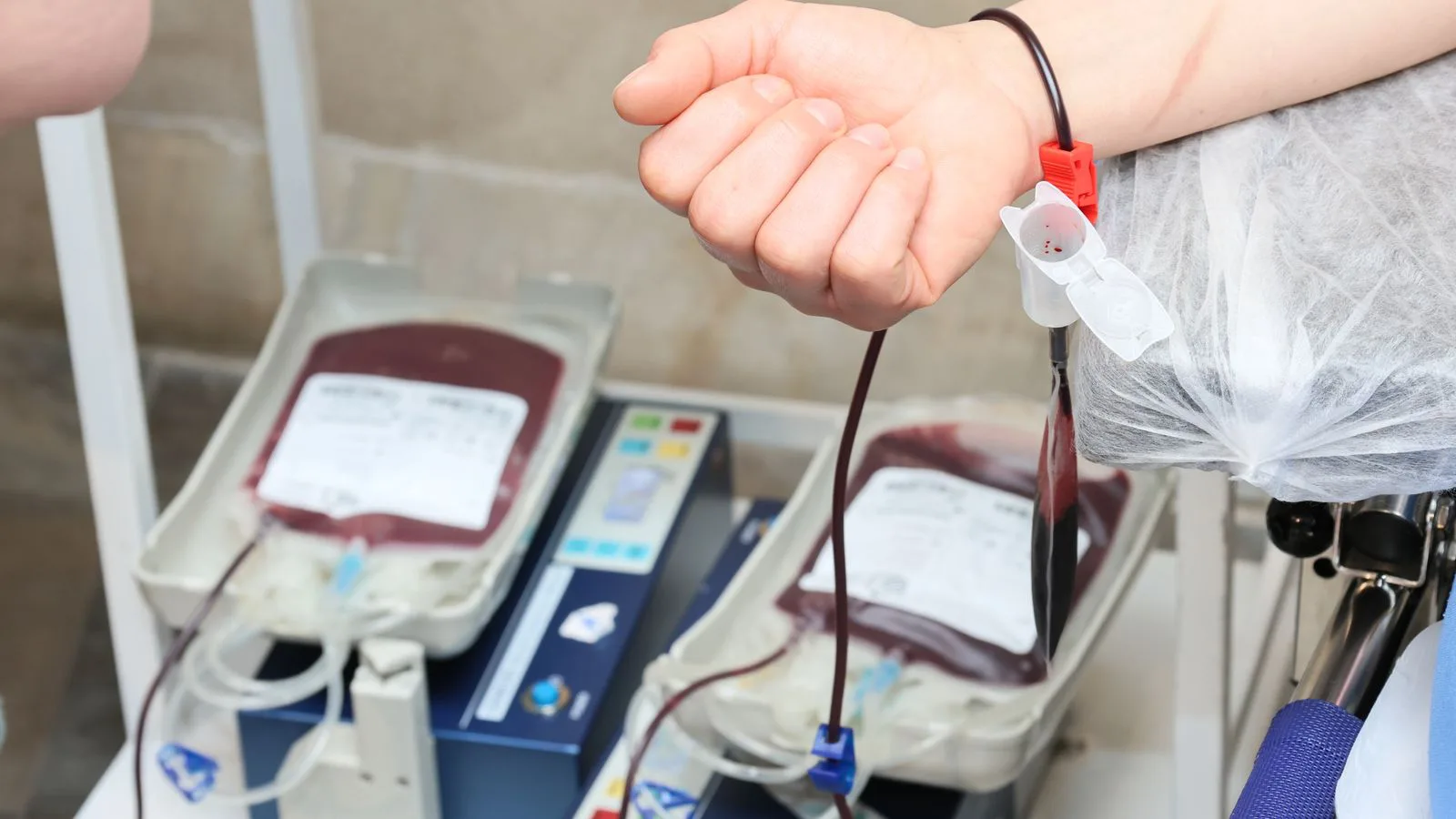
Plasma is back in a day, red cells in weeks, iron in months — and it is the iron that sets the interval. The arithmetic of a unit, and the minimum intervals published by seven national services.
Three clocks, running at completely different speeds
A donation removes about half a litre of a suspension, and the parts of that suspension come back at wildly different rates. The fluid is the fastest: plasma is mostly water and salts, and normal drinking restores the volume within a day or two — which is why the service hands you a drink before you leave and tells you to keep drinking. This is also why plasma-only donation, where the cells are returned to you, carries intervals measured in days rather than months.
The red cells are the second clock. The marrow builds them continuously, and NHS Blood and Transplant puts most donors' haemoglobin back to normal within six to twelve weeks. Note how much wider that window is than the interval most services actually impose — six to twelve weeks straddles the 56 days the United States and Germany allow. The third clock is the slow one, and it is the reason the intervals exist at all: iron. Building a red cell requires iron, and the iron that left in the bag is not coming back from anywhere except your diet.
What a unit actually takes: the iron arithmetic
You can derive the figure rather than look it up. A haemoglobin molecule weighs about 64,500 g/mol and holds four iron atoms of 55.845 each, so iron is 4 × 55.845 ÷ 64,500 = 0.346% of haemoglobin by mass, or 3.46 mg of iron per gram of haemoglobin. Now take a donation. A 500 mL unit from a donor at 15 g/dL contains 75 grams of haemoglobin, and 75 × 3.46 gives 260 mg of iron leaving the body in the bag. Run it at the other end of the range — a 470 mL unit from a donor sitting at the 12.5 g/dL screening floor — and it is 203 mg. Every whole blood donation is somewhere in that 200 to 260 mg band.
That number only means something against what you have. Storage iron — the reserve held as ferritin, separate from the iron already at work in circulating red cells — runs at roughly 1,000 mg in a typical man and around 300 mg in a typical menstruating woman. So a 250 mg donation is about a quarter of a man's reserve and the great majority of a woman's. Two donations a year, for a woman starting from a modest reserve, can be the whole thing. This is not a small tax on a large account; for half the population it is most of the account.
How long that takes to put back
The bottleneck is absorption, and it is narrow. The gut takes up a couple of milligrams of iron a day from an ordinary diet, and although donation raises that rate — the body increases absorption when stores fall, as NHS Blood and Transplant notes — it cannot raise it by much. Do the division. At 2 mg a day of net absorption, 250 mg takes 125 days, about eighteen weeks. Push absorption to 3 mg a day and it is 83 days; to 4 mg a day, still 63 days. Six whole blood donations a year is 1,500 mg, which means finding an extra 4.11 mg of net absorbed iron every single day, indefinitely. That is a great deal to ask of a diet.
Those are estimates from first principles, and there is a trial that measured the real thing. The HEIRS study, published in JAMA in 2015, randomised blood donors to a low daily dose of iron or to none, and tracked how long they took to recover. Donors who took no iron needed between 11 and 23 weeks to recover 80% of their post-donation haemoglobin fall, and more than 24 weeks to restore ferritin. Donors given 37.5 mg of elemental iron a day recovered haemoglobin in four to five weeks and ferritin in about eleven. Read those numbers against a 56-day interval and the tension is obvious: the shortest legal interval in several markets is shorter than the unsupplemented recovery time.
The intervals, and why they differ by country and by sex
Because the underlying physiology is the same everywhere, the spread between national rules is a spread of policy, not of biology. The United States permits a whole blood donation every 56 days, the same for men and women, up to six a year. Germany sets the same 56-day floor but caps the year at six for men and four for women. France allows eight weeks with the same six-and-four cap. Spain and Portugal set two months and cap at four and three. The United Kingdom is more conservative still, at twelve weeks for men and sixteen for women. Italy is the most cautious of all: ninety days between donations, four a year for men and post-menopausal women, and two a year for women of childbearing age.
The sex difference is not a courtesy. It follows directly from the iron arithmetic: a menstruating woman is already running a monthly iron loss on top of anything a donation takes, and starts from a storage reserve around a third of a man's. The Italian rule, which distinguishes women of childbearing age from post-menopausal women rather than simply women from men, is the version of that logic drawn most precisely — it targets the actual mechanism rather than the demographic proxy. The American rule, applying the same 56 days to everyone, is the one that leans hardest on individual screening to catch the donors for whom that interval is too short.
Plasma and platelets follow a different logic entirely, because in apheresis the red cells go back into you. Nothing much leaves except protein and water, both of which regenerate in days. Hence the intervals collapse: two weeks in the United Kingdom, France and Italy for plasma, seven days for platelets in the United States with a cap of twenty-four a year, and up to sixty plasma donations a year in Germany. If you want to give often, this is the route that the physiology permits — but only the service can tell you whether your own bloods allow it.
The weight rule, and the formula hiding behind it
Every service sets a minimum weight — 110 pounds in the United States, 50 kg in the United Kingdom and across Europe — and it is not arbitrary. The AABB states the reasoning explicitly: the 110-pound minimum and the 10.5 mL per kilogram collection limit exist on the assumption that together they prevent drawing more than 15% of a donor's blood volume. That is the whole rule. The weight floor is a proxy for blood volume, and blood volume is what a donation has to stay a safe fraction of.
The formula that turns a person into a blood volume is Nadler's, published in Surgery in 1962 and still the standard: for a woman, volume in litres is 0.3561 times height in metres cubed, plus 0.03308 times weight in kilograms, plus 0.1833; for a man the constants are 0.3669, 0.03219 and 0.6041. Run it on a donor at the floor — a woman of 5 feet 3 inches and 110 pounds — and you get 3,296 mL. A 500 mL draw from that is 15.2% of her circulation. Run it on a man of 5 feet 11 and 176 pounds and the same 500 mL is 9.4%. The identical bag, on the identical afternoon, is a materially different event for the two of them.
Push the arithmetic one step further and the rule shows its seams. The 10.5 mL per kilogram cap allows 525 mL from a 50 kg donor, which against that same 3,296 mL is 15.9% — slightly above the 15% the cap is meant to guarantee. The two criteria are not perfectly consistent at the very bottom of the range, which is precisely why some services layer an extra check on top: NHS Blood and Transplant asks young female donors below certain height and weight thresholds to confirm they have enough blood to donate safely, using an estimated blood volume rather than weight alone. If you are near the minimum weight, that extra check is the rule that actually applies to you.
What the services themselves advise about iron
The published advice is consistent and modest. Eat iron-rich food regularly rather than in bursts: red meat, liver, pulses, dark leafy greens, fortified cereals. Pair plant sources with vitamin C, which improves the absorption of non-haem iron, and keep tea and coffee away from the meal, since they inhibit it. Drink well on the day. None of this is dramatic, and none of it will move 250 mg quickly — the arithmetic above sets the ceiling on what diet alone can do.
Supplements are a different matter and belong to a doctor, not to a web page. The HEIRS trial shows a low daily dose shortens recovery substantially, and several services now offer or recommend supplementation for frequent donors — but iron is actively harmful in haemochromatosis and other iron-loading conditions, and taking it can also paper over an anaemia whose real cause needs finding. The right sequence is: donate within the intervals your service publishes, let it check your haemoglobin, and if you are repeatedly deferred or feel persistently tired, take that to your doctor and ask about a ferritin test rather than starting tablets on your own.
| Market and source | Whole blood | Whole blood per year | Plasma | Platelets |
|---|---|---|---|---|
| United States — FDA 21 CFR 630.15 and the American Red Cross | 56 days (8 weeks); 112 days for a double red cell donation | Up to 6, the same for men and women | Every 28 days, up to 13 a year | Every 7 days, up to 24 a year |
| United Kingdom — NHS Blood and Transplant | 12 weeks for men, 16 weeks for women | About 4 for men, about 3 for women | As often as every 2 weeks | As often as every 2 weeks |
| France — Établissement français du sang | 8 weeks | Up to 6 for men, up to 4 for women | Every 2 weeks, up to 24 a year | Every 4 weeks, up to 12 a year |
| Spain — Real Decreto 1088/2005 | 2 months | Up to 4 for men, up to 3 for women | Set by the regional transfusion centres, not by the decree | Set by the regional transfusion centres, not by the decree |
| Portugal — Instituto Português do Sangue e da Transplantação | 2 months | Up to 4 for men, up to 3 for women | Set by the collecting centre | Set by the collecting centre |
| Germany — DRK Blutspendedienste | 56 days | Up to 6 for men, up to 4 for women | Up to 60 a year | Roughly every 14 days, up to 26 a year |
| Italy — AVIS, under the Ministry of Health decree | 90 days | Up to 4 for men and post-menopausal women; up to 2 for women of childbearing age | Every 14 days | Every 14 days |
Frequently asked questions
- If my haemoglobin is fine, why do I still have to wait?
- Because haemoglobin is the last thing to fall, not the first. The body protects circulating haemoglobin by emptying the iron stores behind it, so ferritin can be well down while the finger-prick test still passes. That is exactly what the HEIRS trial measured: haemoglobin recovered in 11 to 23 weeks without supplementation, but ferritin took more than 24. The interval is set for the reserve you cannot see at the donation chair, not for the number they read out to you.
- Why can I give plasma every two weeks but whole blood only every few months?
- Because in a plasma donation the red cells are separated out and returned to you, so almost no iron leaves the building. What you lose is water and protein, and both are remade within days. Whole blood takes the cells and the iron in them, which is the part that takes months. It is the same reason platelet intervals are short: the limiting resource in each case is whatever the procedure actually removes.
- Can I donate in another country if I have already donated at home?
- The intervals apply to your body, not to a national register, so the honest answer is that the shortest of the two is not the one to use. The gap between the most permissive rule and the most cautious is large — 56 days in the United States against 90 days in Italy, and against a 16-week wait for women in the United Kingdom — and that gap reflects a difference in caution, not in physiology. Declare your last donation date truthfully at screening and let the service decide; that is exactly what the question is there for.
- Does giving blood make you lose weight or lower your blood pressure?
- Not in any way worth counting on. Half a litre of blood weighs about half a kilogram, and the fluid is back within a day or two, so the weight is back with it. As for blood pressure, a donation can leave you briefly light-headed on standing, which is a short-lived volume effect and not a treatment — do not treat donation as blood pressure management, and if yours needs managing, that is a conversation with a doctor. Give blood because someone needs it, and take the free haemoglobin check as the genuine incidental benefit.
- I was turned away for low haemoglobin. What now?
- Treat it as information rather than a setback. A single low reading is common and often reflects the last donation more than anything else, but a repeated one is a result that belongs with your doctor, because the causes worth finding — heavy periods, coeliac disease, a bleeding source in the gut — are found by investigating, not by taking iron. Meanwhile, lengthen the interval rather than shortening it, eat as described above, and ask the service whether they can check ferritin as well as haemoglobin, since that is the number that actually explains the deferral.
Articles you may find interesting
All guides →Related tools
This article explains where the donation rules come from. It is not medical advice and it cannot tell you whether you are eligible — only the blood service can, through its own screening on the day, and its rules override anything here. Do not start iron supplements on your own either: iron is harmful in haemochromatosis and other iron-loading conditions, it can mask the cause of an anaemia that needs investigating, and iron tablets are among the commonest causes of fatal poisoning in small children. If you are told your haemoglobin is too low to donate, treat that as a result to take to your doctor, not as a hurdle to get around.
Sources
- U.S. Food and Drug Administration / eCFR — 21 CFR 630.15 — donation frequency for Whole Blood, Red Blood Cells and Plasma collected by apheresis
- American Red Cross — Types of blood donations — whole blood every 56 days, Power Red every 112 days, platelets every 7 days, plasma every 28 days
- NHS Blood and Transplant — Who can give blood — 12 weeks for men, 16 weeks for women; weight 50 kg to 158 kg
- NHS Blood and Transplant — How your body replaces blood — haemoglobin back to normal in 6 to 12 weeks for most people
- Établissement français du sang — Qui peut donner — 8 semaines entre deux dons de sang total, 6 dons par an pour un homme et 4 pour une femme
- Boletín Oficial del Estado (España) — Real Decreto 1088/2005 — intervalo mínimo de dos meses; máximo de 4 extracciones anuales en hombres y 3 en mujeres
- Instituto Português do Sangue e da Transplantação — Já dei sangue este ano. Posso repetir a dádiva? — intervalo mínimo de 2 meses, até 4 dádivas para homens e 3 para mulheres
- DRK-Blutspendedienste — Wie oft darf man Blut spenden — 56 Tage Mindestabstand, 6 Vollblutspenden für Männer und 4 für Frauen pro Jahr
- AVIS — Associazione Volontari Italiani del Sangue — Tipologie di donazione — 90 giorni tra due donazioni di sangue intero; 2 all'anno per le donne in età fertile
- AABB — Association Bulletin #08-04 (revised July 2022) — the 110 lb minimum and the 10.5 mL/kg collection limit are set to keep a draw under 15% of blood volume
- JAMA — Kiss J.E. et al., Oral iron supplementation after blood donation: a randomized clinical trial (HEIRS), 2015;313(6):575–583
- Surgery — Nadler S.B., Hidalgo J.U. & Bloch T., Prediction of blood volume in normal human adults, 1962;51(2):224–232
Spotted a mistake in this article?