How Much Carpet Do I Need? Why the Floor Area Is Not the Order Quantity
Published 7/14/2026 · 8 min read · Real-estate calculators

Marco Bianchi — Home, DIY & motoring writer at OneKitly
Renovation · Materials
Checked against 2 sources
Measure the room, multiply length by width for the floor area, then work out how that area comes off a roll — because carpet is manufactured in fixed widths, normally 12 ft and 15 ft, and you pay for the full width whatever you use of it. A room 13 ft by 17 ft has 221 square feet of floor, or 24.6 square yards. It will not come off a 12 ft roll in one piece, so you buy 17 running feet of a 15 ft roll: 15 × 17 = 255 square feet, 28.3 square yards. You have bought 34 square feet you will throw away, 15 percent more than the floor area, and that offcut is normally the largest single item of waste in the job — larger than trim, larger than pattern match. Then add on top: about 3 in of trim on every cut edge, one full pattern repeat for every seam in a patterned carpet, and the area of every doorway, alcove and bay measured separately.
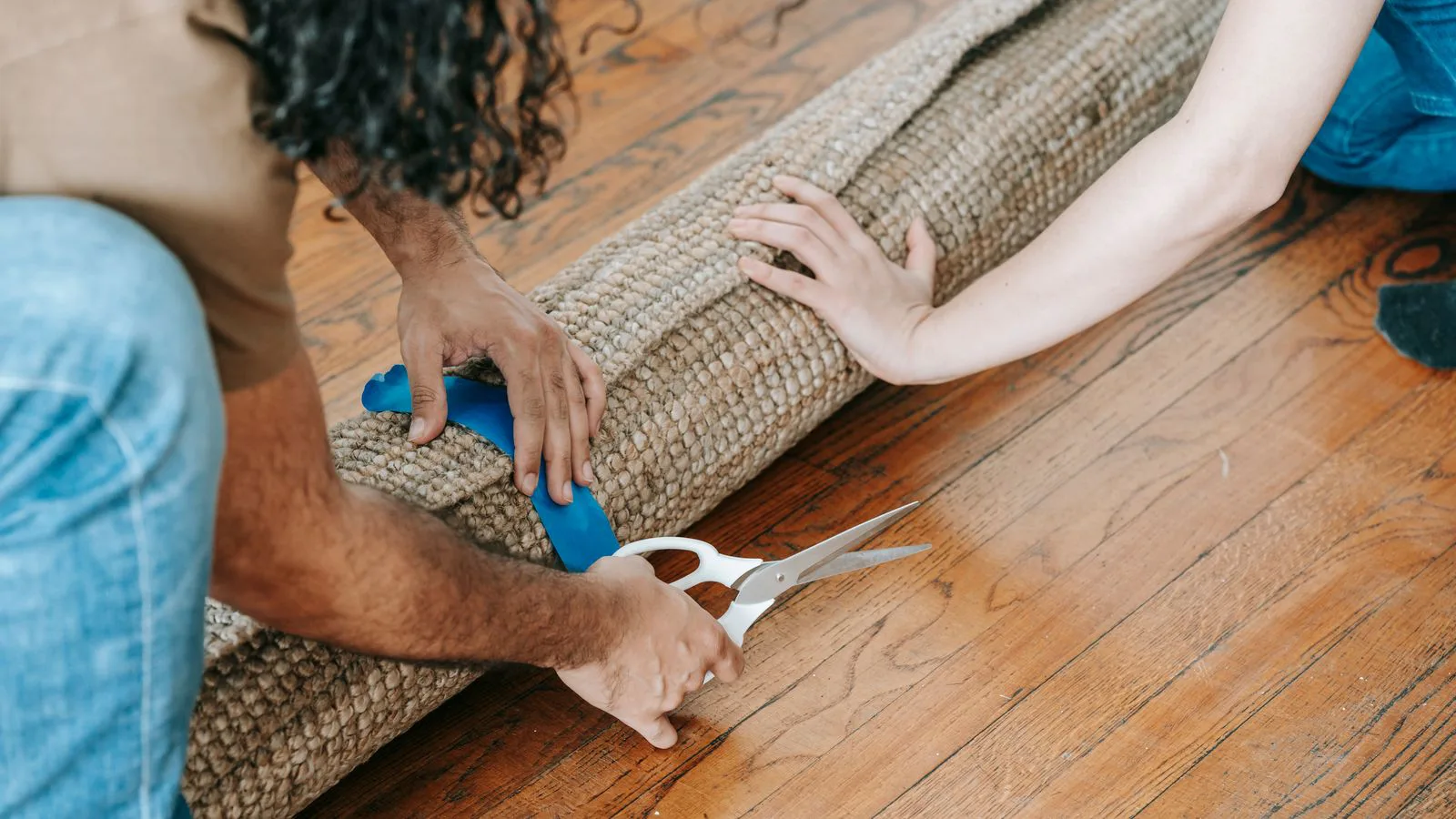
A 13 by 17 ft room is 221 square feet of floor, but carpet comes off a 12 or 15 ft roll, so you buy 255 square feet and bin 34. Here is how to work out the order quantity your supplier will actually invoice.
The roll width decides the waste, not your measuring
Tile, laminate and paint are all sold in units small enough that the area answer is nearly the order quantity — you round up a box and move on. Carpet is not. It arrives as a continuous roll of one fixed width, and the fitter cuts a length off it. You can choose the length to the inch; you cannot choose the width at all. That single constraint is why a carpet estimate is a different kind of calculation from every other floor covering, and why an answer expressed purely as an area is incomplete.
Work an unlucky room and the size of the effect is obvious. Thirteen feet is one foot wider than a 12 ft roll and two feet narrower than a 15 ft one. The 12 ft roll leaves a 1 ft by 17 ft gap that you cannot fill honestly — a fill strip has to run with the pile in the same direction, which means buying another 17 ft of roll for a strip 12 in wide, so nobody does it outside a closet. So you take the 15 ft roll, cut 17 ft, and trim 2 ft off the width: 255 square feet bought against 221 laid, 34 square feet gone. Move the same room to 15 ft wide and the waste falls to nothing; move it to 15 ft 1 in and you are buying two widths.
Pile direction, pattern repeat and the seams you cannot avoid
Carpet has a direction. The pile leans one way, and two pieces laid with the lean opposed will read as two different shades under the same light — permanently, not until it settles. Every piece in a room therefore has to run the same way, which removes the option of rotating an offcut to fill a gap and is the reason the calculation is a length off a fixed width rather than a jigsaw. It also means a room whose long dimension exceeds the roll length available in that batch has a seam whether you like it or not, and seams should be planned to fall away from doorways and out of the main light.
A pattern adds a second allowance on top of the roll width. To match across a seam the fitter has to slide one piece along until the design lines up, and the material that slides past is gone. Budget one full repeat for every seam: on a common 18 in repeat that is 18 in of extra run per seam, and on a large repeat it can be twice that. Stairs are their own order line entirely — allow roughly the riser plus the tread plus an inch of nosing per step, about 19 in, so a fourteen-step flight eats around 22 ft of runner before you have touched a landing.
Read the quotation before you compare it
Carpet is quoted in at least three different units and they are not close together. The US trade still prices by the square yard, which is nine square feet, so a price that looks three times another may be identical. Our 255 square feet is 28.3 square yards; a quote per square foot and a quote per square yard for the same carpet differ by a factor of nine, and reading one as the other is the commonest way to buy the wrong product. Ask which unit, and ask whether it is the floor area or the roll area being charged.
Then check what the price includes. Underlay, gripper rod, door bars, uplift and disposal of the old floor, and the fitting itself are separately priced far more often than not, and an installed price and a supply-only price for the same carpet can differ by half. Ask the supplier to state the ordered quantity in the same breath as the price, so you can see both what you are buying and how much of it you will actually walk on. If their figure and yours disagree by more than a few percent, the usual cause is that one of you was quoting floor area and the other roll area.
Frequently asked questions
- How much extra should I add for waste?
- There is no single percentage, and quoting one is how people end up short. The waste is not a proportion of the area, it is whatever the roll width leaves over, so it depends entirely on how your room dimensions sit against 12 and 15 ft. Our 13 by 17 ft room wastes 15 percent; the same room at 15 by 17 ft wastes nothing. If you must guess before you know the roll width, 10 percent covers trim and small errors on a simple rectangular room and nothing else — it will not cover a bad width match, a pattern, or stairs. Do the roll-width arithmetic instead; it takes a minute.
- Can I use the offcut in another room?
- Sometimes, and it is worth planning for. Our 2 ft by 17 ft offcut is a usable strip for a hallway, a landing or a walk-in cupboard, provided the pile runs the right way when it gets there and the room is under 2 ft wide in one direction. The way to capture that value is to give the fitter every room's dimensions at once and let them plan the cutting across the whole job, rather than ordering room by room. A single 15 ft roll cut cleverly across three rooms will nearly always beat three separate orders — but only if whoever does the cutting knows all three rooms before the first cut.
- Do I measure into the doorways?
- Yes, to the centre of the door leaf when it is closed, because that is where the carpet stops and the door bar goes. A standard doorway adds around 4 to 6 in to the room dimension it opens off, which sounds negligible until it pushes your run past a whole foot and the supplier charges you for it anyway. Alcoves, bay windows and the space beneath a radiator all count the same way: carpet goes there, so it belongs in the measurement. What does not count is anything permanently built in and floor-standing, such as fitted wardrobes or a kitchen island, but be careful — fitted furniture is often removed before the next carpet is laid, and a floor that stops at the wardrobe line dictates the layout for the next twenty years.
Articles you may find interesting
All guides →Related tools
Sources
Spotted a mistake in this article?