Mulch Depth Is the Whole Answer — and It Is a Trade-Off
Published 8/19/2026 · 13 min read · Everyday calculators

Marco Bianchi — Home, DIY & motoring writer at OneKitly
Renovation · Materials
Checked against 3 sources
Depth is the answer and the volume follows from it: bed area times depth, in the same units. Two to four inches is the working window for most beds, and the right end of it depends on the material rather than on your patience. Extension guidance puts bark, wood chips and pine straw at 2 to 3 inches, coarse chunky mulch up to 4, screened compost and other fine material at 1 to 2, and gravel or small stone at about 1 — and it caps everything at 4 inches, whatever it is made of. Below roughly 2 inches, light reaches the soil and weeds germinate through; above 4, you start trading the benefit for waterlogging, reduced soil oxygen and roots that grow up into the mulch looking for air. Fine material is worse for this than coarse, because it mats into a crust that sheds water instead of letting it through. Then the arithmetic. In the United States, a cubic yard covers 108 sq ft at 3 inches deep, and a cubic yard is 13.5 bags of the standard 2 cubic foot size — not 27, which is the number of cubic feet in a yard and the commonest miscount there is. In metric, a cubic metre covers about 13.3 sq m at 7.5 cm, and a cubic metre is 20 bags of 50 litres or about 14 of 70. And one warning about the calculator itself: it takes your area and depth in United States units if that is your market, but answers in cubic metres and 50 litre bags regardless. Convert its answer at 1.31 cubic yards to the cubic metre.
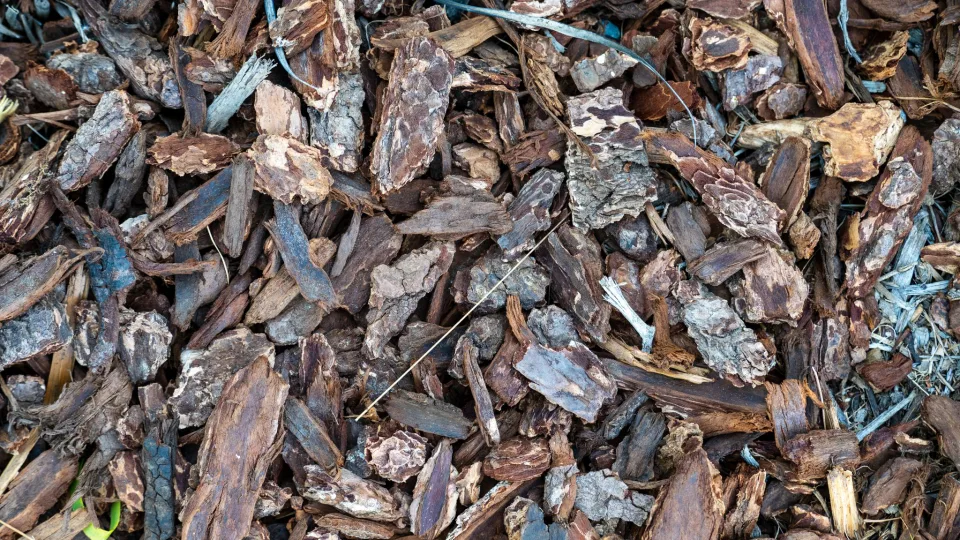
Two to four inches, and the right end of that window depends on the material: bark takes 3, screened compost takes 1 to 2, and gravel takes 1. Here is the depth trade-off, the settling nobody buys for, and the bag conversion where the count goes wrong.
The window, and why it is a window rather than a number
Mulch does three jobs, and each one wants a different depth. Weed suppression wants enough material that light does not reach the soil, which is the lower bound. Moisture retention wants a layer thick enough to break the evaporative link between soil and air, and gets steadily better up to a point. Soil temperature buffering wants the same. But the soil underneath still has to breathe and still has to be reachable by rain, and those two requirements set the upper bound. Two to four inches is where the three jobs overlap for most materials, and it is the range that extension fact sheets converge on independently.
Below the lower bound the failure is visible within weeks. A thin layer of a coarse mulch has gaps between the pieces, and every gap is a place a seed can germinate with light. A thin layer of a fine mulch has no gaps, but it also has no thickness, and it will be washed and blown into drifts by the second heavy rain, leaving bare patches. If you cannot afford the depth for the whole bed, mulch part of it properly rather than all of it thinly — half a bed at 3 inches beats a whole bed at 1.
Bark, gravel and compost want different depths for different reasons
Particle size decides where in the window you land. A coarse bark or chip mulch is mostly air between the pieces, so water runs straight through it and air exchanges freely — that is why it tolerates the top of the range, 3 inches routinely and 4 at the outside. A fine mulch is the opposite. Screened compost, sawdust, grass clippings and shredded leaves have particles small enough to knit together; laid thick they form a mat that repels water rather than absorbing it and that limits oxygen to the soil. Extension guidance puts fine material at 1 to 2 inches and says grass clippings and shredded leaves should never be deeper than 2.
Gravel and stone are a different case again and the depth is much shallower — around an inch is enough for weed control, because stone does not decompose, does not settle much and gets its suppression from mass rather than from thickness. Piling it deeper adds weight the soil has to carry, makes the bed hard to plant into, and creates a layer that stores and radiates heat in a way an organic mulch does not. The other thing to know about stone is that it is a decision you make once: bark can be dug in at the end of its life, and gravel has to be picked out.
Too deep: what actually goes wrong, and it is not one thing
The usual shorthand is that thick mulch stops water reaching the roots. That is true of fine material and only partly true of coarse, and it is worth separating the mechanisms because the fixes differ. First, water: a fine mulch laid thick knits into a crust that sheds rain sideways instead of letting it soak in, so the soil under a deep compost layer can be dry after a downpour. Second, air: an excessively deep layer holds water in the profile and cuts soil oxygen, and roots respond by growing upward into the mulch looking for it — which leaves you with a shallow-rooted plant that dies in the first drought after you stop mulching. Third, winter temperature: a deep organic layer keeps soil warmer than it should be in winter, which extension guidance lists alongside waterlogging and shallow rooting as a consequence of excess depth.
The gap against the stem is a separate rule and it is the one most often broken. Mulch heaped against a trunk keeps the bark permanently wet, which interferes with the respiration of the living tissue underneath and invites decay, insects and rodents that shelter in it over winter. Extension guidance is specific and easy to follow: keep mulch 2 to 3 inches clear of the stems of woody plants, and feather the layer down as it approaches a trunk rather than piling it into a cone. This has nothing to do with how deep the bed is mulched — you can be perfectly within the depth window and still kill a young tree with a volcano around its base.
Settling: the depth you buy is not the depth you keep
An organic mulch loses depth. Air is compressed out of a freshly spread layer by rain and by its own weight, and the material itself decomposes, which is the point of it — a bark mulch is feeding the soil the whole time it is suppressing weeds. Extension guidance treats this as routine, saying organic mulches need replenishing from time to time and recommending fresh mulch seasonally to maintain the depth. What none of the sources checked for this article puts a number on is how much and how fast, so this piece will not invent one: it depends on the material, the particle size, how wet the site is and how much traffic the bed gets.
What matters more than the number is what you do about it, and there is one rule that catches most people out. Do not top up by laying a fresh full depth on the old layer. The 4 inch ceiling applies to the total, not to the new material, and beds that get a fresh layer every spring are exactly how a bed ends up 8 inches deep with roots growing sideways through the mulch. Before topping up, rake the existing layer to break the crust and see how much is genuinely left, remove any of it that has become a compacted mat, and then add only what brings the total back into the window. Two years out of three that is a thin dressing rather than a delivery.
Bags, bulk and the conversion where the count goes wrong
Mulch is quoted in one unit and sold in another, which is where the miscount lives. In the United States it is priced in cubic yards in bulk and sold in cubic-foot bags at the store. A cubic yard is 27 cubic feet, so it is 13.5 bags of the standard 2 cubic foot size or 9 bags of 3 cubic feet. The mistake people make is buying 27 bags for a cubic yard, because 27 is the number they remember — that is twice what they need at the 2 cubic foot size. In metric the same trap is milder because the units line up better: a cubic metre is 1,000 litres, so 20 bags of 50 litres or about 14 of 70. Check the litres printed on the sack rather than counting sacks, because 50, 60 and 70 litre bags all exist and they look identical on a pallet.
Keep one coverage figure in your head as a cross-check, because it catches an order of magnitude error faster than recomputing. In the United States, one cubic yard covers 324 sq ft at 1 inch, 162 at 2 inches, 108 at 3 and 81 at 4. In metric, one cubic metre covers 20 sq m at 5 cm, 13.3 at 7.5 cm and 10 at 10 cm. If a calculator hands you a number that does not sit near one of those, one of your two inputs is in the wrong unit.
What this calculator does, and the unit warning for United States readers
The calculation is one line: area times depth. Enter 20 sq m at 5 cm and it returns 1 cubic metre and 20 bags of 50 litres; at 7.5 cm the same bed returns 1.5 cubic metres and 30 bags. Bags are always rounded up, so a bed needing 670 litres comes back as 14 bags rather than 13.4, leaving 30 litres over — which is the right way round, since a surplus goes on the next bed and a shortfall means a second trip. There is no sanity check on depth: type 100 cm and it will faithfully tell you that you need 20 cubic metres and 400 bags.
The unit handling is where it will catch out a reader in the United States. The two input fields convert to your market, so you type square feet and inches. The two result fields do not, so the answer comes back in cubic metres and 50 litre bags whatever you entered. A 200 sq ft bed at 3 inches deep returns 1.4158423 cubic metres and 29 bags — while the answer you actually wanted is 1.85 cubic yards, or 25 bags of the standard 2 cubic foot size. Multiply the tool's cubic metres by 1.308 to get cubic yards, or by 17.66 to get 2 cubic foot bags. Read its bag count as a count of 50 litre European sacks, not as anything you will find on a pallet in a North American store.
| Material | Depth | Why |
|---|---|---|
| Bark, wood chips, pine straw | 2–3 in | Coarse enough that rain runs through and air exchanges; the default for a shrub bed |
| Coarse chunky chip | Up to 4 in — the ceiling for any mulch | Large air gaps make deep layers safe; go past 4 in and even this waterlogs |
| Screened compost, fine shredded | 1–2 in | Fine particles knit into a crust that sheds water and limits oxygen |
| Grass clippings, shredded leaves | Never over 2 in | They mat together and go anaerobic; dry the clippings before spreading |
| Gravel, small stone | About 1 in | Suppresses by mass, not thickness; does not decompose, so it never needs topping up |
| Gap around a woody stem | 2–3 in clear, whatever the depth | Mulch on bark keeps it wet and invites decay, insects and overwintering rodents |
Worked with our own calculator
Mulch calculator
Given
- Area (m²)
- 20
- Depth (cm)
- 5
Result
- Volume (m³)
- 1
- 50 L bags
- 20
These figures are produced by the calculator below, not typed in by hand — they are recomputed whenever the tool changes.
Run it on your own figures →Frequently asked questions
- How deep should mulch be?
- Two to four inches for most beds, with the material deciding where in that range you land: bark and wood chips at 2 to 3 inches, coarse chunky mulch up to 4, screened compost and other fine material at 1 to 2, and gravel at about 1. Four inches is a ceiling rather than a target — extension guidance is explicit that mulch should not be allowed to build up beyond it. And keep it 2 to 3 inches clear of any woody stem regardless of how deep the rest of the bed is.
- How much area does a cubic yard of mulch cover?
- One cubic yard covers 324 sq ft at 1 inch deep, 162 at 2 inches, 108 at 3 and 81 at 4. Those four numbers are worth memorising because they let you sanity-check any calculator's answer in your head: if you are mulching a 400 sq ft bed at 3 inches, you need somewhere close to four cubic yards, and a tool telling you forty has taken one of your inputs in the wrong unit.
- How many bags make a cubic yard?
- Thirteen and a half bags of the standard 2 cubic foot size, or nine bags of 3 cubic feet. The commonest miscount is buying 27 bags, because 27 is the number of cubic feet in a cubic yard and it sticks in the memory as though it were a bag count — that is twice what you need at the 2 cubic foot size. Always divide the cubic feet by the bag's own volume, and read the volume off the bag rather than assuming it.
- Do I need to add mulch every year?
- Organic mulch needs replenishing, because it decomposes and settles — that is what it is for. But topping up is not the same as laying a fresh full depth. The four-inch ceiling applies to the total layer, so the routine is to rake the existing mulch first, break up any compacted mat, see how much is genuinely left, and then add only enough to bring the total back into the window. In most years that is a light dressing. Gravel and stone mulch does not decompose and never needs topping up, which is one of the few things to be said in its favour.
- Can mulch stop water reaching the plants?
- Yes, but mostly with fine material rather than coarse. Screened compost, sawdust and shredded leaves have particles small enough to knit into a crust that sheds rain sideways, so soil under a deep fine layer can stay dry through a downpour. Coarse bark and chip are far more permeable and rarely do this. The wider problem with excessive depth is not water arriving but water leaving: a layer that is too deep holds moisture in the profile, cuts soil oxygen, and pushes roots upward into the mulch to find air, which leaves the plant shallow-rooted and vulnerable the first summer it is not mulched.
Articles you may find interesting
All guides →Related tools
All three of these are estimates, and in each case the pack in your hand outranks them. The detergent bottle carries a dose set for a measured load and a stated water-hardness band; the fertiliser bag carries an application rate set for its own analysis and formulation; the mulch sack carries a volume and, often, a depth. Where a figure here and a figure on the pack disagree, follow the pack — the manufacturer tested that product and these tools did not. Nothing here is advice for a commercial holding, where fertiliser rates and application windows are set by law rather than by preference, and nothing here replaces a soil test.
Sources
Spotted a mistake in this article?