Power-to-Weight Ratio Explained (W/kg in Cycling)
Published 2/12/2026 · 3 min read · Sport calculators

Power-to-weight ratio is the power you produce divided by your body weight, expressed in watts per kilogram (W/kg). It is the single best predictor of climbing speed in cycling, because on a hill you must lift your own weight against gravity. A rider putting out 300 watts at 75 kg has a ratio of 4.0 W/kg, while a lighter rider at 60 kg needs only 240 watts for the same 4.0 W/kg. That is why two riders with very different raw power can climb at the same pace.
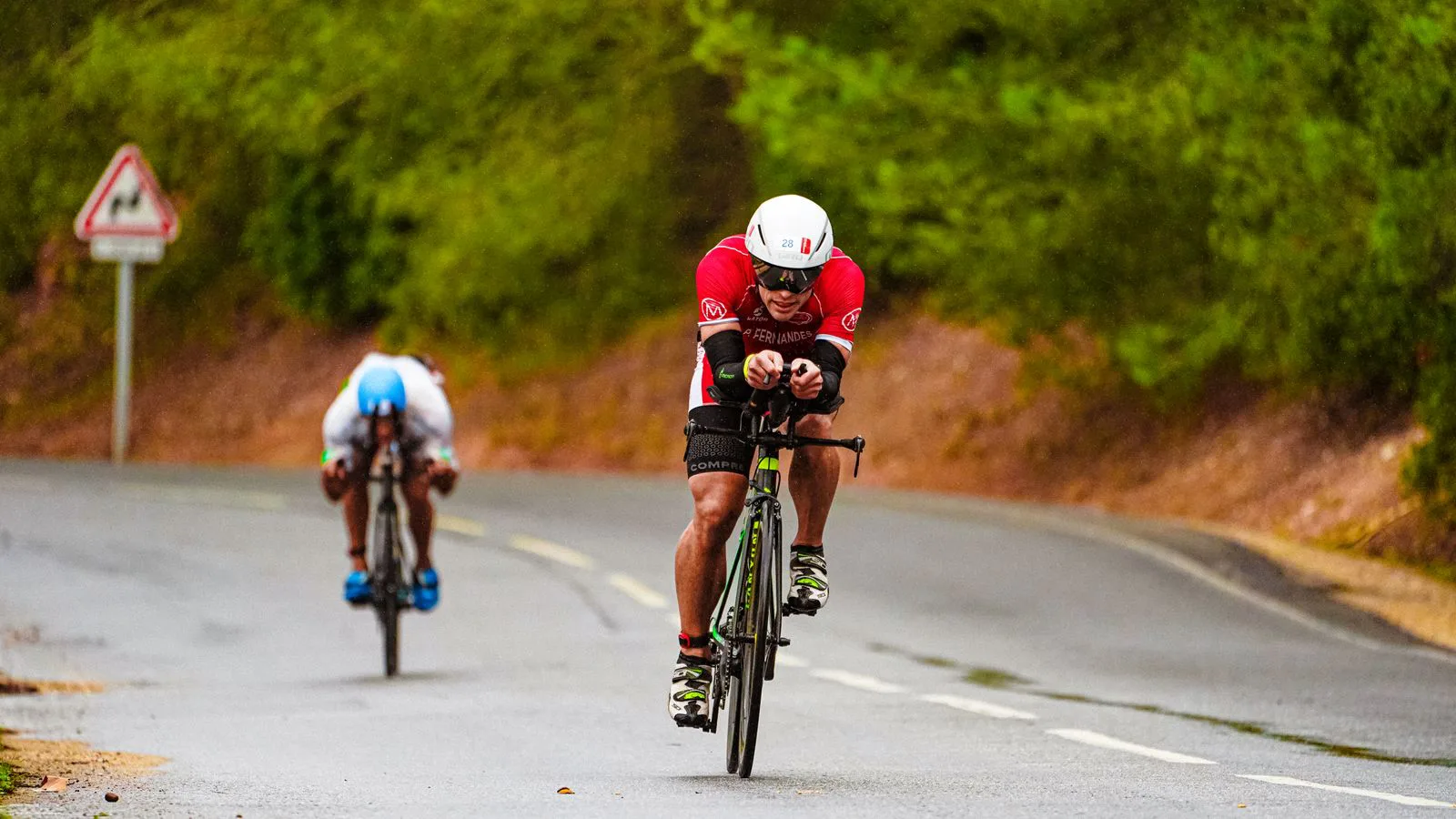
Watts per kilogram is the number that decides who climbs fastest. Learn how W/kg works, what it means for FTP and how to improve it.
Why W/kg matters on climbs
On a steep climb, most of your effort goes into fighting gravity, and gravity acts on your total mass. Heavier riders need proportionally more power just to move the same speed uphill, so raw watts alone don't tell the story. Dividing power by weight cancels out body size and shows who can climb fastest.
On flat ground the picture flips: air resistance dominates, and raw watts matter more than W/kg because a bigger, more powerful rider can push more air aside. This is why heavier sprinters win flat stages while lighter climbers shine in the mountains. Power-to-weight is decisive uphill, less so on the flat.
Reading your numbers with FTP
Riders usually quote W/kg at their functional threshold power (FTP) — the highest steady power they can hold for about an hour. As a rough guide, a keen amateur sits near 3.0-3.5 W/kg, a strong club rider around 4.0, and elite professionals push well above 5.0 W/kg at threshold. Comparing at FTP keeps the numbers meaningful across riders.
In the United States you may occasionally see watts per pound (W/lb), but W/kg is the international standard used by power meters and training software everywhere, so it is the figure to learn. To sanity-check, 4.0 W/kg is about 1.8 W/lb. Sticking to W/kg lets you compare directly with published benchmarks and training platforms.
Two ways to raise your ratio
There are only two levers: raise the top number by producing more power, or lower the bottom number by shedding non-essential weight. More power comes from structured training — threshold intervals, VO2 max work and a solid aerobic base. Gains here are durable and also make you faster on the flat.
Losing weight can help, but only if it comes from fat rather than muscle, and only down to a healthy point. Cutting weight too far costs power and hurts health, which lowers the very ratio you are chasing. For most riders, building the engine is the smarter and safer route to a better W/kg than aggressive dieting.
Worked with our own calculator
Power-to-weight ratio calculator
Given
- Power (W)
- 500
- Weight (kg)
- 82.5
Result
- Power-to-weight (W/kg)
- 6.061
These figures are produced by the calculator below, not typed in by hand — they are recomputed whenever the tool changes.
Run it on your own figures →Frequently asked questions
- What is a good power-to-weight ratio?
- At FTP, around 3.0-3.5 W/kg marks a keen amateur, 4.0 a strong club rider, and above 5.0 W/kg is elite territory. Judge yourself against riders of similar age and experience rather than the pros.
- Is W/kg only useful for cycling?
- It is most famous in cycling, but any sport where you move your own body against gravity benefits — running uphill, rowing and cross-country skiing all reward a high power-to-weight ratio.
- Do I need a power meter to know my W/kg?
- To measure it directly, yes — a power meter or a smart trainer reads your watts. Without one you can estimate power from climb times and gradient, but a meter gives the reliable number training software expects.
- Does W/kg change with the duration I hold?
- Yes. You can hold a much higher ratio for 5 seconds than for an hour, so always state the duration. A 5-second sprint might be 15 W/kg, while a one-hour FTP effort might be 4 W/kg for the same rider.
Articles you may find interesting
All guides →Related tools
Sources
Spotted a mistake in this article?