Solar Panels: the Self-Consumption Rate Decides the Payback
Published 7/29/2026 · 11 min read · Everyday calculators

Marco Bianchi — Home, DIY & motoring writer at OneKitly
Renovation · Materials
Checked against 5 sources
A rooftop array produces one kind of kilowatt-hour and sells it at two very different prices. In France, the arrêté of 1 June 2026 sets the purchase tariff for surplus electricity at 1.1 cents per kilowatt-hour before VAT, while Eurostat puts the household retail price at 25.61 cents for the second half of 2025 — so a kilowatt-hour you consume yourself is worth 23.3 times one you export. The consequence is that the self-consumption rate, not the yield, is the variable that decides the payback. On a south-facing array at 35 degrees near Lyon, PVGIS puts the yield at 1,279 kilowatt-hours per kilowatt-peak a year; at a 20 % self-consumption rate that array earns about 77 euros per kilowatt-peak a year, at 30 % about 108, at 50 % about 171, at 70 % about 233 and at 90 % about 296. Moving from 30 % to 70 % more than doubles the revenue — a rise of 116 %. Moving the same array from Lyon to Madrid, where PVGIS gives 1,630 kilowatt-hours per kilowatt-peak, a 27 % better yield, raises revenue by only 33 %. The self-consumption rate has more leverage than the sun. Spain reaches the same conclusion by a different route: article 14 of Royal Decree 244/2019 caps the compensation for surplus at the value of the energy actually drawn from the grid in the billing period, so beyond a certain size an exported kilowatt-hour is worth not a little but exactly nothing. The practical rule that follows is to size the array to the consumption curve rather than to the roof, and to treat any quote that does not state an assumed self-consumption rate as incomplete.
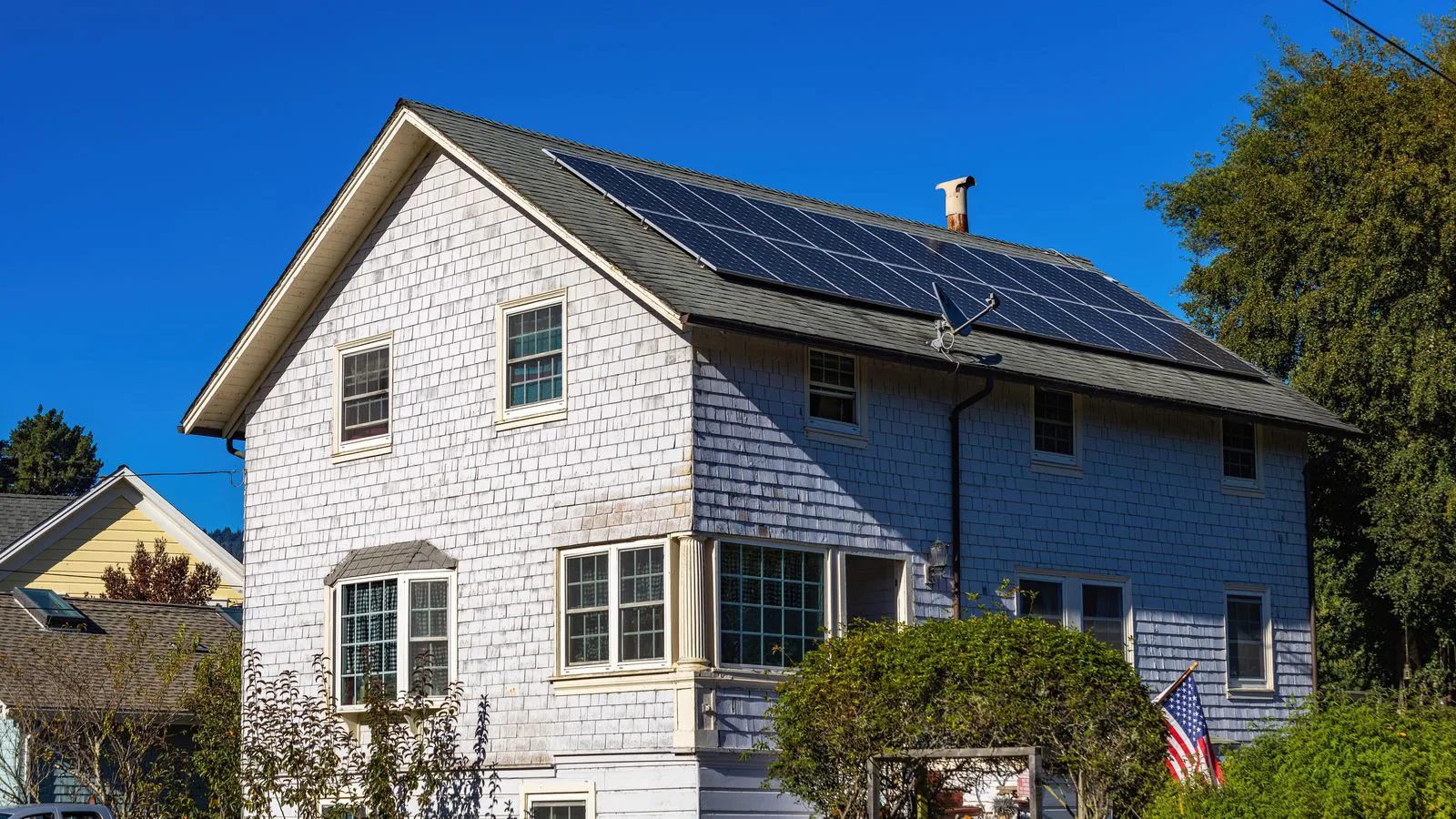
Since June 2026 a French rooftop is paid 1.1 cents for an exported kilowatt-hour and avoids 25.61 cents by consuming the same one. That ratio of 23 to 1 makes the self-consumption rate — the variable almost every quote omits — worth more than the amount of sun falling on the roof.
Two prices for the same kilowatt-hour
A panel does not know what happens to the electron it makes. The household does. A kilowatt-hour that is used the instant it is produced never enters the meter, so its value is the retail price it displaces — every cent of it, taxes and network charges included, because those are charged on what you draw and not on what you generate. A kilowatt-hour that is exported is bought at whatever the regulator has decided that surplus is worth. In France the arrêté of 1 June 2026, published in the Journal officiel on 4 June, sets that purchase tariff at 1.1 cents per kilowatt-hour before VAT and removes the investment premium that used to accompany it.
Set that against Eurostat's household electricity price for France in the second half of 2025 — 25.61 cents per kilowatt-hour, all taxes and levies included — and the ratio is 23.3 to one. Exporting a hundred kilowatt-hours earns one euro and ten cents, which is what four and a bit self-consumed kilowatt-hours are worth. That is not a detail of the financial model; it is the financial model. Everything about sizing, orientation, batteries and diverters follows from a single question: how much of what this roof makes will the house be awake to use.
The number almost no quote states
The self-consumption rate is the share of what the array produces that the household uses on the spot. It is not a property of the panels and it cannot be read off a datasheet: it is a property of the overlap between a generation curve that peaks at midday in June and a consumption curve that, in most homes, peaks at breakfast and in the evening. A household where nobody is home on weekdays and everything runs on a timer at night will sit at the bottom of the range; one that runs a heat pump, an electric car charger or a hot-water diverter during daylight will sit near the top. There is no national average worth printing here, because the number is about your habits and your appliances, and it is measurable from your own meter data.
What can be printed is what each level of it is worth, because that is arithmetic. Using PVGIS, the European Commission's own irradiation model, a one-kilowatt-peak array facing south at 35 degrees near Lyon produces 1,279 kilowatt-hours a year after a 14 % system loss. Multiply by the blended value of a kilowatt-hour at each self-consumption rate and you get the annual revenue per kilowatt-peak in the table below. Divide the price per kilowatt-peak you were quoted by that figure and you have your payback in years, before degradation and before an inverter replacement — which is the only payback number anyone should quote you, and the only one that survives being checked.
It has more leverage than the sun
Here is the comparison that settles the priority. Take the same array and raise its self-consumption rate from 30 % to 70 %: annual revenue rises by 116 %, more than doubling. Now take the same array at a fixed 50 % self-consumption and move it from Lyon to Madrid, where PVGIS gives 1,630 kilowatt-hours per kilowatt-peak against 1,279 — a 27 % better yield in one of the sunniest capitals in Europe: annual revenue rises by 33 %. Habits beat latitude, and it is not close. For reference, the same model gives 1,590 kilowatt-hours per kilowatt-peak at Lisbon and 1,058 at Berlin, so the entire north-south spread of western Europe is worth about half of what a good load-shifting strategy is worth on a single roof.
The design conclusion is uncomfortable for anyone selling by the panel. Past the point where the array covers the daytime load, every additional panel produces almost exclusively exported kilowatt-hours, and in France those are worth 1.1 cents each. A larger array is not a proportionally better investment; it is a rapidly worse one, because the marginal kilowatt-hour is paid at a twenty-third of the average one. Size to the consumption curve, then add capacity only if you are simultaneously adding load that runs in daylight.
Spain and Portugal arrive at the same place by another road
Spain does not set a low surplus price; it sets a ceiling. Article 14 of Royal Decree 244/2019 values the surplus at a price agreed with the supplier on the free market, or at the hourly market price less deviation costs on the regulated tariff — and then states that the economic value of the surplus can in no case exceed the economic value of the energy drawn from the grid over the billing period, which may not exceed one month. A household that generates more than it buys therefore hits a wall: the excess above its own bill is compensated at zero. Structurally that is the French position with the numbers rearranged, and it produces the same instruction — the array is worth what the household consumes from it.
Portugal sits between the two. Self-consumption there is governed by Decree-Law 15/2022, under which a self-consumption unit may sell its surplus to the last-resort supplier at a price referenced to the wholesale market rather than at a fixed administrative tariff. That means the Portuguese surplus price is neither a ceiling nor a fixed number but a market variable, which is honest and also unbudgetable: it can be worth several cents in a tight market and almost nothing in a sunny, well-supplied one, and it is precisely lowest at the hours when your own array is exporting. Whichever of the three regimes you are under, the same design principle survives, and it is the reason this article does not print a single national payback figure.
What would change this verdict
A battery changes it directly, by converting exported kilowatt-hours into self-consumed ones — but only if the value it converts exceeds what the battery costs over its cycle life, and at a 23-to-1 price ratio that arithmetic is far more favourable than it was when surplus tariffs were four times higher. A tariff change would change it too: the French surplus tariff is set by arrêté and has already been cut twice in the space of about fifteen months, so the number in this article is a reading of the grid in force in mid-2026 and not a permanent feature. And a change in what you do during the day changes it most cheaply of all: an electric car charged at noon rather than at midnight, a hot-water cylinder heated on surplus, a heat pump allowed to run its heating cycle in the afternoon. Those are worth more than a bigger array and cost nothing to try.
| Self-consumption rate | Average value of a generated kilowatt-hour | Annual revenue per kilowatt-peak | Years to repay each 1,000 of installed cost per kilowatt-peak |
|---|---|---|---|
| 20 % | 6.00 cents | about 77 euros | 13.0 |
| 30 % | 8.45 cents | about 108 euros | 9.3 |
| 50 % | 13.36 cents | about 171 euros | 5.9 |
| 70 % | 18.26 cents | about 233 euros | 4.3 |
| 90 % | 23.16 cents | about 296 euros | 3.4 |
Worked with our own calculator
Solar panel calculator
Given
- Daily energy use (kWh)
- 20
- Panel power (W)
- 800
- Peak sun hours/day
- 8
Result
- Panels needed
- 5
- System size (kWp)
- 4
These figures are produced by the calculator below, not typed in by hand — they are recomputed whenever the tool changes.
Run it on your own figures →Frequently asked questions
- How do I measure my own self-consumption rate before buying?
- You cannot measure it directly before an array exists, but you can compute it well enough to decide. Get your half-hourly or hourly consumption data from your meter — most European smart meters expose it through the distributor's portal — and overlay it with an hourly generation profile for your location, orientation and proposed size, which PVGIS produces free. The share of the generation profile that sits under the consumption curve is your self-consumption rate. Do this before you accept a size, because it is the only step that turns a quote into a decision, and it takes an afternoon.
- Does a battery make sense at these prices?
- The case for one is stronger now than it has ever been, and for a bad reason: the surplus tariff collapsed rather than the batteries getting cheap. Each kilowatt-hour a battery shifts from export to self-consumption is worth the difference between the two prices, which in France is 24.5 cents. Divide the battery's installed cost by its guaranteed throughput in kilowatt-hours over its warranty, and if that cost per cycled kilowatt-hour is below the price difference, the battery pays. Two things spoil it: round-trip losses of roughly 10 to 15 %, which come off the top, and seasonal mismatch — a battery shifts hours, not months, and cannot move a June surplus into December.
- Should I still face the panels due south?
- Not necessarily, and this is the clearest practical consequence of the whole article. Due south maximises total annual production, which is the right objective when every kilowatt-hour is bought at the same price. When a self-consumed kilowatt-hour is worth more than twenty times an exported one, the right objective is instead to maximise the production that lands under your consumption curve — and an east-west split, which produces less in total but produces it in a broader morning-and-evening shape, can beat due south on revenue in a household that is busy at breakfast and dinner. Run both orientations through PVGIS against your own hourly data before assuming south.
- Why did the French surplus tariff fall so far?
- The tariff is administrative, not a market price, and it is set by arrêté within the S21 framework created by the arrêté of 6 October 2021. Successive amendments have cut it as installed capacity grew and as midday wholesale prices in sunny hours fell — the surplus arriving on the grid is arriving precisely when it is least needed. The arrêté of 1 June 2026 took it to 1.1 cents before VAT and removed the investment premium at the same time. What matters for a reader is not the reason but the fragility: a figure fixed by arrêté can be revised by arrêté, so read the tariff grid in force on the day you sign rather than the one in an article, including this one.
- Does this arithmetic also cover panel degradation and the inverter?
- No, and both work against the array. Crystalline silicon modules lose output slowly and their warranties normally guarantee a stated minimum after twenty-five years, so a payback expressed in first-year revenue is slightly optimistic over a long horizon. The inverter is the larger omission: it is the component most likely to need replacing once within the array's life, and its replacement cost lands as a lump sum some years in. Neither changes the ranking of variables in this article, because both apply equally at every self-consumption rate — but both mean that a payback computed here is a floor and not a promise.
Articles you may find interesting
All guides →Related tools
This is a general explanation of how a calculation works, not financial, tax or energy advice. Every price, rate and threshold is given with the year it applies to and the source that publishes it, because these numbers move — energy prices are republished twice a year, tax rules change with each budget, and a transfer tax changes whenever a region legislates. The worked examples state their assumptions in full and are arithmetic, not forecasts: change one input and the verdict can change with it. Check any figure against the source cited, and get a quote for your own building, before you act on any of it.
Sources
- Légifrance — Arrêté du 1er juin 2026 modifiant l'arrêté du 6 octobre 2021 (JORF of 4 June 2026): the surplus purchase tariff TPa set at 1.1 c/kWh before VAT, and the removal of the investment premium
- Eurostat — nrg_pc_204 — Electricity prices for household consumers, band DC, all taxes and levies included, 2025-S2: 25.61 cents per kWh in France
- European Commission Joint Research Centre — PVGIS — PVGIS v5.2 annual yields for a 1 kWp system, south-facing at 35 degrees with 14 % system loss: 1,279 kWh at Lyon, 1,630 at Madrid, 1,590 at Lisbon, 1,058 at Berlin
- Agencia Estatal Boletín Oficial del Estado — Real Decreto 244/2019, art. 14 — simplified compensation of surplus, and the rule that its economic value may never exceed the value of energy drawn from the grid in a billing period of at most one month
- Diário da República — Decreto-Lei n.º 15/2022 — the Portuguese self-consumption regime, under which surplus may be sold to the last-resort supplier at a wholesale-referenced price rather than a fixed tariff
Spotted a mistake in this article?