Sous Vide Times and Temperatures: The Chart, and What It Leaves Out
Published 6/24/2026 · 6 min read · Everyday calculators

Marco Bianchi — Home, DIY & motoring writer at OneKitly
Renovation · Materials
Checked against 2 sources
Set the bath to the temperature you want the food to end up at — 133 °F for a medium-rare steak, 145 °F for a pork chop, 150 °F for a juicy chicken breast, 122 °F for silky salmon — and set the time by thickness, not weight. A piece 1 in thick reaches its core in about 1 hour, 1.5 in takes about 2 hours, and 2 in takes about 3 hours 30; frozen, multiply by 1.5. Safety is a separate clock: pasteurisation comes from time held at temperature once the core is up, and USDA figures for poultry give 27.5 minutes at 140 °F, 9.2 minutes at 145 °F and 2.8 minutes at 150 °F. Below 130 °F nothing pasteurises at all, so anything cooked cooler than that — rare steak, 122 °F salmon — is a short cook served immediately, not a safe hold.
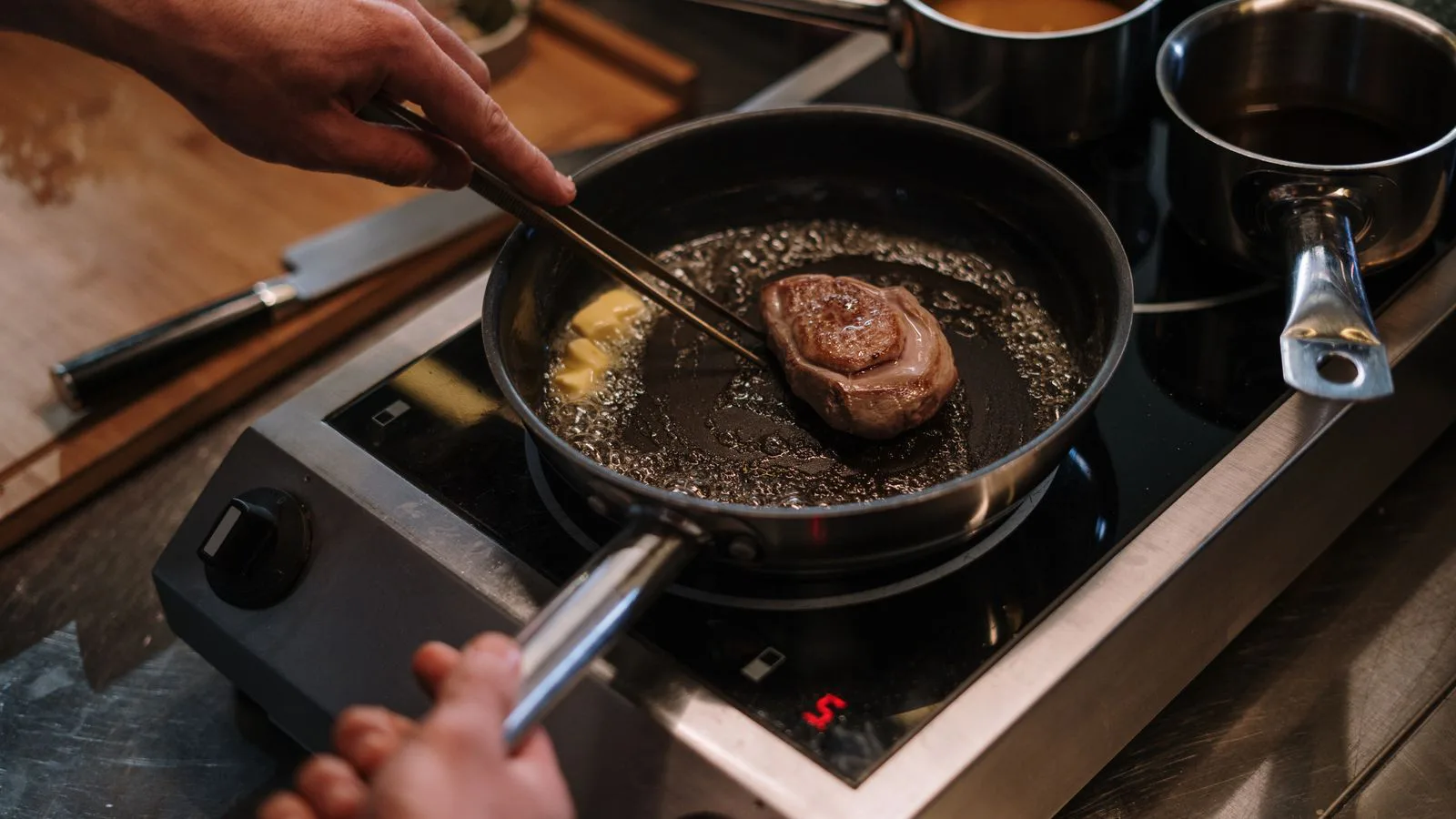
Temperature sets doneness, thickness sets time, and time at temperature is what makes food safe. Those are three different clocks, and most charts print only one of them.
Time comes from thickness, and it is not linear
A 7 oz steak and a 1 lb steak of the same thickness take exactly the same time, because heat travels inwards from both faces and does not care how wide the piece is. Weight-based tables are the single most common error in sous vide writing, imported from oven roasting where the whole surface matters. What you need is a ruler, and ideally a caliper: measure the thickest point, and for a bone-in chop measure beside the bone rather than through it.
The relationship is roughly quadratic, which is where intuition fails. Going from 1 in to 2 in does not double the time, it multiplies it by about 3.5 — 1 hour becomes 3 hours 30. A 3 in roast needs close to 6 hours 40 just to reach its core. Frozen straight from the freezer adds about 50 percent, so a 1 in steak goes from 1 hour to 1 hour 30. All of these are minimums to reach temperature, not recommendations for how long to leave things.
Pasteurisation is time at temperature — and this is where charts mislead
The familiar instruction to cook chicken to 165 °F describes an instantaneous kill, not the only safe outcome. USDA lethality data for poultry gives the equivalent holds at lower temperatures: 68.4 minutes at 136 °F, 27.5 minutes at 140 °F, 9.2 minutes at 145 °F, 2.8 minutes at 150 °F and 47.7 seconds at 155 °F, all measured after the core has already reached that temperature. That is precisely why sous vide chicken at 150 °F is safe and far juicier than a bird pulled from an oven the instant a probe touches 165 °F.
The line that must not be crossed sits at 130 °F. Below it there is no meaningful lethality at all, and the food is simply sitting inside the temperature range where bacteria multiply — the FDA Food Code treats 41 to 135 °F as the danger zone and allows a cumulative four hours in it. So a rare steak at 129 °F and salmon at 122 °F are short cooks, eaten promptly, and they carry the ordinary risk of rare meat and lightly cooked fish. Neither is made safe by the water bath, and for raw-style fish you also want product frozen to the FDA parasite specification: -4 °F for seven days, or -31 °F until solid and then held fifteen hours.
The upper limit: what over-holding actually does
Sous vide is often sold as impossible to overcook, and that is true of temperature and false of texture. Enzymes stay active for hours at these temperatures and keep breaking down muscle protein, so a steak that is perfect at 2 hours turns soft at 4 and unpleasantly mealy somewhere past 6. Fish is far less forgiving: salmon holds its structure for roughly thirty minutes beyond the time it needs and then starts to fall apart on the spatula. Tough cuts full of collagen are the genuine exception, and they improve for many hours.
The other thing the bath cannot do is brown. Nothing below 212 °F produces a Maillard crust, so the sear is a separate operation and the enemy is surface water: pat the piece bone dry, get the pan or torch as hot as you can, and give it 45 to 60 seconds a side. If you want a thicker crust without pushing the interior further, chill the bagged food in ice water for ten minutes before searing — you buy time in the pan without buying doneness.
| Cut and doneness | Bath temperature | Time at 1 in thick | Time at 1.5 in thick | Longest useful hold |
|---|---|---|---|---|
| Beef steak, medium rare | 133 °F | 1 h | 2 h | 4 h |
| Beef steak, medium | 140 °F | 1 h | 2 h | 4 h |
| Pork chop, medium | 145 °F | 1 h | 2 h | 4 h |
| Chicken breast, juicy | 150 °F | 1 h | 2 h | 4 h |
| Chicken thigh, tender | 165 °F | 1 h to core, 2 h for texture | 2 h to core, 3 h for texture | 4 h |
| Salmon fillet, classic | 122 °F — not pasteurised | 1 h | 2 h | 1 h 30 |
Frequently asked questions
- Is chicken at 145 °F really safe?
- Yes, provided it is held there long enough. USDA lethality data gives 9.2 minutes at 145 °F for the same reduction in Salmonella that 165 °F achieves instantly — and in practice a sous vide bath holds the core there for an hour or more, so the margin is large. What is not safe is reaching 145 °F and immediately pulling it, which is what happens in a pan. The safety comes from the hold, not from the number.
- Can I leave a steak in the bath all day and sear it at dinner?
- Not if you cooked it below 130 °F — that is inside the danger zone and the four-hour cumulative limit applies. At 133 °F or above it is microbiologically fine for a long stretch, but the texture is not: past roughly four hours the meat softens noticeably and by eight it is mushy. If you want to cook ahead, run the bag properly, then chill it fast in ice water and refrigerate; reheat in the bath at serving temperature and sear then.
- Does cooking from frozen change the temperature or only the time?
- Only the time. The bath temperature is the destination and it does not move; frozen food simply takes longer to get there — about 50 percent longer, so a 1 in steak goes from 1 hour to 1 hour 30 and a 1.5 in one from 2 hours to 3. Note that the extra time is spent climbing through the danger zone, which is another argument for keeping the whole cook inside the four-hour window when the target is below 130 °F.
Articles you may find interesting
All guides →Related tools
Sources
Spotted a mistake in this article?