Yeast Conversion Chart: Fresh, Active Dry and Instant, With the Actual Factors
Published 7/10/2026 · 7 min read · Everyday calculators

Marco Bianchi — Home, DIY & motoring writer at OneKitly
Renovation · Materials
Checked against 2 sources
Fresh yeast times 0.4 gives active dry yeast, and fresh yeast times 0.33 gives instant yeast. Going the other way, divide: active dry times 2.5 is fresh, instant times about 3.03 is fresh. Active dry to instant is 0.33 ÷ 0.4 = 0.825, and instant to active dry is 1.21 — note that many recipe sites quote 0.75 for that step, which is wrong by about 10 percent. Worked through: a 0.6 oz cake of fresh yeast is 6.8 g of active dry, which is essentially one 1/4 oz packet, or 5.6 g of instant, about 1 3/4 teaspoons. A 1.5 oz European fresh cube is 16.8 g of active dry or 13.9 g of instant. Two practical differences survive the arithmetic: active dry is conventionally dissolved in warm water before it goes into the dough, instant goes straight into the flour; and instant is the strongest by weight, so it is the one you can most easily overdose.
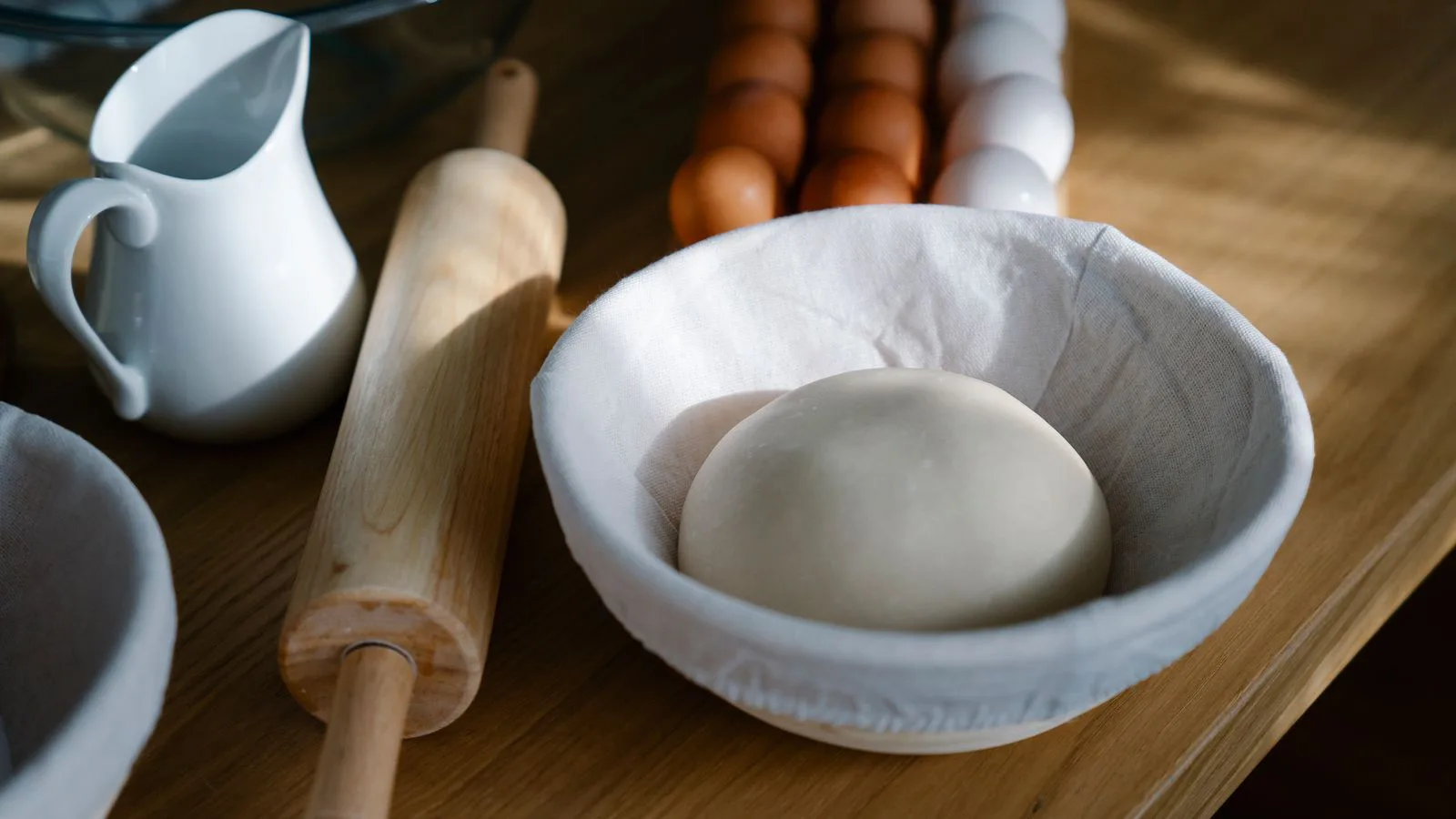
Multiply fresh yeast by 0.4 for active dry and by 0.33 for instant. Those two numbers are the whole chart, they are King Arthur's professional figures, and they are approximate — here is how far, and what else changes when you swap.
The factors are approximate, and the manufacturer beats the chart
0.4 and 0.33 are general guidelines, not physical constants. What they encode is roughly this: fresh yeast is about 70 percent water, so most of what you weigh is moisture, while dry yeasts are around 5 to 8 percent water and correspondingly concentrated. But strains differ, drying processes differ, and the live cell count per gram differs between brands by more than the difference between the two dry types. King Arthur, whose professional reference is where these two numbers come from, says outright that it is best to follow the conversion ratio provided by the manufacturer. If the sachet in your hand prints a ratio, use that one.
The chart also hides a small dough-yield problem that professional bakeries fix and home bakers never notice. When you replace 42 g of fresh yeast with 13.9 g of instant you have removed 28 g of mass from the dough, most of it water. On a single loaf that is nothing. On a 20 kg mix it is enough to change the hydration, and most yeast manufacturers advise making up the weight difference between dry and fresh with additional water. If you are scaling a formula up and the dough suddenly feels tighter than it used to, this is why.
Active dry needs water first; instant does not — and that is the real difference
Active dry yeast is dried in larger granules with a layer of dead cells on the outside, and it must be hydrated in warm water before being incorporated into a dough. Instant yeast is dried faster into finer particles that rehydrate on contact, so it can be mixed straight into the flour. Modern active dry has improved enough that dumping it dry into a well-hydrated dough usually works anyway, but usually is doing a lot of work in that sentence: in a stiff, low-hydration dough such as bagels at 52 percent water, undissolved granules genuinely do underperform.
If you do rehydrate, use water around 105 to 110 °F, take it from the recipe's water rather than adding extra, and keep it away from the salt and the sugar until it has dissolved. Water hotter than about 130 °F starts killing yeast, and ice-cold water is a problem for instant in particular — it is sensitive to ice, so if your dough water is very cold it is better to mix for a minute or two before adding the yeast. The old ritual of watching for foam is not a rehydration step, it is a freshness test, and it is worth doing on any packet that has been open in the fridge for months.
Converting the amount is the easy half; the time is the other half
A converted dose gives you the same gas production only if everything else is equal, and in a home kitchen it never is. Fermentation rate roughly two-and-a-half times for every 18 °F of dough temperature, which means a 5 °F difference between two kitchens moves the rise time more than the difference between a well-converted and a badly converted yeast dose. If your substituted dough is running fast or slow, look at the thermometer before you blame the arithmetic.
The most useful habit here is to stop thinking in grams of yeast and start thinking in percent of flour, because that is the number that transfers between recipes. Twenty grams of fresh yeast means nothing until you know it was on 1 kg of flour, at which point it is 2 percent fresh — or 0.8 percent active dry, or 0.66 percent instant. Written that way, you can drop the dose onto any batch size, and you can compare two recipes from two countries at a glance instead of doing three conversions in your head.
| Fresh yeast | Active dry (× 0.4) | Instant (× 0.33) | Where this amount comes from |
|---|---|---|---|
| 0.35 oz (10 g) | 4 g — 1 1/3 tsp | 3.3 g — 1 tsp | A slow overnight dose, about 2 % of 1 lb of flour |
| 0.7 oz (20 g) | 8 g — 2 2/3 tsp | 6.6 g — 2 1/4 tsp | 2 % of 2 lb of flour — a standard straight dough |
| 1.5 oz (42 g) | 16.8 g — 5 1/2 tsp | 13.9 g — 4 1/2 tsp | One European fresh-yeast cube, the standard retail block |
| 0.6 oz (17 g) | 6.8 g — 2 1/4 tsp, one packet | 5.6 g — 1 3/4 tsp | One US fresh cake — it lands within 3 % of one 1/4 oz packet of active dry |
| 0.75 oz (21.2 g) | 8.5 g — 2 3/4 tsp | 7 g — 2 1/4 tsp, one sachet | Read backwards from one 7 g sachet of instant, the direction most people need |
Worked with our own calculator
Yeast conversion calculator
Given
- Fresh yeast (g)
- 30
Result
- Active dry yeast (g)
- 12
- Instant yeast (g)
- 10
These figures are produced by the calculator below, not typed in by hand — they are recomputed whenever the tool changes.
Run it on your own figures →Frequently asked questions
- Can I use instant yeast in a recipe that calls for active dry, one for one?
- You can, and the dough will simply rise a bit faster, because instant is about 21 percent stronger per gram — the correct factor is 0.825, so 7 g of active dry is 5.8 g of instant. On a loaf with a two-hour rise that difference shows up as maybe fifteen or twenty minutes, which most recipes absorb without complaint. Where it matters is anything proofed on a schedule you cannot move, such as pizza dough timed to a party, or a long cold ferment where a fast start eats the flavour development you were paying for.
- How many grams is a teaspoon of dry yeast?
- About 3 g for a level teaspoon, which is the figure the calculator uses, and the standard 1/4 oz packet holds 2 1/4 teaspoons, or roughly 7 g. Volume measures of yeast are the weakest link in any bread recipe: granule size differs between active dry and instant, and a heaped spoon can carry half again as much as a level one. On a formula where the yeast is 1 percent of the flour, being one gram out on a small loaf is a 20 percent error in the dose. Weigh it if you own a scale that reads to 0.1 g; if you do not, level the spoon carefully and accept a wider window on the rise time.
- Can I substitute sourdough starter for commercial yeast with a factor?
- No, and any chart that offers you one is selling a convenience that does not exist. Commercial yeast is a single selected strain at a known and consistent cell count; a starter is a live culture of wild yeasts and lactic bacteria whose activity depends on how recently it was fed, at what temperature, and at what hydration. The usual working substitution is structural rather than arithmetic: replace the yeast with 20 percent of the flour weight as starter at 100 percent hydration, subtract that starter's flour and water from the main dough, and expect the bulk to take three to four times as long. The bread will also taste different, which is the reason to do it.
Articles you may find interesting
All guides →Related tools
Sources
Spotted a mistake in this article?