The One-Mile Walk Test, and What a VO2max Estimate Assumes
Published 12/30/2025 · 14 min read · Health calculators

The Rockport walk test, published by Kline and colleagues in Medicine & Science in Sports & Exercise in 1987, estimates VO2max from a hard one-mile walk using five inputs: VO2max in mL/kg/min = 132.853 − 0.0769 x weight in pounds − 0.3877 x age in years + 6.315 x sex (1 for male, 0 for female) − 3.2649 x time in minutes − 0.1565 x ending heart rate in beats per minute. Work one person through it: a 45-year-old man of 176 lb who covers the mile in 14 minutes 30 seconds and finishes at 145 bpm. The terms are 132.853 − 13.534 − 17.447 + 6.315 − 47.341 − 22.693 = 38.2 mL/kg/min. Two assumptions decide whether that number means anything. First, it is a regression fitted to a validation sample and the authors reported a standard error of estimate of about 5 mL/kg/min, so the honest reading of 38.2 is a range of roughly 28 to 48. Second, the equation was built on people walking as fast as they could sustain. A stroll produces a meaningless answer: the same man walking the mile in 20 minutes at 100 bpm computes to 27.2, and the difference is his effort, not his fitness.
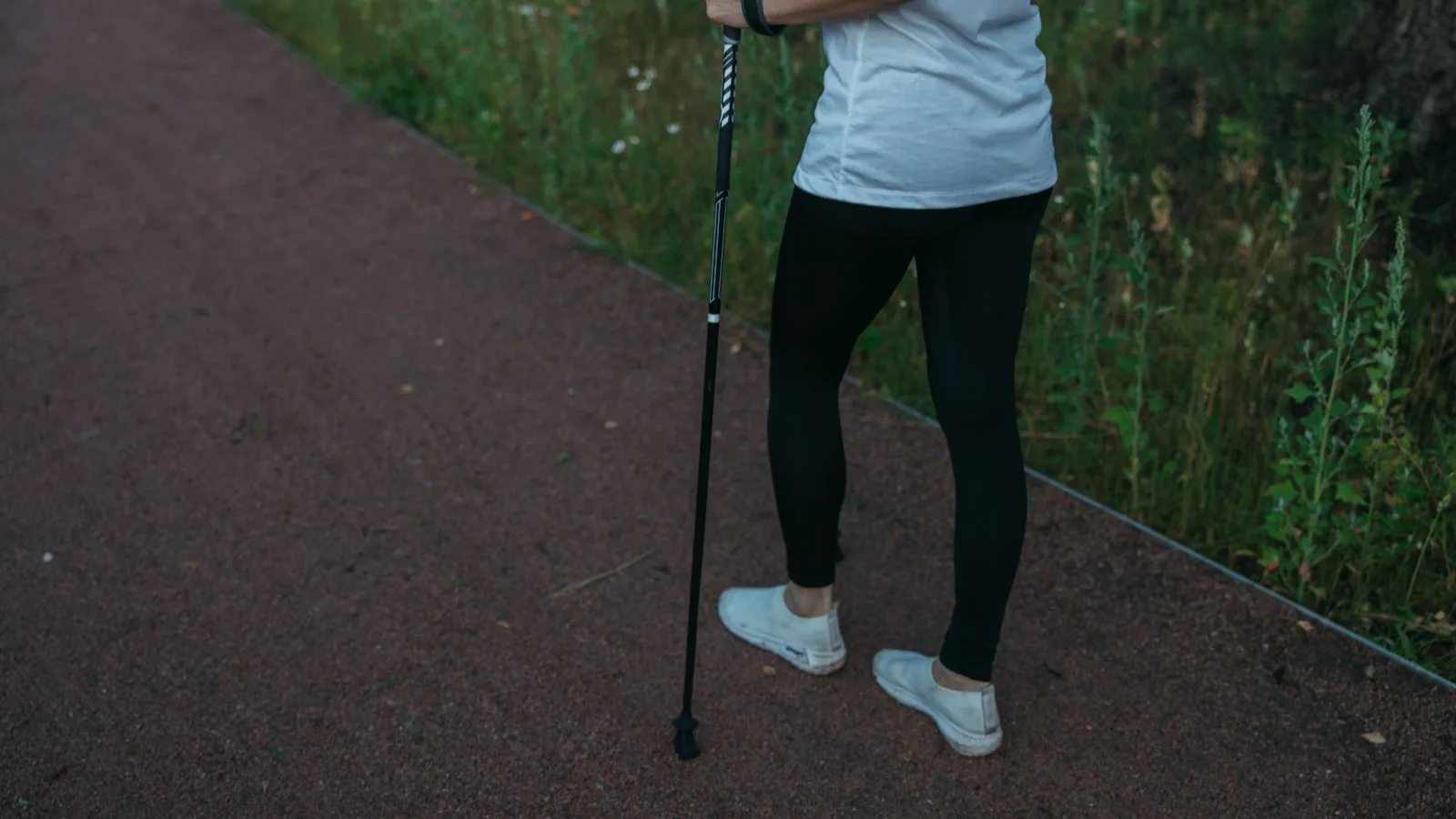
The Rockport test turns a brisk one-mile walk into a VO2max number using five inputs and one published regression. Here is the equation, one person worked through it, and the two assumptions — a stated standard error and a genuinely brisk pace — that decide whether the answer means anything.
The equation, term by term
VO2max in mL/kg/min = 132.853 − 0.0769 x weight in pounds − 0.3877 x age in years + 6.315 x sex (1 for male, 0 for female) − 3.2649 x time in minutes − 0.1565 x ending heart rate. Every term has a physiological reading. The constant is where the line starts. Weight enters negatively because VO2max is expressed per kilogram of body mass, so carrying more mass at the same absolute oxygen uptake gives a lower ratio. Age enters negatively because maximal oxygen uptake declines with age at a fairly predictable population rate. The sex term reflects average differences in haemoglobin mass and lean tissue between men and women in the validation sample, and it is a population average rather than a statement about any individual.
The two terms you supply on the day are time and ending heart rate, and together they carry the information about your fitness. Walking the mile faster means moving more oxygen, so time enters negatively. Finishing at a lower heart rate for the same speed means doing that work at a smaller fraction of your cardiac reserve, so heart rate also enters negatively. That pairing is the engine of the test: it is not measuring how fast you walked, it is measuring how cheaply you walked that fast. Two people finishing in the same time but 30 beats apart are not equally fit, and the equation separates them by 0.1565 x 30 = 4.7 mL/kg/min.
One person, worked through
A 45-year-old man weighing 176 lb walks the mile in 14 minutes 30 seconds — 14.50 minutes as a decimal, which is how the equation wants it — and his heart rate immediately at the finish is 145 bpm. The weight term is 0.0769 x 176 = 13.534. The age term is 0.3877 x 45 = 17.447. The sex term is +6.315. The time term is 3.2649 x 14.50 = 47.341. The heart-rate term is 0.1565 x 145 = 22.693. Assemble: 132.853 − 13.534 − 17.447 + 6.315 − 47.341 − 22.693 = 38.15, which rounds to 38.2 mL/kg/min.
Two details of arithmetic trip people up. The first is the time format: 14 minutes 30 seconds is 14.50, not 14.30, and entering 14.30 changes the estimate by 0.20 x 3.2649 = 0.65 mL/kg/min in the wrong direction. The second is the heart rate: the equation wants the rate at the finish, taken immediately, because it drops fast once you stop. A chest strap or a wrist monitor read within the first few seconds is fine; a manual pulse count started thirty seconds after finishing is not, and will inflate the estimate. Note also what happens to the sex term. Feed exactly the same walk into the equation scored as female and the answer falls by 6.315, from 38.1 to 31.8. That is not a judgement about the walker; it is the term that anchors the regression to the sample it was fitted on.
It is a regression, and it comes with a standard error
Kline and colleagues fitted this equation to several hundred adults aged 30 to 69 whose VO2max had been measured directly, and they reported a standard error of estimate of about 5 mL/kg/min alongside a high correlation with the laboratory value. Both figures matter and only the second usually gets quoted. A high correlation means the equation ranks people well; a standard error of 5 means any individual prediction carries roughly that much scatter around the true value. Two standard errors is about 10, so a point estimate of 38 mL/kg/min corresponds to a plausible range from roughly 28 to 48. That range spans several categories on any published fitness classification.
The practical consequence is that a single result is not a measurement of your fitness, it is one draw from a distribution. Where the test earns its keep is in tracking change in the same person, because much of the error is systematic rather than random — the same walker on the same course with the same watch will carry a similar bias each time, so a difference between two of their own tests is more trustworthy than either absolute number. If the estimate rises from 38 to 42 over three months of training, on the same course and measured the same way, that change is real information. If your estimate is 38 and a friend's is 41, the two are statistically indistinguishable.
Why a stroll produces a meaningless number
Every submaximal test rests on the same physiological assumption: that heart rate and oxygen uptake rise together in a roughly straight line over the working range, so that an observed heart rate at a known workload can be extrapolated towards maximum. That relationship is linear enough to use in the middle of the range and unreliable at the bottom of it, where heart rate is dominated by resting variability, by caffeine, by how recently you stood up, and by how warm you are. Walking slowly puts you exactly there, at a point on the curve the equation was never fitted to.
The arithmetic makes it concrete. Our 45-year-old walker who scored 38.2 mL/kg/min at 14:30 and 145 bpm scores 27.2 if he strolls the same mile in 20:00 at 100 bpm. He has lost 11 points of apparent fitness by walking gently, which is nonsense as a statement about his body and entirely correct as a statement about the equation: it was told he needed 20 minutes to cover a mile, and it believed him. Compare that with what happens when he genuinely pushes harder. One minute faster at 15 bpm higher nets only +0.92, because the time gain of 3.26 is mostly cancelled by the heart-rate cost of 2.35. That near-cancellation is the test working properly, and it is the signature of a valid effort.
So the protocol is not a suggestion. Walk as fast as you can sustain for the full mile without breaking into a run, keep the pace even rather than sprinting the last lap, take the heart rate at the finish, and do not sit down first. If your ending heart rate is barely above where it sits when you climb a flight of stairs, you have not produced a usable data point and the honest response is to repeat the test rather than record the number.
One mile, on a metric track
The test is imperial by construction. Its coefficients were fitted to a one-mile walk and a weight in pounds, so the distance is not a round number anywhere outside the United States and the United Kingdom: one mile is 1,609.344 metres. There are three honest ways to handle that. Measure 1,609 m with a GPS watch or a mapped route. Walk five laps of a 300 m track plus 109 m. Or accept the small error of four laps of a standard 400 m track, which is 1,600 m — 9.34 m short, or 0.581% of the distance.
Quantify that last option before worrying about it. At the pace in our worked example, 0.581% of 14.50 minutes is 5.1 seconds, and 5.1 seconds is 0.0842 minutes, which through the time coefficient is 0.0842 x 3.2649 = 0.28 mL/kg/min. Against a standard error of 5, that is noise. Four laps of a 400 m track is a perfectly acceptable substitute, provided you do it the same way every time — which is the general rule for this test. Consistency of course, footwear, weather and time of day matters far more to a comparison between your own results than the last nine metres of the distance.
Where it sits against a laboratory test and against the Cooper run
A laboratory VO2max test measures expired gas while the workload rises to exhaustion, so it observes oxygen uptake directly rather than inferring it. It is the reference standard, and it costs a graded exercise protocol, a metabolic cart and supervision. The Rockport test infers the same quantity from five easily obtained numbers, and it buys that convenience with a standard error of about 5 mL/kg/min. The trade is reasonable for its purpose: monitoring an individual's fitness over time, or screening a group, at close to zero cost and with far less risk than a maximal protocol.
The Cooper 12-minute run sits in between. Cooper published it in JAMA in 1968, and its arithmetic is even simpler: VO2max = (distance covered in metres − 504.9) ÷ 44.73, so 2,400 m gives 42.4 mL/kg/min. Because it is maximal rather than submaximal, it does not need a heart rate at all, and it does not depend on the assumption of a linear heart-rate relationship — but it demands an all-out effort, which is exactly what makes it unsuitable for anyone untrained, older, or with a cardiac, respiratory or joint condition. The walk test exists so that those people can be assessed at all. Choose on that basis: Cooper if you already run and are healthy, Rockport if you are being assessed rather than competing.
| Change | New estimate | Shift | What it tells you |
|---|---|---|---|
| One minute faster (13:30) | 41.4 | +3.26 | Exactly the time coefficient, 3.2649 |
| One minute slower (15:30) | 34.9 | −3.26 | Symmetric: the model is linear in time |
| Ten beats lower (135 bpm) | 39.7 | +1.57 | Ten times the heart-rate coefficient, 0.1565 |
| Ten beats higher (155 bpm) | 36.6 | −1.57 | A measurement error here costs half of a minute's error |
| One minute faster but 15 bpm higher | 39.1 | +0.92 | Pushing harder mostly cancels itself — as it should |
| A stroll: 20:00 at 100 bpm | 27.2 | −10.9 | Outside the protocol; the number measures effort, not fitness |
Frequently asked questions
- How accurate is the one-mile walk test?
- Accurate enough to track your own change and not accurate enough to compare you with someone else. Kline and colleagues reported a standard error of estimate of about 5 mL/kg/min alongside a high correlation with directly measured VO2max, and those two facts pull in different directions: the correlation says the equation ranks people well, the standard error says any single prediction has that much scatter. Two standard errors around a point estimate of 38 gives a plausible range of roughly 28 to 48. Because much of the error is systematic — your own course, watch and walking style bias every attempt the same way — a difference between two of your own tests carries far more information than either number on its own. So use it as a repeatable benchmark, and repeat it the same way each time.
- Can I run instead of walking?
- Not and still use this equation. The coefficients were fitted to walking, and walking and running have different mechanical efficiencies at the same speed, so a running time fed into a walking regression does not describe the same physiology. If you run the mile, the sensible move is to use a test designed for running — the Cooper 12-minute run, for instance, whose formula is VO2max = (metres covered − 504.9) ÷ 44.73, giving 42.4 mL/kg/min for 2,400 m. Note the trade-off, though: Cooper's test is maximal, and a maximal effort is exactly what the walk test was designed to avoid. If you are being assessed rather than competing, or you have any cardiac, respiratory or joint condition, the walk is the appropriate choice and running it defeats the purpose.
- Why does the equation ask for my sex?
- Because the regression was fitted on a sample of men and women, and the sex term absorbs the average difference between them that the other four variables do not explain — chiefly differences in haemoglobin mass and lean tissue that affect oxygen transport at a given body weight. Its size in this equation is 6.315 mL/kg/min, so scoring an identical walk as female rather than male drops the estimate from 38.1 to 31.8. That is a statement about a 1980s validation sample, not about the person walking, and it is one of the clearest reminders that this is a population regression. If your body composition is far from the average for your recorded sex, the term will fit you less well, and that is one more reason to use the test to track your own trajectory rather than to place yourself in a table.
- What is a good VO2max?
- The question has no single answer, because published classifications are always split by age and sex and vary between reference sets. A more useful frame is the direction of travel. Cardiorespiratory fitness declines with age in most people, so holding an estimate steady over five years is itself an achievement, and the American Heart Association has argued for treating cardiorespiratory fitness as a clinical vital sign precisely because it predicts outcomes across the range rather than only at the top of it. The largest health gains from raising fitness are concentrated at the low end, which means the person with the most to win from training is the one whose current number looks worst. Rather than hunting for a target figure, compare your estimate with your own last one, and take the trend to a clinician if it is falling without an obvious explanation.
- Do I need a heart rate monitor?
- Effectively yes, because the heart rate has to be captured at the finish and it falls quickly once you stop. A chest strap is the most reliable option; a wrist device is acceptable if you read it in the first few seconds and it has been tracking steadily during the walk. Counting a pulse by hand is workable only if you start counting immediately and use a short window, and even then it is the weakest link in the measurement. Quantify what a mistake costs: the heart-rate coefficient is 0.1565, so an error of 10 bpm shifts the estimate by 1.57 mL/kg/min and an error of 20 bpm by 3.13. That is smaller than the equation's own standard error of about 5, so an imperfect heart rate does not ruin the test — but a heart rate taken a minute after finishing, by which point it may have fallen 20 or 30 beats, will inflate your result systematically every time.
Articles you may find interesting
All guides →Related tools
A one-mile walk test is a fitness estimate, not a heart test, and it cannot detect or rule out heart disease. If you have been inactive, are over 40, or have any heart, lung, joint or blood pressure condition, ask a doctor before doing a brisk timed walk — and stop immediately if you get chest pain, unusual breathlessness or dizziness. The result is a statistical estimate with a wide margin of error and should never be read as a diagnosis.
Sources
- Medicine & Science in Sports & Exercise (Kline GM et al., 1987) — Estimation of VO2max from a one-mile track walk, gender, age, and body weight
- American College of Sports Medicine — ACSM's Guidelines for Exercise Testing and Prescription
- JAMA (Cooper KH, 1968) — A means of assessing maximal oxygen intake: correlation between field and treadmill testing
- American Heart Association (Ross R et al., Circulation, 2016) — Importance of assessing cardiorespiratory fitness in clinical practice: a case for fitness as a clinical vital sign
- World Health Organization — Global recommendations on physical activity for health
Spotted a mistake in this article?