Electric or Petrol: From How Many Miles a Year Does It Pay Off?
Published 8/3/2026 · 15 min read · Car calculators

Marco Bianchi — Home, DIY & motoring writer at OneKitly
Renovation · Materials
Checked against 4 sources
For every 1,000 euros of extra purchase price, an electric car has to cover about 8,500 miles in Portugal, 8,700 in France, 9,000 in Spain, 9,700 in Italy and 12,700 in Germany before the fuel saving pays it back — that is roughly 13,700 to 20,500 kilometres. On a 6,000-euro premium at 9,300 miles a year (15,000 kilometres), break-even lands at about five and a half years in Portugal, France and Spain, six and a quarter in Italy and eight and a fifth in Germany. The inputs: household electricity including all taxes in the second half of 2025 (Eurostat, published 5 May 2026), from 0.2435 euros per kWh in Portugal to 0.3869 in Germany; petrol at the EU weighted average of 1.911 euros a litre in the week to 10 August 2026 (European Commission Weekly Oil Bulletin); 17 kWh per 100 kilometres at the plug and 6.0 litres per 100 kilometres, both stated assumptions you should replace with your own. Now the correction to the way this question is usually asked. The local electricity price matters, but it is not the biggest lever. Ranked by how far each one moves the break-even: charging away from home dominates — paying twice the domestic rate multiplies the French break-even by 2.6 — then the purchase premium, which scales it exactly proportionally, and only then the country, which spans a factor of 1.5 from Portugal to Germany. And there is a hard ceiling that ends the argument: at these assumptions an electricity price of 0.674 euros per kWh wipes out the saving completely, and public rapid-charging tariffs are not far from it.
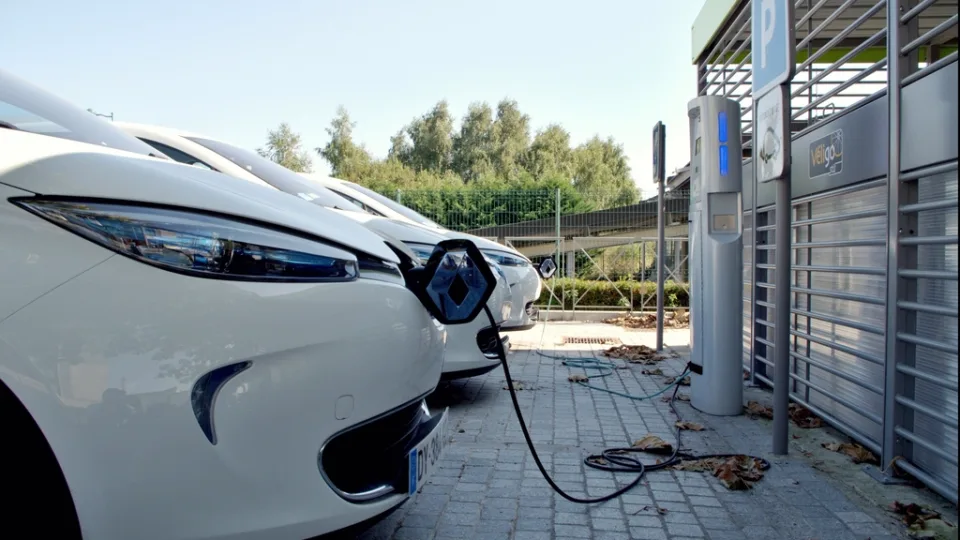
The break-even is a division, and the number underneath it moves more with where you charge than with which country you live in. Electricity and fuel prices from 2025 and 2026, the arithmetic in full, and the point at which an electric car stops saving anything at all.
The break-even is one division, and both terms are yours to fill in
Strip the argument down and the whole question is: how far do you have to drive before a smaller running cost has repaid a larger purchase price. Break-even distance equals the extra you paid for the electric car, divided by what you save per mile. That is the entire model. Its virtue is that both terms are things you can look up rather than opinions: the premium is the difference between two quotes on your desk, and the saving per mile is a subtraction between two prices you already pay. Its vice is that people quote the answer without ever stating either term, which is why the same question gets answered with wildly different numbers by people who are all, in their own inputs, correct.
One consequence of the shape is worth stating before any number appears, because it settles an argument people have without noticing. The premium sits in the numerator, so it scales the answer exactly proportionally: double the price gap and the break-even doubles, no more and no less. The electricity price sits inside the denominator, in a subtraction, so it moves the answer non-proportionally and can in principle destroy it entirely — if electricity gets expensive enough the denominator reaches zero and there is no distance at which the car pays for itself. That asymmetry is the reason the honest headline is not the price of the car and not the country, but the price of the energy going into the battery.
What a hundred kilometres costs on each side, at 2025 and 2026 prices
The petrol side first, because it is the same everywhere in this comparison. The European Commission's Weekly Oil Bulletin put the EU weighted average for Euro-super 95 at 1.911 euros a litre in the week to 10 August 2026. At 6.0 litres per 100 kilometres — about 39 miles per US gallon, and a fair figure for a compact petrol car in mixed use — a hundred kilometres costs 11.46 euros, or 0.1146 euros a kilometre. Your own pump price will differ: the same bulletin showed a spread of well over twenty cents a litre between member states in that week, so substitute the price you actually pay before drawing any conclusion from what follows.
The electric side is where the countries separate. Eurostat's household electricity prices for the second half of 2025, published on 5 May 2026, for the medium consumption band of 2,500 to 4,999 kWh a year and including every tax and levy, run from 0.2435 euros per kWh in Portugal and 0.2561 in France through 0.2669 in Spain and 0.2966 in Italy to 0.3869 in Germany, against an EU average of 0.2896. At 17 kWh per 100 kilometres measured at the plug — that is the figure that matters, because charging losses are real and you pay for them — a hundred kilometres costs 4.14 euros in Portugal, 4.35 in France, 4.54 in Spain, 5.04 in Italy and 6.58 in Germany. Subtract from the petrol side and the saving per kilometre is 7.33 cents in Portugal, 7.11 in France, 6.93 in Spain, 6.42 in Italy and 4.89 in Germany.
The country moves the answer by half; where you charge moves it by more
Divide 1,000 euros of purchase premium by each of those savings and you get the country ranking in a form that transfers to any price gap. Portugal: about 13,650 kilometres, or 8,480 miles, per 1,000 euros. France 14,060 kilometres. Spain 14,440. Italy 15,570. Germany 20,460. Multiply by your own premium and you have your answer: a 6,000-euro gap needs about 82,000 kilometres in Portugal and about 123,000 in Germany. Note what happened to the spread. Germany's domestic electricity costs 1.59 times what Portugal's does, but the break-even distance is only 1.50 times as long, because the petrol side of the subtraction did not move. Differences in the electricity price are always damped on their way into the answer.
Now change one thing that is not the country. Stay in France, at 0.2561 euros per kWh at home, and charge instead at a public point priced at twice the domestic rate. The cost per hundred kilometres goes from 4.35 euros to 8.71, the saving per kilometre collapses from 7.11 cents to 2.76, and the break-even distance per 1,000 euros of premium jumps from about 14,060 kilometres to about 36,275 — a factor of 2.6 from a single choice about where the cable goes in, against a factor of 1.5 for the entire distance from Lisbon to Berlin. Push further and the sum stops working at all: at these consumption assumptions the electric car saves nothing whatsoever once electricity reaches 0.674 euros per kWh, which is a tariff you can meet at a motorway rapid charger without trying hard. Anyone who cannot charge at home is not looking at a longer payback; they are frequently looking at no payback at all.
The petrol side is not fixed either
The break-even is a ratio between two moving prices, and pretending one of them is a constant is how these comparisons age badly. Hold the French domestic electricity price and move the pump price instead: at 1.60 euros a litre the saving falls to 5.25 cents a kilometre and the break-even stretches to about 19,060 kilometres per 1,000 euros of premium; at 2.05 euros a litre it tightens to about 12,580. That is a swing of a third and a half in either direction from a fuel price that has moved by more than that inside a single year. Anyone quoting a payback period without stating the fuel price they assumed is quoting a number with no shelf life.
There is one more asymmetry worth noticing, because it cuts against the electric car in a way the headline numbers hide. The petrol price at the pump is roughly half tax across most of the Union, and the electricity price used above already includes taxes and levies too — Eurostat put those at 28.9 % of the EU household bill in the second half of 2025. Both sides are therefore exposed to fiscal decisions rather than to physics, and the two are not moving in the same direction: fuel duty is a shrinking base that member states will have to replace, while grid levies on electricity are rising to pay for network investment. Nothing in this arithmetic is protected against a change in either, and a five-year payback is long enough for both to happen.
What this sum leaves out, and which way each omission points
Three omissions point in the electric car's favour and are worth adding to your own version. Maintenance is genuinely lower: no oil changes, no cambelt, no clutch, and brake pads that last far longer because regenerative braking does most of the work. Purchase incentives, where they still exist, come straight off the numerator and therefore off the break-even proportionally — a grant worth a third of the premium cuts the break-even by a third. And local costs that are waived or reduced for zero-emission vehicles, from registration tax to city access charges and parking, are recurring savings that this per-kilometre model never sees. All three are national or municipal, change often, and are exactly the sort of figure that should be read at the source on the day you decide rather than taken from any article.
Two omissions point the other way and are larger than most people allow. The first is the residual value, which for the electric car is the least predictable number in the whole exercise: the technology is moving, battery health is the buyer's main worry on the used market, and a five-year-old electric car is being priced against a new one with more range for less money. If the electric car depreciates faster than the petrol one, that difference belongs in the numerator alongside the purchase premium, and it can easily be larger than the fuel saving being counted. The second is the cost of the home charge point itself, which is a real capital outlay for the person who has somewhere to put one — and an absolute barrier for the person who does not, which brings us back to the finding that dominates everything else in this article.
The decision rule, in three lines
First, answer the charging question before anything else, because it decides whether the rest of the calculation is worth doing. If you can charge at home or at work on a domestic-priced tariff, continue. If your charging will be mostly public and rapid, the saving per kilometre is small enough that the electric case has to be made on grounds other than money, and it may be a good case — quieter, cleaner locally, cheaper to service — but it is not the arithmetic in this article. Second, take your own three numbers: the price gap between the two cars you are actually choosing between, your electricity tariff per kWh, and your fuel price per litre. Third, divide, and compare the answer with the distance you truly drive.
One last discipline, and it is the one that saves people the most money in this comparison: use your own odometer, not your impression. A household that believes it drives 20,000 kilometres a year and actually drives 11,000 is not making a small error, it is making one that nearly doubles the payback period, and it is the single most common mistake in this whole exercise. Two readings taken a year apart settle it in ten seconds. If the honest number puts break-even beyond the time you expect to keep the car, that is a complete answer — and it says nothing about whether electric cars are good, only about whether this one, at this price, on your mileage, pays for itself.
| Criterion | Portugal | France | Spain | Italy | Germany |
|---|---|---|---|---|---|
| Household electricity, all taxes, 2nd half of 2025 | 0.2435 per kWh | 0.2561 per kWh | 0.2669 per kWh | 0.2966 per kWh | 0.3869 per kWh |
| Electricity for 100 kilometres at 17 kWh | 4.14 | 4.35 | 4.54 | 5.04 | 6.58 |
| Saving per kilometre against petrol at 11.46 for 100 kilometres | 7.33 cents | 7.11 cents | 6.93 cents | 6.42 cents | 4.89 cents |
| Distance to recover each 1,000 euros of purchase premium | about 8,480 miles | about 8,740 miles | about 8,970 miles | about 9,680 miles | about 12,715 miles |
| Years to break even on a 6,000-euro premium at 9,300 miles a year | about 5.5 | about 5.6 | about 5.8 | about 6.2 | about 8.2 |
| Electricity price at which the saving disappears entirely | 0.674 per kWh — 2.8 times the domestic price | 0.674 per kWh — 2.6 times the domestic price | 0.674 per kWh — 2.5 times the domestic price | 0.674 per kWh — 2.3 times the domestic price | 0.674 per kWh — only 1.7 times the domestic price |
Worked with our own calculator
EV charging cost calculator
Given
- Distance (km)
- 300
- Consumption (kWh/100 km)
- 17
- Price per kWh
- $0.22
Result
- Charging cost
- $11.22
These figures are produced by the calculator below, not typed in by hand — they are recomputed whenever the tool changes.
Run it on your own figures →On this site
Frequently asked questions
- Does the answer really depend on the electricity price more than on the price of the car?
- Not as a general statement, and the precise version is more useful. The purchase premium scales the break-even exactly proportionally: double it and the break-even doubles. The electricity price acts inside a subtraction, so its effect is amplified — the whole range of national household prices in this article, a factor of 1.59 from Portugal to Germany, moves the break-even by a factor of 1.50, which is less than proportional. What genuinely outweighs the car price is the choice between charging at a domestic tariff and charging on a public rapid network, which in France multiplies the break-even by 2.6 and can push it to infinity. So the ranking is: charging location first, purchase premium second, country third.
- I cannot charge at home. Is that the end of it?
- For the money argument, usually yes. At a public price of twice the domestic rate the French break-even per 1,000 euros of premium goes from about 14,060 kilometres to about 36,275, and at 0.674 euros per kWh — well within the range of motorway rapid charging — the saving reaches zero and no distance repays anything. There are partial escapes worth checking: charging at work, a slow public point on a domestic-style tariff, a subscription that cuts the per-kWh price, or a night tariff on a home point you could still install elsewhere. But if your realistic pattern is rapid public charging most of the time, decide on other grounds, because the fuel saving that carries this whole calculation is not there.
- Does a cheap night tariff change the picture?
- Substantially, and in the one direction that matters. The prices used here are national averages across a whole consumption band and a whole half-year; an off-peak rate can sit well below them, and because the electricity price sits inside the subtraction, a lower rate widens the saving more than proportionally. Work it through with your own two-rate tariff rather than the average: take the off-peak price per kWh, multiply by your consumption per 100 kilometres, subtract from the petrol cost per 100 kilometres, and divide the premium by the result. The reason this matters more for an electric car than for anything else in the house is timing — charging is the one large load you can schedule completely, so the whole of it can sit in the cheap hours.
- Should the second-hand value be in this calculation?
- Yes, and it belongs in the numerator rather than as a separate afterthought. What you are really recovering through fuel savings is not the sticker premium but the premium net of any difference in resale value, so the correct numerator is the price gap today minus the price gap when you sell. If the electric car holds its value equally well, nothing changes. If it depreciates faster — which is the risk while battery technology and charging networks are both moving — the effective premium is larger than the sticker gap and every break-even figure in this article rises with it. If it holds value better, the reverse. Since nobody can supply that number honestly for five years out, the sane approach is to run the sum twice, once with no residual difference and once with a pessimistic one, and see whether the decision survives both.
- Do purchase incentives change the break-even a lot?
- Exactly proportionally, which makes them the easiest variable in the whole model to reason about. An incentive reduces the numerator, so it reduces the break-even by the same percentage: cut a 6,000-euro premium to 4,000 euros and every distance in this article falls by a third. That is why incentives are effective and why their withdrawal moves the market so sharply. The caution is that they are national or regional, revised frequently, often conditional on income, on the price of the vehicle or on scrapping an older one, and sometimes exhausted before the year ends. Read the current rules at the administration that runs the scheme on the day you buy, not from a table in an article — including this one.
Articles you may find interesting
All guides →Related tools
This is a general explanation of how a calculation works, not financial, tax or investment advice. Every rate, ceiling and threshold is given with the year it applies to and the instrument that sets it, because these numbers are revised — some every year, some in the middle of one. Worked examples use stated assumptions that will not match your own quote, your own contract or your own tax position, and past returns are not a promise of future ones. Check any figure against the source cited, and take advice from a qualified professional before committing money.
Sources
- Eurostat — Electricity prices for household consumers, dataset nrg_pc_204, band 2 500-4 999 kWh, all taxes and levies included, second half of 2025 — the per-country prices used throughout this article
- Eurostat — EU household electricity prices stable in 2025 (published 5 May 2026) — EU average of 0.2896 euro per kWh in the second half of 2025 and taxes and levies at 28.9 % of the bill
- European Commission — Weekly Oil Bulletin — consumer prices for petroleum products in EU countries; the week to 10 August 2026 put the EU weighted average for Euro-super 95 at 1 910.69 per 1 000 litres, taxes included
- Eurostat — Electricity price statistics — methodology of the consumption bands and the tax components, and the half-yearly reference periods
Spotted a mistake in this article?