Gear Ratios, and Why Your Speedometer Lies After New Tyres
Published 7/14/2026 · 15 min read · Car calculators

Marco Bianchi — Home, DIY & motoring writer at OneKitly
Renovation · Materials
Checked against 4 sources
The whole drivetrain is one multiplication. Engine rpm is divided by the gearbox ratio, divided again by the final drive, and what comes out is wheel revolutions per minute; multiply that by the tyre's rolling circumference and you have road speed. Written once: speed = rpm ÷ (gear × final drive) × circumference. On a six-speed with a 0.646 top gear, a 4.056 final drive and a 205/55 R16 tyre, sixth gear is an overall 2.620:1 and gives 28.25 mph per 1,000 rpm, so 70 mph is 2,478 rpm. The speedometer taps into this chain before the tyre, counting revolutions of the gearbox output or the wheel and multiplying by the circumference the manufacturer assumed. Fit a tyre with a different circumference and the assumption is wrong by exactly the circumference ratio. Derive the diameter from the code itself: sidewall height is width × aspect ÷ 100, so 205/55 R16 is 406.4 + 2 × 112.75 = 631.9 mm, while 225/45 R17 is 431.8 + 2 × 101.25 = 634.3 mm — only 0.38% larger, because plus-sizing is designed to be neutral. A 215/65 R16 is 685.9 mm, 8.55% larger, and an indicated 60 mph is then a true 65.1 mph. In Europe that direction is illegal: a speedometer may over-read but never under-read.
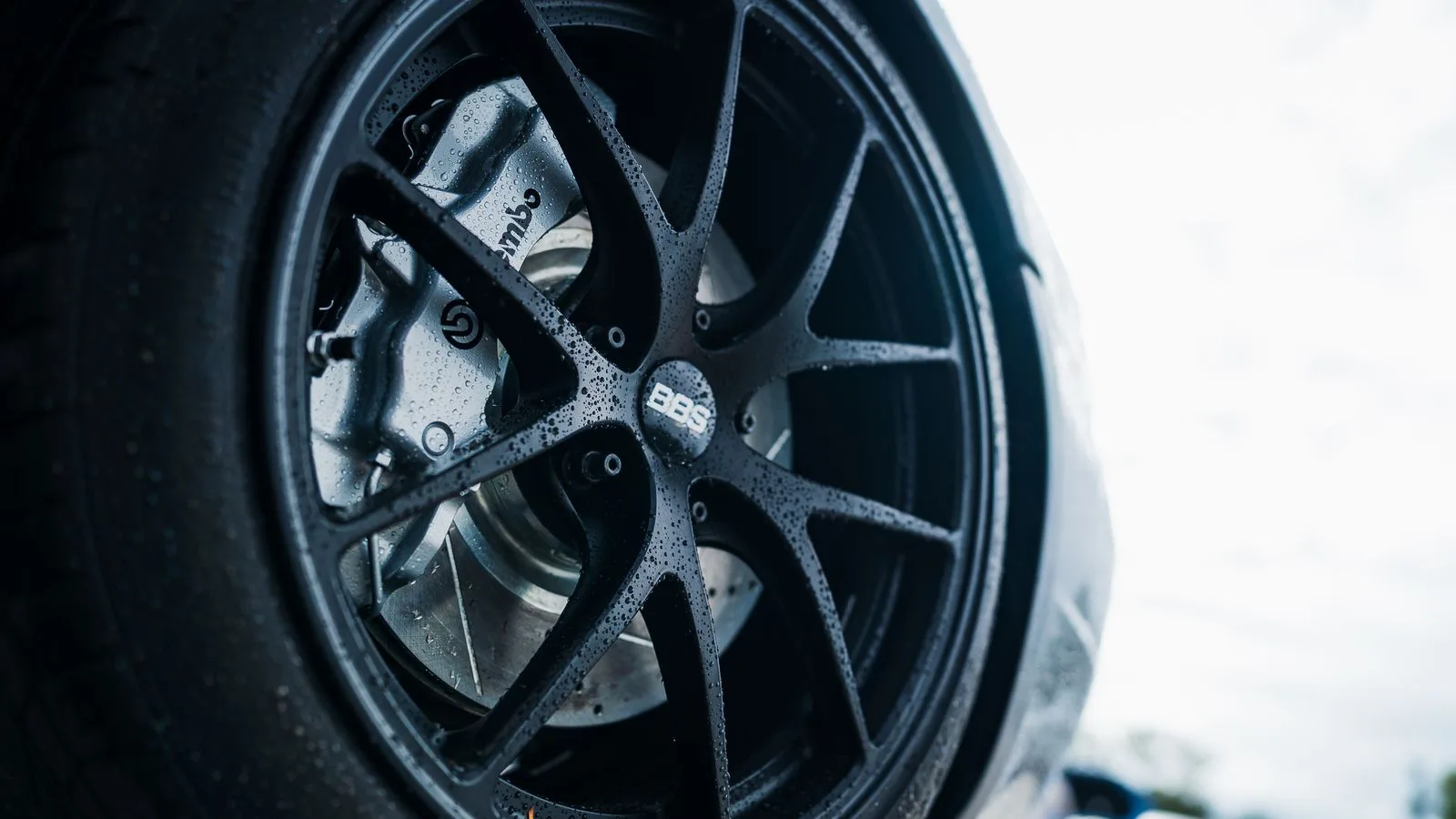
Engine rpm reaches the road through one unbroken multiplication chain, and the last link is the tyre. Change the tyre's rolling circumference and the speedometer goes wrong by exactly that percentage — in a direction the law cares about.
The drivetrain is one long multiplication
Between the crankshaft and the tarmac there is nothing but ratios. The gearbox turns its output shaft slower than its input by the ratio of the gear you have selected. The final drive slows it again by the axle ratio. The wheel then turns at that reduced speed, and each of its revolutions carries the car forward by one rolling circumference. Multiply the reductions together and you get the overall ratio; divide engine rpm by it and multiply by circumference, and the answer is road speed. There is no other physics in the chain, and every drivetrain question — top speed, cruising rpm, why first gear feels violent — is answered by rearranging that one line.
Keep the units honest and the calculation never goes wrong. Tyres are sized in millimetres the world over, so convert the circumference to feet once and stay there. Then rpm ÷ (gear × final) gives wheel revolutions per minute, multiplying by circumference gives feet per minute, multiplying by 60 gives feet per hour, and dividing by 5,280 gives miles per hour. Collapse the constants and you get the form that is actually useful for comparing gears: mph per 1,000 rpm = 11.364 × circumference in feet ÷ (gear × final drive), where 11.364 is simply 60,000 ÷ 5,280. This number, one per gear, is a complete description of the gearbox. Everything else is division.
One six-speed, worked from first to sixth
Take a typical front-wheel-drive six-speed: 3.545, 1.955, 1.281, 0.973, 0.778 and 0.646, behind a 4.056 final drive, on 205/55 R16 tyres whose circumference we derive below as 1,985 mm, which is 6.513 ft. Multiply each gear by the final drive and you get the overall ratios: 14.379, 7.929, 5.196, 3.946, 3.156 and 2.620 to one. Divide 11.364 × 6.513 = 74.01 by each of those and you get the speed per 1,000 rpm: 5.15, 9.33, 14.25, 18.75, 23.45 and 28.25 mph. That single column tells you everything the gearbox does. Sixth gear turns the engine 2.62 times for every turn of the wheel; first gear turns it 14.38 times.
Read it forwards to size a cruise. At 70 mph in sixth the engine is turning 70 ÷ 28.25 × 1,000 = 2,478 rpm. Read it backwards to size an acceleration: 3,000 rpm gives 15.4 mph in first, 28.0 in second, 42.7 in third, 56.3 in fourth, 70.4 in fifth and 84.7 in sixth. The steps between gears shrink as you go up — first to second is a 1.81 factor, fifth to sixth only 1.20 — because a wide bottom gear is needed to get the car moving while the top gears only have to keep it moving against drag.
The same ratio that divides speed multiplies torque, which is why first gear feels the way it does. Feed 200 lb-ft of engine torque through an overall 14.379:1 and the wheels see 2,876 lb-ft, minus transmission losses. Divide by the rolling radius of 1.0366 ft and that is 2,774 lbf of tractive force. On a 3,100 lb car that is 0.895 g of acceleration — more than dry tyres can hold. This is not a spreadsheet curiosity: it is the reason a firm launch spins the wheels in first and cannot in third. In first gear the limit is the tyre, and adding engine torque does nothing at all.
Getting the circumference out of the size code
A tyre code such as 205/55 R16 is three measurements, and two of them are not in the units they look like. The 205 is the section width in millimetres. The 55 is the aspect ratio: the sidewall height as a percentage of that width, so the sidewall is 205 × 55 ÷ 100 = 112.75 mm. The 16 is the rim diameter in inches, which is 16 × 25.4 = 406.4 mm. The tyre has a sidewall above the rim and another below it, so the overall diameter is 406.4 + 2 × 112.75 = 631.9 mm, and the circumference is π × 631.9 = 1,985 mm. Note carefully what this means: the same aspect number on a wider tyre gives a taller sidewall, which is why 225/55 R16 is 22 mm bigger in diameter than 205/55 R16 despite sharing both the 55 and the 16.
One honest caveat about that circumference. π × diameter is the geometric value of an unloaded tyre; a tyre carrying a car deflects, so the distance it actually covers per revolution — the rolling circumference tyre makers publish — is typically two or three per cent less. That matters if you want an absolute answer in metres per revolution. It matters much less than people expect for everything in this article, because every comparison here is a ratio of two circumferences, and if both tyres deflect by a similar percentage the ratio is unchanged. Work with geometry to compare sizes; use the manufacturer's published rolling circumference if you need the absolute figure for a speedometer calibration.
Two size codes, compared properly
Run the derivation on the pair people actually ask about, 205/55 R16 against 225/45 R17. The first is 406.4 + 2 × 112.75 = 631.9 mm. The second has a 225 × 45 ÷ 100 = 101.25 mm sidewall on a 431.8 mm rim, giving 431.8 + 2 × 101.25 = 634.3 mm. The difference is 2.4 mm, or 0.38%. That looks like an anticlimax until you see why: this is a plus-size pairing, and plus-sizing exists precisely to hold overall diameter constant while moving metal from the sidewall to the rim. The tyre looks completely different, the ride is firmer, the steering is sharper — and the speedometer barely notices. An indicated 60 mph becomes a true 60.2 mph.
The error only becomes real when the swap is not designed. Keep the 16-inch rim and go from 205/55 to 225/55 and the diameter climbs to 653.9 mm, up 3.48%, so an indicated 60 mph is really 62.1 mph. Go further to 215/65 R16 — a very ordinary-looking code, and a size that will physically mount — and the diameter is 685.9 mm, up 8.55%. An indicated 60 mph is then a true 65.1 mph, and an indicated 30 mph in a school zone is a real 32.6 mph. The change works in both directions: a 205/45 R16 is 590.9 mm, down 6.49%, and an indicated 60 mph is only 56.1 mph. That direction is safer legally and worse practically, because you are being told you are going faster than you are.
The odometer moves with the speedometer and by a slightly different number, which trips people up. If circumference rises 8.55%, the recorded distance is divided by 1.0855, so it falls by 7.87% rather than 8.55% — percentage increases and decreases are not symmetric. Over a true 1,000 miles the odometer records 921, a shortfall of 79 miles. Every distance-derived figure inherits the same error: computed fuel economy comes out 7.87% low, so the car looks thirstier than it is, and service intervals arrive late in real distance terms.
Why the speedometer is wrong, and in which direction
A speedometer does not measure speed. It measures a rotation rate — of the gearbox output shaft on older cars, of the wheel hubs via the ABS sensors on modern ones — and converts it to a speed using one number the manufacturer wrote into the instrument when the car was designed: the rolling circumference of the tyre size the car left the factory on. Change the tyre and you have changed the truth without telling the instrument. Every revolution now covers more ground than the instrument believes, so the reading is low by exactly the circumference ratio. The relationship is not approximate and it is not affected by anything else in the drivetrain — gear ratios, final drive, transmission type all cancel, because the speedometer is downstream of them and upstream of the tyre.
There is a second source of error that is deliberate and much larger than most drivers realise, and it runs the other way. Manufacturers set the instrument to read high on purpose, typically by three to six per cent, so that tyre wear, tyre-pressure variation and manufacturing tolerance can never push a car into under-reading. That factory optimism is a budget you can spend. If your speedometer over-reads by 5% and you fit a tyre 5% larger in circumference, the two cancel and the instrument becomes almost exactly truthful — which sounds appealing and is in fact the point at which you have used up the entire legal margin.
The legal asymmetry: over-reading is allowed, under-reading never is
Across most of Europe, speedometer accuracy is governed by UNECE Regulation No. 39, and the rule is written as a one-sided band. The indicated speed may never be lower than the true speed, and it may exceed it by no more than 10% of the true speed plus 4 km/h. At a true 100 km/h a compliant instrument may therefore show anything from 100 to 114; at a true 50 it may show 50 to 59. There is no allowance at all on the other side. A speedometer that reads 98 when you are doing 100 is non-compliant no matter how good it is on average, because the regulation is not about accuracy in the statistical sense — it is about never telling a driver they are slower than they are.
That asymmetry decides which tyre changes are acceptable. Fitting a larger circumference pushes the indication down relative to the truth and eats into the factory over-read; go far enough and you land on the illegal side of the line. Fitting a smaller circumference pushes the indication up, which stays legal indefinitely but makes the instrument steadily more useless. The practical rule most fitters use — keep overall diameter within about 3% of the original — is a compromise that keeps you inside the band with a factory over-read of typical size, while also protecting the ABS and stability-control calibrations, the gearing and the wheel-arch clearance. It is not a legal limit in itself, and it is worth checking your own vehicle's documentation, which usually lists the approved sizes explicitly.
The United States takes a noticeably lighter approach. The federal standard on controls and displays requires that a passenger car have a speedometer, but it does not impose the one-sided accuracy band that Regulation No. 39 imposes, so tolerance is largely a matter of manufacturer practice and state-level enforcement rather than a type-approval requirement. The engineering consequence is identical either way: the instrument still trusts a circumference it was told once, and it still goes wrong by exactly the ratio of the new tyre to the old. The only difference is whether being wrong in the low direction is also an approval problem.
| Tyre size | Overall diameter | Circumference | Difference | True speed at an indicated 60 mph | Odometer error |
|---|---|---|---|---|---|
| 205/55 R16 | 631.9 mm | 1,985 mm | reference | 60.0 mph | none |
| 225/45 R17 | 634.3 mm | 1,993 mm | +0.38% | 60.2 mph | −0.38% |
| 195/65 R15 | 634.5 mm | 1,993 mm | +0.41% | 60.2 mph | −0.41% |
| 225/55 R16 | 653.9 mm | 2,054 mm | +3.48% | 62.1 mph | −3.37% |
| 215/65 R16 | 685.9 mm | 2,155 mm | +8.55% | 65.1 mph | −7.87% |
| 205/45 R16 | 590.9 mm | 1,856 mm | −6.49% | 56.1 mph | +6.94% |
Worked with our own calculator
Gear ratio calculator
Given
- Driving gear teeth
- 8
- Driven gear teeth
- 23
Result
- Gear ratio (:1)
- 2.875
These figures are produced by the calculator below, not typed in by hand — they are recomputed whenever the tool changes.
Run it on your own figures →Frequently asked questions
- How do I calculate road speed from engine rpm?
- Divide the engine rpm by the gear ratio, divide again by the final drive, and multiply by the tyre's rolling circumference. That gives distance per minute; convert to your preferred unit at the end. The compact form is speed = rpm × circumference ÷ (gear × final drive), and it is easiest to compute once per gear as a speed per 1,000 rpm. On a 0.646 sixth gear behind a 4.056 final drive with a 6.513 ft (1,985 mm) tyre, the overall ratio is 2.620:1 and the answer is 28.25 mph per 1,000 rpm — so 3,000 rpm is 84.7 mph and 70 mph is 2,478 rpm. Two things to watch. Use the rolling circumference rather than π × diameter if you need better than about 3% absolute accuracy, and remember that an automatic with a torque converter will slip a little below lock-up, so the measured speed will sit slightly under the calculated one at low rpm.
- How do I work out a tyre's diameter from its size code?
- Take the code apart. In 205/55 R16, the 205 is the section width in millimetres, the 55 is the sidewall height as a percentage of that width, and the 16 is the rim diameter in inches. So the sidewall is 205 × 55 ÷ 100 = 112.75 mm, the rim is 16 × 25.4 = 406.4 mm, and because there is a sidewall above and below the rim the overall diameter is 406.4 + 2 × 112.75 = 631.9 mm. Multiply by π for the geometric circumference, 1,985 mm. The trap is the aspect ratio: it is a percentage, not a length, so the same second number means different sidewall heights on different widths. A 225/55 R16 has a 123.75 mm sidewall and a 653.9 mm diameter, 22 mm more than the 205/55 R16 even though both read 55 and 16. Always recompute from the code rather than assuming two similar-looking sizes match.
- Will bigger tyres make my speedometer read high or low?
- Low. The instrument counts revolutions and multiplies by the circumference it was programmed with, so if each revolution now covers more ground than it believes, it reports less speed than you actually have. The error equals the circumference ratio exactly. Going from a 631.9 mm diameter to a 685.9 mm one is an 8.55% increase, so an indicated 60 mph is a true 65.1 mph and an indicated 30 mph is a true 32.6 mph. That is the direction European type approval forbids, because Regulation No. 39 allows a speedometer to over-read but never to under-read. In practice a modest increase is often absorbed by the factory over-read, which is typically three to six per cent — but that margin exists to cover tyre wear and tolerance, and spending it on a size change leaves nothing in reserve.
- How much can I change tyre size before it matters?
- The working rule in the trade is to keep the overall diameter within about 3% of the original, and that rule is doing more jobs than the speedometer alone. At 3% the reading error stays inside the factory over-read on most cars. It also keeps the ABS and stability-control wheel-speed references close enough to their calibration, leaves the gearing effectively unchanged, and avoids fouling the wheel arch on full lock or full suspension compression. Compute the change from the codes rather than guessing: 205/55 R16 to 225/45 R17 is only +0.38% and is a designed plus-size pairing, while 205/55 R16 to 225/55 R16 is +3.48% and already outside the rule despite looking like a small step. And treat the 3% figure as engineering practice rather than law — the authority is the list of approved sizes in your vehicle's own documentation.
- Does changing tyre size affect the odometer as well?
- Yes, and by a slightly different percentage, which surprises people. The odometer counts the same revolutions as the speedometer, so it multiplies by the same wrong circumference. With a tyre 8.55% larger, recorded distance is true distance divided by 1.0855, a shortfall of 7.87% — not 8.55%, because a percentage increase and the corresponding decrease are never the same number. Over a true 1,000 miles the odometer shows 921. Everything computed from that figure inherits the error: fuel economy per unit distance comes out 7.87% low, resale mileage is understated, service intervals arrive later in real distance than intended, and warranty mileage limits are reached later than the manufacturer expected. Going the other way, a smaller tyre makes the odometer over-record by 6.94% for a 6.49% smaller circumference.
Articles you may find interesting
All guides →Related tools
Sources
- UNECE — Regulation No. 39 — Uniform provisions concerning the approval of vehicles with regard to the speedometer and odometer equipment
- European Tyre and Rim Technical Organisation — ETRTO Standards Manual — tyre designation and dimensions
- US Government Publishing Office — 49 CFR 571.101 — Federal Motor Vehicle Safety Standard, Controls and displays
- Tire and Rim Association — Year Book — dimensional standards for passenger car tyres
Spotted a mistake in this article?