Belt Length Between Two Pulleys: The Geometry, and Why the Answer Is Not What You Order
Published 8/14/2026 · 15 min read · Real-estate calculators

Marco Bianchi — Home, DIY & motoring writer at OneKitly
Renovation · Materials
Checked against 3 sources
A belt around two pulleys is two straight runs and two arcs, and neither part is what intuition suggests. The straight runs are slightly shorter than the centre distance, because they are the hypotenuse's neighbour: each equals the square root of C squared minus half the diameter difference, squared. And the arcs are not two full circles — the big pulley is wrapped by more than half its circumference and the small one by less, and the two excesses cancel almost exactly. Adding twice the centre distance to both full circumferences therefore overshoots badly. Take an 8 in driver, a 4 in driven pulley and 16 in between the shafts. The naive sum gives 69.70 in. The calculator returns 51.10 in, using L = 2C + π(D1 + D2)/2 + (D1 − D2)²/(4C) — twice the centre distance, plus one average circumference for the two arcs together, plus a small correction of 0.25 in for the fact that the pulleys are different sizes. The naive figure is 18.60 in too long, 36.4 % over. Add a driver speed of 1 725 rpm and the tool also returns the driven speed, 3 450 rpm, and the belt's surface speed. Then comes the part no formula covers: 51.10 in is not a belt you can buy. Belts come in a preferred series of lengths, so the computed figure is the input to a catalogue lookup, not an order. Pick the nearest stocked length and solve backwards for the centre distance, remembering that belt length changes at very nearly twice the rate of centre distance — move the motor 1 in and you have changed the belt requirement by 1.98 in.
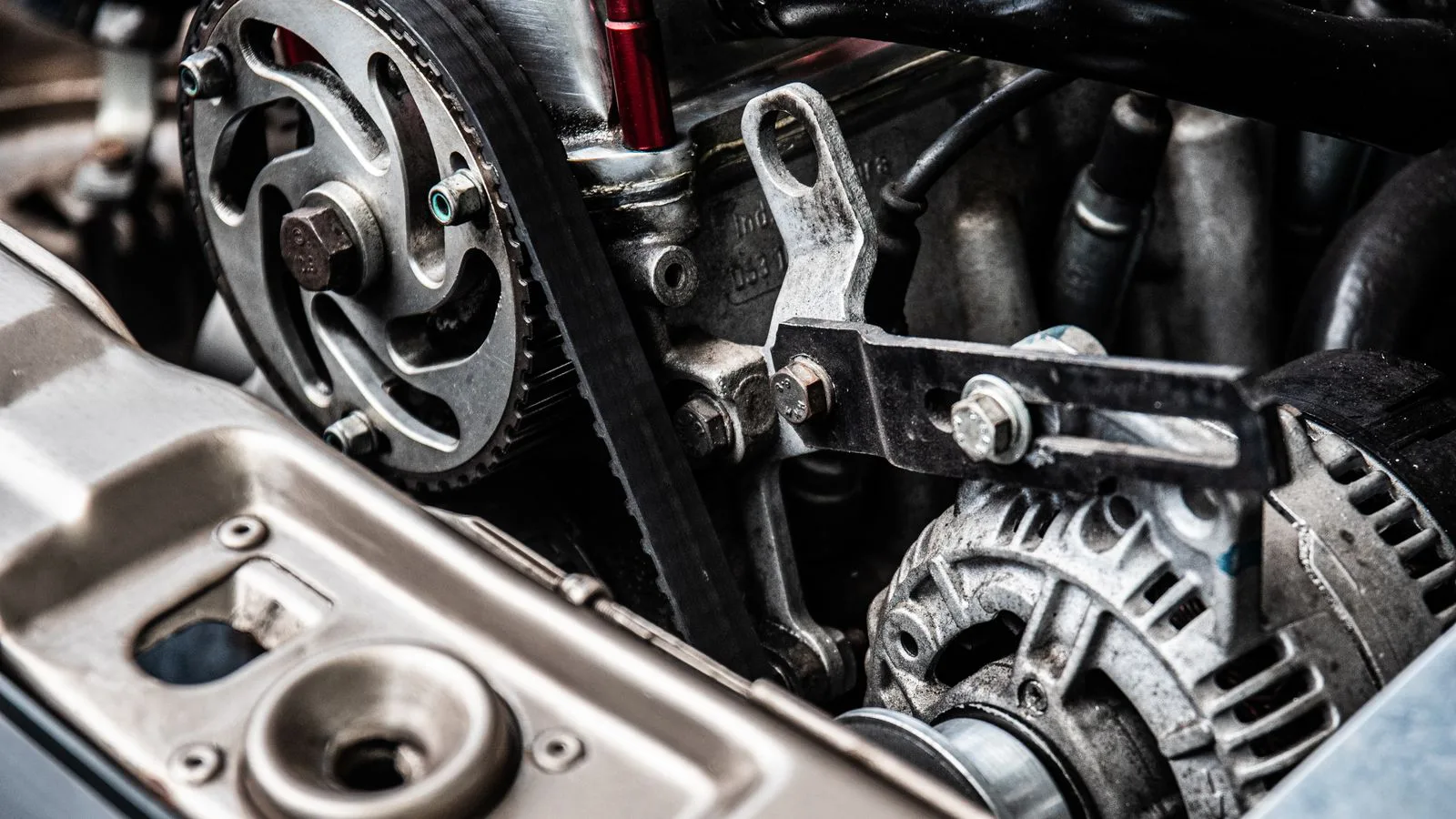
Twice the centre distance plus both circumferences is 36 % too long. Here is the real formula, how the two straight runs and the two arcs actually add up, how far the standard approximation drifts, and what to do with a figure that is not a catalogue length.
Why it is not twice the centre distance plus both circumferences
The naive sum double-counts almost everything. A belt touches each pulley over one arc and then leaves along a tangent; it never goes all the way round either one. On the large pulley the arc is a little more than half the circumference, on the small one a little less, and the two departures from half cancel almost perfectly — which is why the exact answer contains one average circumference, π(D1 + D2)/2, and not two whole ones. Sum both full circumferences and you have counted a complete extra lap of each pulley that the belt never makes.
The straight runs are the other half of the surprise, and they go the other way: they are shorter than the centre distance, not longer. Each tangent is the leg of a right triangle whose hypotenuse is the centre distance and whose other leg is half the difference of the diameters, so it measures the square root of C² − ((D1 − D2)/2)². With 200 mm and 100 mm pulleys 400 mm apart, each straight run is 396.86 mm rather than 400 — 3.14 mm short, twice over. The correction term (D1 − D2)²/(4C) in the formula is what puts that back and then some, and it is the only place where the size difference between the two pulleys shows up at all. On the metric example it is worth 6.25 mm out of 1 277.49 — half a percent. On two pulleys of the same diameter it is exactly zero, the wrap is exactly 180° on both, and the belt is simply twice the centre distance plus one circumference.
The formula, the crossed variant, and how far the approximation drifts
The tool implements the classical closed forms. Open: L = 2C + π(D1 + D2)/2 + (D1 − D2)²/(4C). Crossed: the same first two terms, but the correction becomes (D1 + D2)²/(4C), because a crossed belt wraps both pulleys by more than half. On the metric example, open gives 1 277.49 mm and crossed 1 327.49 mm — 50 mm longer for the same hardware, which is worth knowing before you order. The tool also prints the first two terms on their own as a second output, labelled as the length excluding the correction: 1 271.24 mm. That figure is not a belt, it is a diagnostic — it tells you how much of the answer is pure geometry and how much is the pulley mismatch.
Both closed forms are approximations, not identities. The exact answer needs an arcsine, because the belt's wrap angle on each pulley depends on the geometry: 180° plus twice the arcsine of the half-difference over the centre distance on the large pulley, and 180° minus the same on the small one. Run the tool's own default and the drift is invisible — 1 277.49 mm against an exact 1 277.50, eight microns. Push the ratio and it grows: 250 mm and 50 mm pulleys 160 mm apart wrap the small pulley over only 102.6°, and there the formula comes out 2.33 mm short, or 0.27 %. Crossed belts drift faster because the correction term is larger. The bias is always the same direction — the approximation under-reports — which is the safe direction to be wrong in, since you would rather find the belt a hair tight in the middle of its adjustment than a hair loose at the end of it.
The computed length is an input to a catalogue, not an order
Nobody makes a belt to a millimetre you nominated. Belts are moulded and cured on drums in a preferred series of lengths, marked with a section letter and a length code, and stocked in that series — which is exactly why the useful workflow runs the other way round from the one people expect. You compute the length your current geometry wants, you look it up, you find it falls between two stocked sizes, and then you choose which stocked size to build the drive around and move the motor to suit.
The arithmetic for that move is easier than it looks, because the length is dominated by its first term. Differentiate and you get dL/dC = 2 − (D1 − D2)²/(4C²), which on the metric example is 1.984 — call it two. Every millimetre you move the motor changes the belt requirement by just under two millimetres, and the same ratio holds in inches. So if the tool says 1 277.49 mm at a 400 mm centre distance and you want to land on 1 250 mm instead, you need to lose 27.49 mm of belt, which means pulling the shafts 13.86 mm closer: set C to 386.14 mm. Feed 386.14 back into the tool and it returns 1 250.00 mm, which is the check worth doing rather than trusting the derivative.
Two practical constraints bound that choice. The motor has to keep enough take-up travel in both directions: slack to slip the new belt on without levering it over the flange, which ruins the cords, and tightening travel left over for the stretch the belt will take in its first hours of running. And there is a floor on wrap angle. Below about 120° on the small pulley a V-belt starts to slip before it transmits its rated power, which the table below turns into a minimum centre distance for a given pair of pulleys. Both are reasons to design toward the middle of the adjustment range rather than to a number.
Speed, ratio and which pulley drives
Fill in a driver speed and the tool adds two numbers that decide whether the drive is any use. The driven speed is the driver speed times the ratio of diameters, so an 8 in pulley at 1 725 rpm turning a 4 in pulley gives 3 450 rpm — but only if the selector says the 8 in one is driving. Flip it and the same hardware reports 862 rpm, because the ratio inverts. That selector is easy to leave alone by accident, and the symptom is a plausible-looking number that is out by the square of the ratio if you then reason about torque from it.
The other number is belt surface speed, which is the circumference of the driving pulley times its speed: 15.18 m/s on the metric example, 18.35 m/s on the imperial one. It matters because belt sections have a speed range in which they behave, and both ends of it are real. Too slow and the belt has to carry too much force to move the same power, so it needs a bigger section or more strands. Too fast and centrifugal force starts to lift the belt out of the groove, cutting the very grip it depends on, and the section runs hot. Note that this output stays in metres per second whatever market you are in, because the engine has no imperial mapping for that unit — a US shop wanting feet per minute should multiply by 197.
What the tool will not tell you
It does not check that the layout is physically possible. Ask it for 200 mm and 100 mm pulleys with only 120 mm between the shafts and it returns 732.07 mm without comment, even though the two radii add up to 150 mm and the pulleys would therefore be occupying the same space. Set the centre distance to zero and one output goes to infinity while the other still shows a finite 471.24 mm, which is the second term computing happily on its own. Set the driven diameter to zero and it will still give you a belt length and a belt speed, and only the driven-speed field goes blank. These are all the same class of gap: the formula is being evaluated, the drawing is not.
The unit selector deserves its own warning because it governs all three lengths at once. Type 200, 100 and 400 with the unit left on inches and you get a belt of 32 448.2 mm, which is arithmetically perfect and describes a drive the size of a bus. There is no cross-check between the diameters and the centre distance, and nothing about the result flags the mismatch. The rule is simply to set the unit before typing anything, and to sanity-check the answer against twice the centre distance — the belt is always a bit more than that plus one average circumference, and never anything else.
| Centre distance | Belt length (open) | Wrap on the small pulley | Verdict |
|---|---|---|---|
| 3 in | 26.18 in | 96.4° | Too little grip — a V-belt will slip before it reaches rated power |
| 4 in | 27.85 in | 120.0° | The usual floor — acceptable, with derated power |
| 6 in | 31.52 in | 141.1° | Sound, and compact |
| 10 in | 39.25 in | 156.9° | Comfortable — the normal design zone |
| 16 in | 51.10 in | 165.6° | The tool's own default — grip is no longer the limit |
| 24 in | 67.02 in | 170.4° | Long span — expect whip and consider an idler |
Worked with our own calculator
Belt length calculator (pulleys)
Given
- Belt configuration
- Crossed belt (pulleys reverse)
- Pulley 1 diameter (driver)
- 400
- Pulley 2 diameter (driven)
- 200
- Centre distance
- 800
- Length unit (all three)
- centimeters (cm)
- Driver speed (RPM, optional)
- 5
- Which pulley is the driver
- Pulley 2
Result
- Belt length
- 26,550 mm
- Length excluding correction term
- 25,425 mm
- Driven pulley speed (RPM)
- 2.5
- Belt (surface) speed
- 0.524 m/s
These figures are produced by the calculator below, not typed in by hand — they are recomputed whenever the tool changes.
Run it on your own figures →Frequently asked questions
- Which diameter do I measure on a V-belt pulley?
- The one the belt actually runs on, which is not the one your callipers reach easiest. A V-belt sits down inside its groove, so its line of contact is below the outside diameter of the pulley by an amount that depends on the belt section and how worn the groove is. Catalogues call it the pitch, datum or effective diameter and print it for every pulley; use that figure. Measuring across the rims and feeding the result in will overstate both arcs and give you a belt that is a few percent too long — enough to run out of adjustment travel. Flat belts and toothed belts are easier: a flat belt runs on the outside surface, and a toothed belt runs on a pitch line just above the tooth roots, again printed in the catalogue.
- How tight should the belt be?
- Tight enough not to slip, and no tighter, because everything past that point is spent on the bearings rather than the load. The shop method is deflection: press the middle of the longest free span with a known force and check the belt moves a set distance, typically around 1/64 of the span per unit of span, with the force and the deflection both given in the belt maker's table for that section. The reason it is a span-relative rule is that a longer span is inherently floppier at the same tension. Two mistakes are common and opposite: over-tightening because the drive squealed once, which kills the motor and shaft bearings months later and is not diagnosed as tension; and never re-checking, when a new belt does most of its seating and stretching in its first few hours, so the correct routine is to tension it, run it briefly under load, and tension it again.
- Why does the crossed belt need more length than the open one?
- Because crossing the belt increases the wrap on both pulleys at once instead of trading it between them. In an open drive the belt gains arc on the big pulley and loses the same arc on the small one, so the total stays near one average circumference. Cross it and the belt has to reach across the centreline twice, which wraps each pulley by more than half and lengthens both straight runs. That is why the correction term changes from (D1 − D2)² to (D1 + D2)², which is a much bigger number: on the metric example it takes the belt from 1 277.49 mm to 1 327.49 mm, 50 mm longer. The extra wrap is also the reason crossed drives grip well and the reason they wear out fast — the belt rubs against itself where the two runs cross, so they are used for reversing a slow shaft, not for transmitting real power.
- The tool gives two lengths. Which one do I use?
- The first one, always. The second is labelled as the length excluding the correction term and is only the first two terms of the formula: twice the centre distance plus one average circumference, 1 271.24 mm on the metric example against the full 1 277.49 mm. It is the length you would need if both pulleys were wrapped by exactly 180°, which happens only when they are the same size. Its use is diagnostic — the gap between the two numbers tells you at a glance how much of the answer comes from the pulleys being mismatched, and if that gap is large relative to the total, you are in the region where the closed-form approximation starts drifting from the exact arcsine result. On two equal pulleys the two outputs are identical, which is the tool telling you the correction term is zero.
- Can I just measure the old belt instead?
- You can, and you should read the code moulded into its back first, because that is the answer without any measuring at all. If the marking is unreadable, measuring works but with two traps. A used belt has stretched, sometimes by a percent or more, so measuring one gives you a length that was never a catalogue size. And a V-belt is measured on its pitch line, not around its outside or its inside, so laying a tape around the outer surface overstates and around the inner surface understates — the usual bodge is to wrap a piece of string in the groove of a pulley of known size. The calculator sidesteps both by working from the geometry that is still on the machine: two pulleys you can measure and a centre distance you can measure, none of which has stretched.
Articles you may find interesting
All guides →Related tools
The belt length here is a geometric result from the diameters and centre distance you entered, computed with the standard closed-form approximation and rounded to the tool's display precision. It is not a part number. Belt sections, power ratings, minimum pulley diameters, service factors and tensioning forces all come from the belt maker's own tables for the specific product, and a drive that is geometrically correct can still be undersized for the power it has to carry. The tool applies no plausibility check to the layout, so a centre distance smaller than the sum of the two radii still returns a number. Guard every belt drive before running it, and isolate the machine before touching a belt: a hand near a nip point is the single most common serious injury in a workshop.
Sources
Spotted a mistake in this article?