Headlight Aim and How Far You Can Actually See
Published 3/3/2026 · 12 min read · Car calculators

Marco Bianchi — Home, DIY & motoring writer at OneKitly
Renovation · Materials
Checked against 4 sources
A dipped beam has a horizontal cut-off aimed slightly below the horizontal, so where it lands on flat road is pure trigonometry: reach = mounting height ÷ tangent of the downward angle. UN Regulation No 48 sets that angle for you. It requires headlamps to be mounted between 500 and 1,200 mm above the ground, and for a low mounting it requires the initial aim to be between −1.0% and −1.5%, with the beam kept between −0.5% and −2.5% under every loading condition. With the lamp centre 28 inches up, a −1.0% aim puts the cut-off 2,800 inches away — 233 feet. At −1.5% it is 156 feet. Now compare that with a stopping distance: at 70 mph, one second of reaction and a firm 0.8 g stop needs 303 feet. The beam runs out 70 feet before the car does. The break-even is around 60 mph at the shallowest legal aim and around 46 mph at the steepest. Aim is also fragile: a tenth of a percentage point moves the reach by six feet, and a boot load that drops the rear 1.2 inches on a 106-inch wheelbase pitches the whole car 1.4%, which is more than the entire legal aim window.
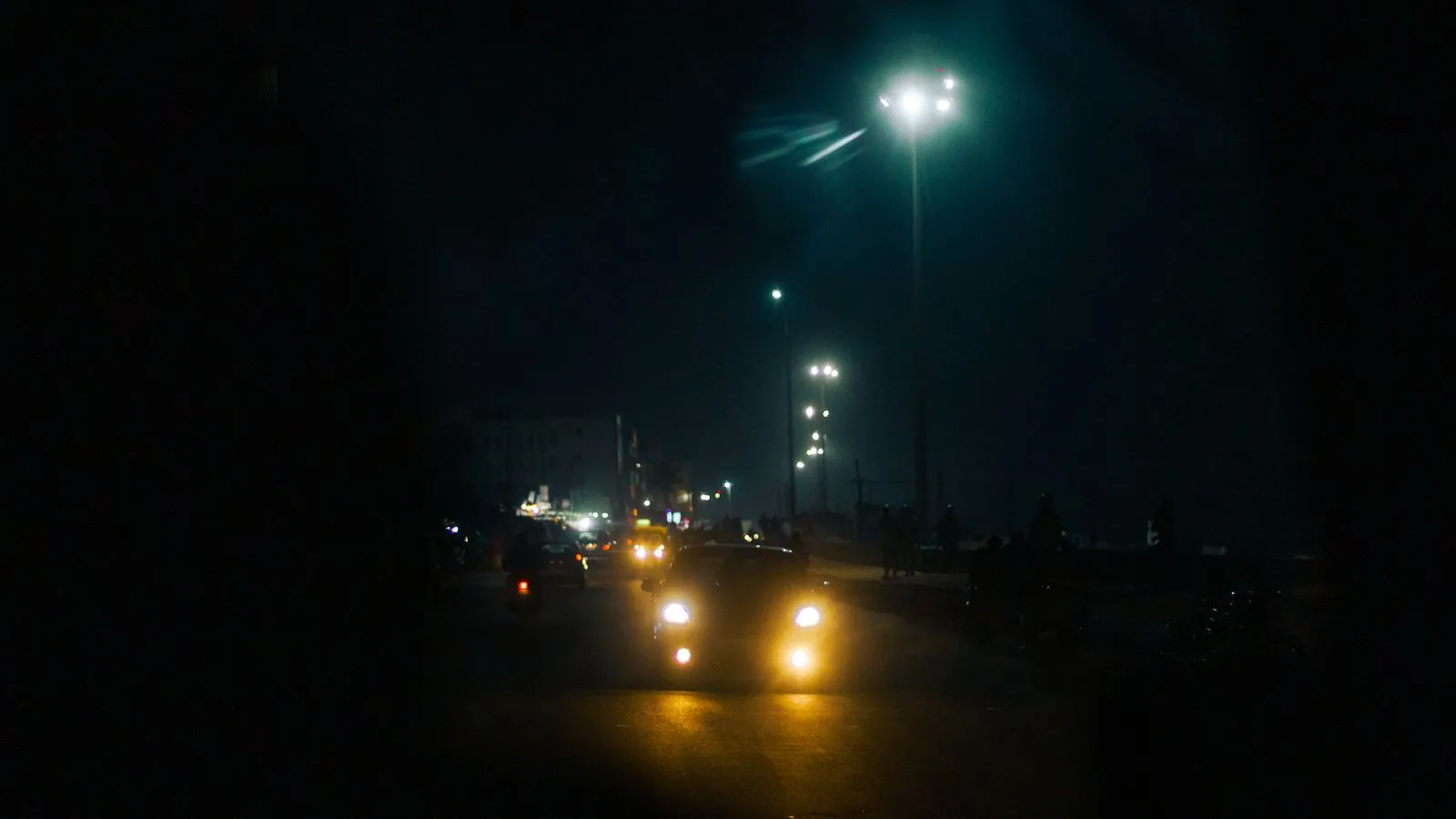
A dipped beam is aimed downward by a fraction of a degree, so its reach on flat road is a single division. Do it and you find that at motorway speed the beam is shorter than the stopping distance — and that a loaded boot can throw the whole calculation away.
The reach of a dipped beam is one division
A modern dipped beam is not a spotlight fading into the distance; it is a sheet of light with a sharp horizontal edge, the cut-off, deliberately aimed a little below the horizontal so it does not shine into the eyes of anyone coming the other way. That makes the reach a right-angled triangle. The lamp is at a known height, the cut-off descends at a known angle, and the two meet the road at height ÷ tangent of the angle. Since the angles are tiny, the tangent is the percentage itself, so reach = height ÷ inclination.
The regulation supplies both inputs. UN Regulation No 48 requires dipped-beam headlamps to sit no less than 500 mm and no more than 1,200 mm above the ground. It then makes the manufacturer stamp an initial downward inclination on the vehicle, specified to a tenth of a percentage point, and constrains it: for lamps whose lower edge is below 0.8 m, the initial aim must be between −1.0% and −1.5%, and the beam must stay between −0.5% and −2.5% in every loading condition of its Annex 5. Lamps mounted above 1.0 m get a steeper window, −1.5% to −2.0% initial and −1.0% to −3.0% overall, because a higher lamp throws further for the same angle and would otherwise dazzle.
Put the lamp centre at 28 inches, a typical figure for a hatchback, and the arithmetic falls out immediately. At −0.5% the cut-off lands 467 feet away. At −1.0% it lands at 233 feet, at −1.5% at 156 feet, at −2.5% at 93 feet. In degrees these are 0.29°, 0.57°, 0.86° and 1.43° — the whole legal range of dipped-beam aim is about one and a sixth degrees wide.
At motorway speed you are outdriving your lights
Set the beam reach beside a stopping distance and the picture changes. Our stopping-distance article works from one second of reaction plus a firm 0.8 g deceleration; use the same figures here so the two are comparable. At 45 mph the car needs 149 feet and the beam gives 233 feet at the shallow aim — comfortable. At 65 mph the car needs 269 feet and the beam still gives 233 feet. At 80 mph the car needs 380 feet against the same 233. Somewhere between the second and third of those, you stopped being able to stop inside your own light.
Solve for the exact crossing and it is uncomfortably low. With the beam at the shallowest permitted initial aim, stopping distance equals reach at 60 mph. With the beam at the steepest permitted initial aim, it equals reach at 46 mph. That is not a fault in the headlamps; it is the price of the constraint that they must not blind the car coming the other way. Main beam exists precisely to lift that constraint when there is nobody to blind, which is why the honest reading of these numbers is that on an unlit road at speed, dipped beam alone is a compromise and not a capability.
A tenth of a degree is tens of metres
Because the reach is a height divided by a very small number, it is exquisitely sensitive to that number. Move the aim from −1.0% to −1.1% — a tenth of a percentage point, the resolution the regulation demands the manufacturer specify to — and the reach falls from 233 feet to 212 feet. Move it from −0.5% to −0.6% and it falls from 467 feet to 389 feet: 78 feet lost from a change of six hundredths of a degree. The same sensitivity works upward, which is why an aim set slightly too high does not merely light a bit further but throws the cut-off into the distance and into other drivers' eyes.
This is why headlamp aim is checked on a proper beam setter against a screen at a fixed distance, and why the roadside method of parking against a wall and eyeballing the line is a rough check rather than an adjustment. The tolerance you are trying to hold is smaller than the difference a slightly soft tyre on one side can produce.
A loaded boot pitches the whole car, and the beam with it
The headlamps are bolted to the body, so whatever angle the body takes, the beam takes too. Load the boot and the rear suspension compresses while the front extends; the body rotates nose-up by an angle equal to the sum of those two movements divided by the wheelbase. Take a modest load that settles the rear by 1.2 inches and lifts the nose by 0.3 inches on a 106-inch wheelbase: the pitch is 1.5 ÷ 106 = 1.42%. Add that to a −1.0% aim and the beam is now pointing 0.4% above the horizontal.
A beam above the horizontal has no reach at all in the useful sense — it never meets the road, so there is no cut-off distance, only a wall of light in the faces of everyone ahead. Even a much gentler load matters: a 0.6-inch rear settle with a 0.15-inch nose rise gives 0.71% of pitch, taking a −1.0% aim to −0.3%. That is already outside the −0.5% floor the regulation sets, and it stretches the reach to 767 feet, which sounds wonderful until you are the driver coming the other way.
That is the whole reason levelling exists. UN Regulation No 48 requires the inclination to stay inside its limits in every loading condition of its Annex 5, and it says that where a device is needed to achieve that, the device shall be automatic — with manual dials permitted provided they have marked positions corresponding to the loading cases and a stop that returns the lamps to the initial aim. If your car has a rotary control by the steering column, that is what it is for, and the numbers on it correspond to load cases, not to brightness.
The beam is not symmetrical, and that is why it does not travel
The cut-off is not a straight horizontal line across the whole beam. On one side it steps upward, so the lamp throws further along the verge and the road signs on the driver's own side while staying low on the side where oncoming traffic is. That step — the elbow, or kink — is the reason a headlamp built for right-hand traffic is not the same object as one built for left-hand traffic. Take a right-hand-traffic car to a left-hand-traffic country and the raised part of its beam now points at the eyes of everyone coming towards you.
The regulations treat this as a real problem rather than a curiosity. UN Regulation No 48 requires that where a lighting system provides a means of temporary use in a territory with the opposite direction of traffic, that means must be explained in the owner's manual. In practice it is either an adhesive mask over part of the lens, a mechanical lever inside the headlamp, or on adaptive systems a menu setting that reshapes the beam electronically. All three are doing the same job: putting the raised part of the cut-off on the other side.
Glare is the constraint, not the bulb
It is tempting to read all of this as a case for aiming higher or fitting brighter bulbs, and both are wrong. The reason the cut-off is where it is has nothing to do with what the lamp can produce and everything to do with what a driver 50 metres away can tolerate. UN Regulation No 112, which approves the headlamps themselves, fixes maximum illuminance at specified points above the cut-off precisely to cap the light that reaches oncoming eyes. Raise the beam and you do not gain distance for free; you spend someone else's ability to see.
The real answers are the boring ones. Keep the lenses clean, because a hazed or yellowed lens scatters light upward and destroys the cut-off you are relying on. Keep the aim checked, especially after any suspension work or a change of tyre size, both of which move the mounting height and therefore the reach. Use the load-compensation control if the car has one. Use main beam whenever there is nobody to dazzle. And on unlit roads, treat the beam reach as the real speed limit — because the arithmetic says it is.
| Speed | Stopping distance | Reach at −1.0% | Reach at −1.5% | Can you stop inside the light? |
|---|---|---|---|---|
| 30 mph | 81 ft | 233 ft | 156 ft | Yes, with room to spare |
| 45 mph | 149 ft | 233 ft | 156 ft | Yes, but only just at the steeper aim |
| 55 mph | 205 ft | 233 ft | 156 ft | No at the steeper aim |
| 65 mph | 269 ft | 233 ft | 156 ft | No at either aim |
| 80 mph | 380 ft | 233 ft | 156 ft | No — the light ends far short |
Frequently asked questions
- Do brighter headlamps see further?
- Not past the cut-off, no. The distance at which a dipped beam stops lighting the road is set by geometry — mounting height divided by aim angle — and no amount of extra light moves it, because above the cut-off the lamp is deliberately dark. Extra output makes the lit area brighter and improves contrast within it, which is a genuine benefit, but the far edge stays where the trigonometry puts it. What actually extends reach is main beam, or an adaptive system that opens the beam upward while masking the vehicles in it.
- How do I check my headlight aim at home?
- You can do a rough check but not a proper adjustment. Park square to a flat wall on level ground about 25 feet away with the car in its normal running state — correct tyre pressures, fuel in the tank, driver aboard. Measure the lamp centre height and mark that height on the wall; the cut-off should sit below the mark by the inclination percentage times the distance. At −1.0% and 25 feet, that is three inches below. If it is nowhere near, the aim needs a workshop with a beam setter, because the tolerance is finer than this method can resolve.
- Why do the headlamps dip when I pull away and then come back up?
- That is an automatic levelling system correcting the pitch of the body. Sensors on the suspension read the ride height at each end, and the actuator behind the headlamp rotates the reflector to hold the cut-off at its designed inclination. Accelerating squats the rear and pitches the beam up; the system dips the lamps to compensate, then relaxes as the body settles. Seeing it work is a good sign. Not seeing it work on a car that has it is a reason to have the sensors checked.
- Does fitting bigger wheels change my headlight aim?
- It changes the mounting height, which changes the reach even at an unchanged angle, and if the rolling radius differs front to rear it changes the angle too. A one-inch rise in ride height at a −1.0% aim moves the cut-off about eight feet further out. That is small, but it stacks with everything else, and any change that alters the car's attitude — new springs, a lowering kit, a different tyre profile — is a reason to have the aim reset. The same applies after replacing a headlamp unit or after front-end body repair.
- Is it legal to drive abroad without adapting the headlamps?
- The rule is national and you must check it for the country you are entering, but the underlying physics is not negotiable: an asymmetric beam built for one direction of traffic aims its raised section at oncoming drivers in the other. Many countries require the beam to be adapted, and vehicle inspections in some of them will fail a car whose beam pattern is wrong for the side of the road. Your handbook will say which method your car uses, because UN Regulation No 48 requires the manufacturer to document it there.
Articles you may find interesting
All guides →Related tools
The figures in this article are illustrative. They are computed on an example vehicle chosen to make the arithmetic visible, not measured on yours, and the arithmetic ignores real effects such as suspension geometry, tyre condition and road camber. Legal limits, plated masses, lighting rules and inspection tolerances vary by country and by vehicle and change over time. Your vehicle's own manufacturer plate, its registration document and its handbook are the authority on what it may carry, tow and be loaded with; if a load, a coupling or a beam setting is in question, have it checked by a qualified workshop rather than by a web page.
Sources
- United Nations Economic Commission for Europe / European Union — UN Regulation No 48 — Installation of lighting and light-signalling devices, paragraphs 6.2.4.2, 6.2.6.1.1, 6.2.6.1.2, 6.2.6.2 and 6.2.9
- United Nations Economic Commission for Europe — UN Regulation No 112 — Headlamps emitting an asymmetrical passing beam (cut-off, elbow and glare test points)
- United Nations Economic Commission for Europe — UN Regulation No 123 — Adaptive front-lighting systems, including the means for temporary use in territories with the opposite direction of traffic
- US National Highway Traffic Safety Administration — FMVSS No 108 — Lamps, reflective devices and associated equipment (visual and optical headlamp aiming)
Spotted a mistake in this article?