Tongue Weight Is the Number That Stops a Trailer Swaying
Published 3/2/2026 · 13 min read · Car calculators

Marco Bianchi — Home, DIY & motoring writer at OneKitly
Renovation · Materials
Checked against 5 sources
Tongue weight is the vertical load the trailer presses down on the hitch ball, and it is decided by one thing: how far the trailer's loaded centre of gravity sits ahead of its own axle. The lever runs from the axle to the coupling, so tongue weight = trailer mass × that offset ÷ the coupling-to-axle length. On a 2,600 lb trailer with 140 inches from ball to axle, a 10% tongue weight of 260 lb means the centre of gravity is only 14 inches ahead of the axle. That is a very small target, and cargo moves it fast: shifting 220 lb of load 39 inches forward changes the tongue weight by 220 × 39 ÷ 140 = 61 lb, more than two full percentage points. With the centre of gravity behind the axle the trailer becomes a pendulum hanging off the ball, and any yaw disturbance is amplified rather than damped — sway that grows instead of dying out, and grows faster the faster you go. North American practice puts a conventional hitch at 10–15% of gross trailer weight and a fifth wheel or gooseneck at 15–25%. Europe works differently: the binding number is the maximum static vertical load stamped on the coupling and on the vehicle plate, with EU rules requiring the design figure to be at least 4% of the towable mass and at least 25 kg.
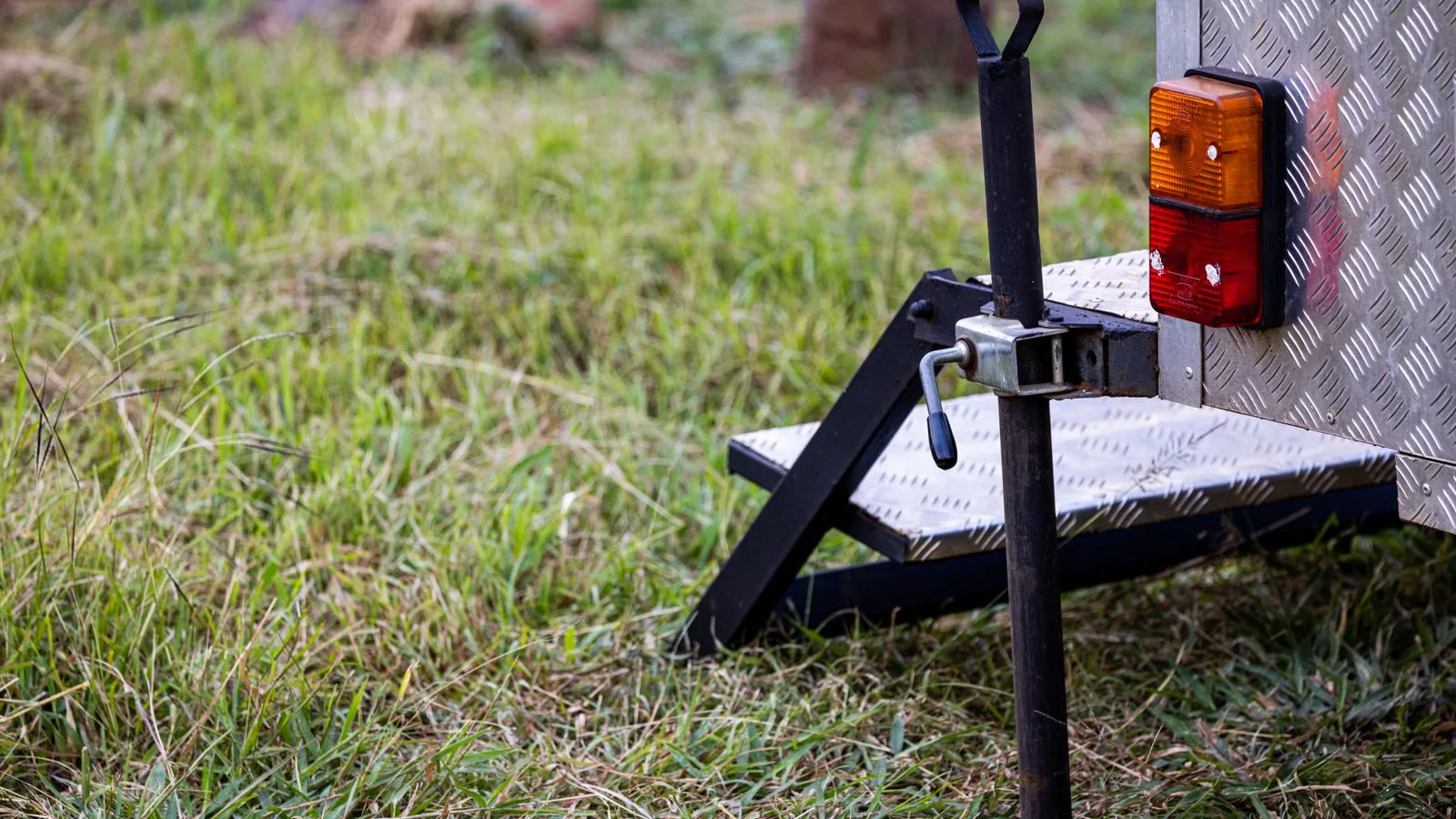
Towing limits tell you whether you may hitch up. Tongue weight tells you whether the combination will stay straight. It is set by where the trailer's centre of gravity sits relative to its axle, it moves faster than anyone expects, and the recommended bands are not the same on the two sides of the Atlantic.
The trailer is a see-saw and the axle is the pivot
A single-axle trailer rests on two supports: its own wheels and the hitch ball. Take moments about the axle and the whole thing collapses to one line. If the loaded centre of gravity sits a distance x ahead of the axle, and the ball is a distance Lc ahead of the axle, then the ball carries mass × x ÷ Lc and the trailer axle carries the rest. Move the centre of gravity behind the axle and x turns negative — the ball is now being lifted rather than pressed down.
The consequence is a target far smaller than most people picture. Take a 2,600 lb loaded trailer with 140 inches from the ball to the axle. A 4% tongue weight puts the centre of gravity 5.6 inches ahead of the axle; 10% puts it 14 inches ahead; 15% puts it 21 inches ahead. The entire usable range of tongue weights corresponds to a band of centre-of-gravity positions barely more than a foot wide. That is why nose weight is not something you set once — it is something a single reloaded box can undo.
Why too little nose weight turns the trailer into a pendulum
Think of the trailer as a body free to rotate about the hitch. Push its nose sideways and its tyres, now running at an angle to their direction of travel, generate a side force at the axle. Where that force acts relative to the centre of gravity decides everything. With the centre of gravity ahead of the axle, the side force is behind the mass and pulls the trailer back into line, exactly like the fletching on an arrow. With the centre of gravity behind the axle, the same force is ahead of the mass and drives the yaw further, exactly like an arrow flown backwards.
The sign of the response is therefore decided by the sign of the tongue weight, and that is the whole reason a positive nose weight is not optional. But the sign is only half the story: even with the centre of gravity properly forward, the restoring moment has to overcome the disturbance faster than the disturbance can grow. The restoring side force rises with the square of speed while the damping available to bleed the energy away rises only in proportion to speed. So the ratio of damping to stiffness falls as speed rises, each sway cycle takes more oscillations to die out, and at some critical speed it stops dying out at all.
That is why sway is a motorway phenomenon and why the standard advice when a trailer starts to weave is to slow down without braking hard — you are trying to get back below the speed at which the oscillation was still self-limiting. It is also why nose weight, tyre pressures on the trailer and the length of the drawbar all matter: they set the stiffness, the damping and the lever arm of the same oscillation.
The recommended bands are not the same everywhere
North America works in percentages of gross trailer weight. The figure used to certify tow ratings under SAE J2807, the standard behind manufacturers' published towing numbers, is 10% of gross trailer weight for a conventional hitch and 15% for a fifth wheel or gooseneck; in service the usual advice is 10–15% conventional and 15–25% for a fifth wheel, which connects over or ahead of the rear axle and therefore tolerates far more vertical load.
Europe does not run on percentages at all. What binds is a mass in kilograms: the maximum static vertical load at the coupling point, the S value, which is marked on the coupling under UN Regulation No 55 and stated for the towing vehicle on its plate and in its handbook. The lowest of those figures governs, and on many passenger cars it is 50, 75 or 100 kg regardless of how heavy the trailer is. EU type-approval sets a floor on the design figure — Regulation (EU) No 1230/2012 requires the technically permissible mass at the coupling point to be at least 4% of the towable mass and at least 25 kg — and German road-vehicle rules require the minimum nose weight actually applied to be at least 4% of the trailer's real mass, needing not exceed 25 kg for trailers up to 3.5 tonnes.
Because the two systems are anchored differently, the practical European recommendation you will see from caravan bodies — aim for something in the region of 5 to 7% of the laden trailer, capped by the plated figure — sits below the North American 10 to 15%, and the reason is not that European trailers are more stable. It is that European tow vehicles are often ordinary cars whose couplings and rear axles are rated for much smaller vertical loads, so the percentage is squeezed from above by a hard kilogram limit. Verify both numbers before you load: the percentage you are aiming at and the kilogram ceiling you must not cross.
What a weight-distributing hitch actually redistributes
Hitching a trailer to a car does the same thing to the car that any load behind the rear axle does: it lifts the front axle. Take a 5,000 lb tow vehicle with a 120-inch wheelbase and a ball 48 inches behind the rear axle. A 600 lb tongue weight takes 600 × 48 ÷ 120 = 240 lb off the front axle and puts 840 lb on the rear. The front tyres have lost a quarter of their load, and with it steering feel, braking share and headlamp aim.
A weight-distributing hitch fixes that with spring bars that force the drawbar and the hitch head apart, applying a couple rather than a force. Work the moments and the answer is precise. To restore the front axle exactly to its unhitched load on the example combination — 5,000 lb vehicle, 120-inch wheelbase, ball 48 inches back, trailer 140 inches from ball to axle, 600 lb tongue weight — the bars must apply 21,400 lb·inches of torque. The result is that the vertical load at the ball itself falls from 600 to 447 lb, the trailer's own axle picks up the missing 153 lb, and the car's rear axle carries 447 lb of extra load rather than 840 lb.
So the hitch does not make weight disappear. It sends part of the nose weight back onto the trailer's own wheels and part forward onto the tow vehicle's front axle, and the total on the road is unchanged. Two things follow. First, the trailer axle's own rating has to absorb what comes back to it. Second, a weight-distributing hitch is not a licence to exceed the coupling's S value or the vehicle's rated mass at the coupling point — those limits are about the structure of the towbar, not about how the load is shared afterwards.
Measuring it with a bathroom scale and a plank
The direct method is to lower the coupling onto a scale with the trailer level and the load in its travelling position. Most household scales stop at 300–400 lb, which covers a small trailer but not a caravan. For anything heavier, use a lever: rest the coupling on one end of a rigid beam, put the scale under the beam at a known fraction of the way along it, and support the far end on a block of the same height. If the scale sits one third of the way from the pivot to the coupling, it reads one third of the true nose weight — read it and multiply back.
Two conditions make or break the measurement. The coupling must be at its towing height, because a trailer nose-down loads the ball more heavily than one that is level and a nose-up one loads it less; and the load must be exactly as it will travel, because the whole point of the exercise is that a moved box changes the answer. Do it once with the trailer as you actually pack it, note the result, and then treat any change of load as a reason to check again.
The loading order that gets you there
Start with the heaviest single item and put it low, directly over or a little ahead of the trailer axle. That is the item with the most leverage, so it is the one you want with the shortest lever arm. Build the rest of the load outward from there, keeping the heavy things near the axle and the light bulky things at the ends. Then strap everything down: a load that can slide forward during braking and back during acceleration is a tongue weight that changes while you drive.
Once loaded, check three numbers in one pass. The nose weight, against both the percentage you are aiming at and the plated limit at the coupling. The tow vehicle's rear axle load, which has gained the nose weight plus the leverage term from the article on weight distribution. And the trailer's tyre pressures, which are specified for its plated axle load and are almost always higher than the number a car owner expects. All three are on plates or in handbooks, and none of them takes longer than the walk around the vehicle you should be doing anyway.
| Where the item sits | Tongue weight | Share of trailer weight | Verdict |
|---|---|---|---|
| 20 inches behind the axle | 96 lb | 4.1% | Too light — sway risk |
| Directly over the axle | 143 lb | 6.1% | European practice; light for a US hitch |
| 20 inches ahead of the axle | 190 lb | 8.2% | Above European practice, below US |
| 40 inches ahead of the axle | 237 lb | 10.2% | US target reached |
| 60 inches ahead of the axle | 284 lb | 12.2% | Check the hitch and the plate first |
Frequently asked questions
- Can tongue weight ever be too high?
- Yes, and it fails in a different way. Excess nose weight overloads the coupling and the tow vehicle's rear axle, and by the lever it lifts the front axle — steering goes light, the front brakes lose their share, and the headlamps point at the trees. On a European car the ceiling arrives quickly because the plated static vertical load at the coupling is often 50 to 100 kg. Too little nose weight makes the trailer unstable; too much makes the car unstable. Both limits are real.
- Does an anti-sway device let me get away with a light tongue weight?
- No. A friction or blade anti-sway device adds damping to the yaw motion, which makes an oscillation die out faster. It does not change the sign of the response, and the sign is what the centre-of-gravity position sets. With the trailer's centre of gravity behind its axle the motion is being driven, not merely under-damped, and adding friction just delays the moment it gets away. Fix the loading first, then add the damping as a margin.
- Why does the same trailer need a different tongue weight when loaded differently?
- It does not need a different percentage — it produces a different one. The percentage is an output of where the mass ended up, not a setting you dial in. Loading heavy items ahead of the axle raises it and loading them behind lowers it, and the table above shows the same trailer swinging from 4.1% to 12.2% purely on the position of one item. The target percentage stays the same; what changes is whether your packing happens to hit it.
- Where do I find my car's maximum nose weight?
- In three places, and the lowest of the three governs. The manufacturer's plate or the registration document gives the technically permissible mass at the coupling point for the vehicle. The towbar itself carries a plate with its approval number and its S value under UN Regulation No 55. And the trailer has its own limit on what it may impose. Never assume the towbar's rating raises the car's; the coupling can be stronger than the vehicle it is bolted to.
- Is a twin-axle trailer immune to this?
- Not immune, but better behaved. Two axles spaced apart resist yaw in their own right, which adds a restoring moment that a single axle does not have, and they raise the speed at which sway becomes self-sustaining. The nose weight arithmetic is the same, with the lever measured to the midpoint between the axles instead of to a single axle. A twin-axle trailer loaded tail-heavy is still a trailer loaded tail-heavy.
Articles you may find interesting
All guides →Related tools
The figures in this article are illustrative. They are computed on an example vehicle chosen to make the arithmetic visible, not measured on yours, and the arithmetic ignores real effects such as suspension geometry, tyre condition and road camber. Legal limits, plated masses, lighting rules and inspection tolerances vary by country and by vehicle and change over time. Your vehicle's own manufacturer plate, its registration document and its handbook are the authority on what it may carry, tow and be loaded with; if a load, a coupling or a beam setting is in question, have it checked by a qualified workshop rather than by a web page.
Sources
- European Union — Regulation (EU) No 1230/2012 — Annex I, Part A, point 3.2: the technically permissible maximum mass at the coupling point shall not be less than 4% of the maximum permissible towable mass and not be less than 25 kg
- United Nations Economic Commission for Europe — UN Regulation No 55 — Mechanical coupling components of combinations of vehicles (definition and marking of the S value)
- Bundesministerium der Justiz (Germany) — § 44 StVZO — Stützeinrichtung und Stützlast
- SAE International — SAE J2807 — Performance Requirements for Determining Tow-Vehicle Gross Combination Weight Rating and Trailer Weight Rating
- US National Highway Traffic Safety Administration — Towing a Trailer — Being Equipped for Safety (DOT HS 809 433)
Spotted a mistake in this article?