How Bowling Scoring Actually Works, and Why a Strike Is Worth More Than Ten
Published 12/10/2025 · 11 min read · Sport calculators

Ten-pin bowling has ten frames and three kinds of frame. An open frame, where two balls leave pins standing, simply scores the pins you felled. A spare, where the second ball clears the rack, scores 10 plus your next one ball. A strike, where the first ball clears it, scores 10 plus your next two balls. That is the whole rule, and every counterintuitive result comes out of it. A perfect game is not twelve times thirty; it is ten scored frames each worth 30, thrown with twelve balls that fell 120 pins, for 300 points — 2.50 points per pin knocked down. A game of nine-count opens fells 90 pins and scores 90, exactly 1.00 point per pin. The same pin is worth two and a half times as much in one game as the other, purely because of what follows it. The famous trap is alternating: strike, spare, strike, spare all the way. People guess 250, reasoning five frames at 30 and five at 20. The real answer is 200. A strike followed by a spare collects only the spare's two balls, which sum to 10, so the frame is worth 20; the spare then collects only the strike's single first ball, also 10, so it is worth 20 too. Every frame scores 20, and the game scores exactly 200.
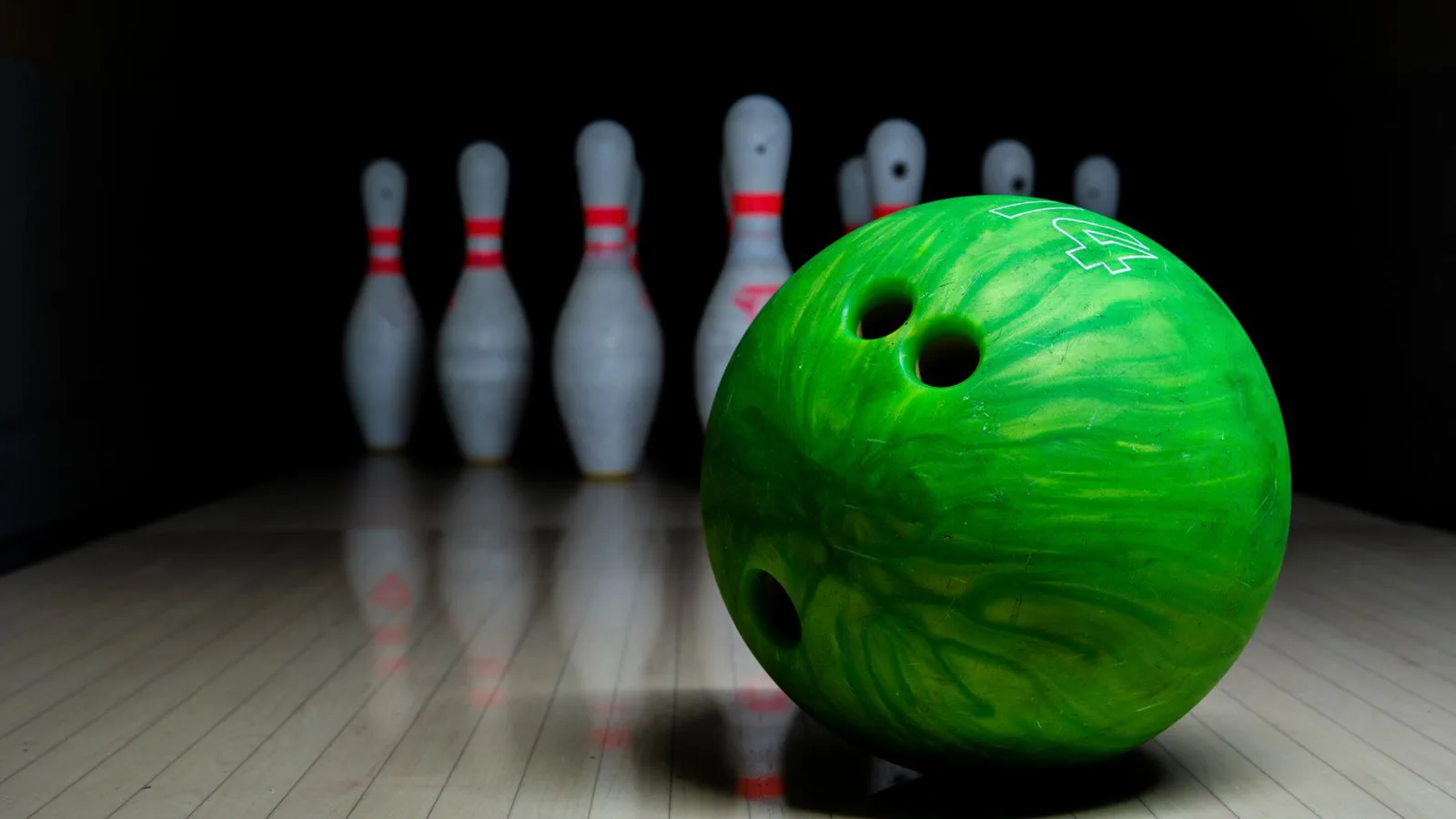
A strike scores ten plus your next two balls, a spare ten plus your next one. That bonus chain is the entire game — it is why a perfect game is 300 and why alternating strikes and spares scores 200, not the 250 almost everyone guesses.
Three kinds of frame, and only one of them is simple
A game is ten frames. In each you get two balls to clear ten pins, except that the frame ends early if the first ball clears them. That gives three outcomes and three scoring rules. An open frame — pins still standing after two balls — is worth exactly the pins you felled, and nothing else ever changes it. A spare, cleared on the second ball, is worth 10 plus whatever your next single ball knocks down. A strike, cleared on the first, is worth 10 plus your next two balls.
The consequence people miss is that a frame's value is not known when you finish it. A strike in the fourth frame stays unresolved until you have thrown two more balls, which may be in the fifth or, if the fifth is also a strike, in the sixth. That is why a scoresheet fills in behind you and why the running total lags the frame you are standing in. It is also why the same physical act — clearing ten pins — is worth different amounts depending entirely on what you do afterwards.
A complete game, frame by frame
Here is a real ten-frame game: strike; 7 then 3 for a spare; 9 then a miss; strike; strike; strike; 8 then 1; 6 then 4 for a spare; strike; and a tenth frame of strike, 9, 1. Frame 1 is a strike, so it takes the next two balls, the 7 and the 3, and scores 20. Frame 2 is a spare and takes the next one ball, the 9, for 19. Frame 3 is open and simply scores 9. Running total after three frames: 48.
Now the chain fires. Frame 4 is a strike followed by two more strikes: 10 + 10 + 10 = 30. Frame 5 is a strike followed by a strike and then the 8: 10 + 10 + 8 = 28. Frame 6 is a strike followed by the 8 and the 1: 10 + 8 + 1 = 19. Frame 7 is open at 9. Frame 8 is a spare followed by the tenth-frame lead-off strike: 10 + 10 = 20. Frame 9 is a strike followed by the strike and the 9: 10 + 10 + 9 = 29. The frame values in order are 20, 19, 9, 30, 28, 19, 9, 20, 29, 20, and the running totals are 20, 39, 48, 78, 106, 125, 134, 154, 183, 203.
The game finishes on 203 having knocked down 108 pins with 16 balls. Hold on to that pin count, because the next section changes the score without changing it at all.
The tenth frame, and why it has extra balls
The tenth frame is not a special rule so much as a repair. A strike needs two following balls and a spare needs one, and in the tenth there is no following frame to supply them, so the frame lends you the balls it owes. A strike in the tenth earns two fill balls; a spare earns one; an open frame earns none and the game simply ends. The fill balls are bonus deliveries, not a new frame, which is why the maximum number of frames stays at ten no matter what.
Its weight is easy to underrate. Replace the worked game's tenth frame — strike, 9, 1, worth 20 — with an open 9 and a miss, worth 9, and the score falls from 203 to 182. That is a 21-point swing from one frame, because losing the strike also strips frame 9 of its bonus, dropping it from 29 to 19. Eleven points from the frame itself and ten from the frame before it. The tenth is where a game is won, and not only for the obvious reason.
Why a perfect game is 300
Twelve strikes are thrown but only ten frames are scored. Each of the ten is a strike followed by two more strikes, so each is worth 10 + 10 + 10 = 30, and ten thirties make 300. The last two balls are the tenth frame's fill balls: they are counted inside frame ten's 30, not as an eleventh and twelfth frame. This is the point most explanations garble — the number is ten times thirty, not twelve times thirty, which would be 360 and is not a score anyone has ever bowled.
The perfect game also gives the cleanest measure of how much the bonus structure inflates a score. Twelve balls felled 120 pins and produced 300 points: 2.50 points per pin. A game of nine-count opens fells 90 pins in twenty balls and scores 90, exactly 1.00 point per pin. Nothing about the pins changed. Only their position in the chain did, and that alone multiplied their worth two and a half times.
The 200 that everybody guesses as 250
Bowl a game that alternates strike, spare, strike, spare through all ten frames. The instinctive arithmetic is five strike frames at 30 and five spare frames at 20, which comes to 250. Score it properly and the answer is 200, and every single frame is worth exactly 20. The strike frames are worth 20 because the two balls that follow them are a spare, and a spare's two balls sum to 10 by definition. The spare frames are worth 20 because the one ball that follows them is the strike's first ball, which is also 10.
The order does not rescue it either: start with the strike instead and the answer is still 200, still 20 a frame. This is the cleanest demonstration that a strike's value is borrowed rather than owned. Thirty points is its ceiling, not its worth, and it only reaches the ceiling when two more strikes follow. Surround it with anything else and it collapses toward its floor, which is the ten pins it actually knocked down.
What one strike is actually worth
There is no single answer, and that is the answer. Take a game of nine-count open frames scoring 90 and turn the fifth frame into a strike. The score becomes 100 — the strike is worth 10 more than the 9 it replaced, because it collects the following frame's 9 and miss. Now take a game of nine-and-spare frames scoring 190 and turn the fifth into a strike. The score becomes 192. The same strike is worth two points here, because the frame it replaced was already collecting a bonus and the frame before it barely gains.
Strikes pay when they arrive together. Put three consecutive strikes into that same 190 game, in frames four, five and six, and it climbs to 213 — twenty-three points from three balls that felled exactly the same 109 pins as before. The bonus chain compounds: each strike collects the next two, so a run of three lifts the frames before and after it as well. That is why bowlers chase consecutive strikes rather than scattered ones, and why the score sheet rewards streaks far out of proportion to the pins involved.
Two last figures make the dependence unmistakable. In a game of nine-count opens, inserting a strike and inserting a nine-plus-spare both give exactly 100 — with nothing good following, a strike and a spare are worth the same. And take the same single missed pin twice: a game of eleven strikes ending on a 9 scores 299, while a 9 and a miss in the first frame followed by eleven strikes scores 279. Both games felled 119 pins. The 20-point difference is nothing but where in the chain the miss landed.
| Game | Value of each frame | Pins knocked down | Final score | Points per pin |
|---|---|---|---|---|
| Perfect game, twelve strikes | 30 | 120 | 300 | 2.50 |
| The mixed game worked below | 20, 19, 9, 30, 28, 19, 9, 20, 29, 20 | 108 | 203 | 1.88 |
| Alternating strike and spare | 20 | 110 | 200 | 1.82 |
| Every frame a nine and a spare | 19 | 109 | 190 | 1.74 |
| Every frame a five and a spare | 15 | 105 | 150 | 1.43 |
| Every frame a nine and a miss | 9 | 90 | 90 | 1.00 |
Frequently asked questions
- How many balls are in a game of bowling?
- It varies, which surprises people. A perfect game takes twelve balls, the fewest possible, because nine frames end on one ball each and the tenth uses three. A game of open frames takes twenty. A game where every frame is a spare takes twenty-one, the maximum, because ten frames of two balls plus one fill ball is as many deliveries as the rules allow. Bowling well means throwing fewer balls, not more.
- Is a spare in the tenth frame worth throwing for?
- Very much so, because it earns a fill ball and it rescues the ninth frame as well. In the game worked above, replacing the tenth-frame strike with an open frame cost 21 points, of which 10 came from frame nine losing its bonus. A spare in the tenth would still have given frame nine a full 10-pin bonus ball. The last frame is the only one whose result reaches backwards as well as forwards.
- Why is the highest possible score 300 and not higher?
- Because a frame is capped at 30 and there are only ten of them. The most a frame can be worth is its own 10 pins plus two bonus balls of 10 each, and that requires a strike followed by two strikes. Ten frames at that ceiling give 300, and there is no mechanism to earn an eleventh frame — the tenth frame's extra deliveries are bonus balls counted inside it, not additional frames.
- What score does a beginner who never misses a spare get?
- It depends entirely on the first ball, which is the useful lesson. Knock down five pins then spare every frame and the game scores 150 — every frame is 10 plus a first ball of 5. Knock down nine then spare every frame and it scores 190. Both bowlers converted every spare; the four-pin difference on the first ball is worth 40 points across a game. Spare conversion sets the floor, but the first ball sets the level.
- Do these rules apply to nine-pin and candlepin bowling too?
- No. Everything above is ten-pin scoring as codified by the sport's governing bodies. Candlepin bowling gives three balls per frame and does not clear fallen pins between them, so its scoring and its record scores are entirely different. Nine-pin, played mostly in central Europe and in parts of Texas, uses its own frame and team structure. Do not carry the strike-and-spare bonus arithmetic across — it is specific to the ten-pin game.
Articles you may find interesting
All guides →Related tools
Sources
Spotted a mistake in this article?