Sleeping Bag Temperature Ratings, and What Comfort Actually Means
Published 3/6/2026 · 14 min read · Sport calculators

The temperature on a sleeping bag label is defined by ISO 23537-1, whose current edition is the second, published in 2022; it cancelled and replaced the 2016 first edition, which had itself superseded the old European standard EN 13537. The test produces four figures, not one. Comfort is the lower end of the comfortable range for a user lying relaxed on their back. Limit is the lower end for a user curled up. Extreme is described by the standard as a point of danger that can lead to death — it is a survival figure and never a use case. Maximum is the upper end, before you sweat. Retailers usually print one of the first two. The physics being measured is a heated manikin's heat loss, so the number is about insulation, and the standard is explicit that the measured resistance includes the mattress underneath the manikin — a foam mat of 0.85 m²·K/W, which is R 4.8. That makes the ground a second, separate and often dominant path. At a 36 °F difference between skin and ground, the ISO mat lets about 24 watts per square metre through; an R 1.5 pad lets 76 through, more than three times as much. A warm bag on a cold mat is not the object the laboratory tested.
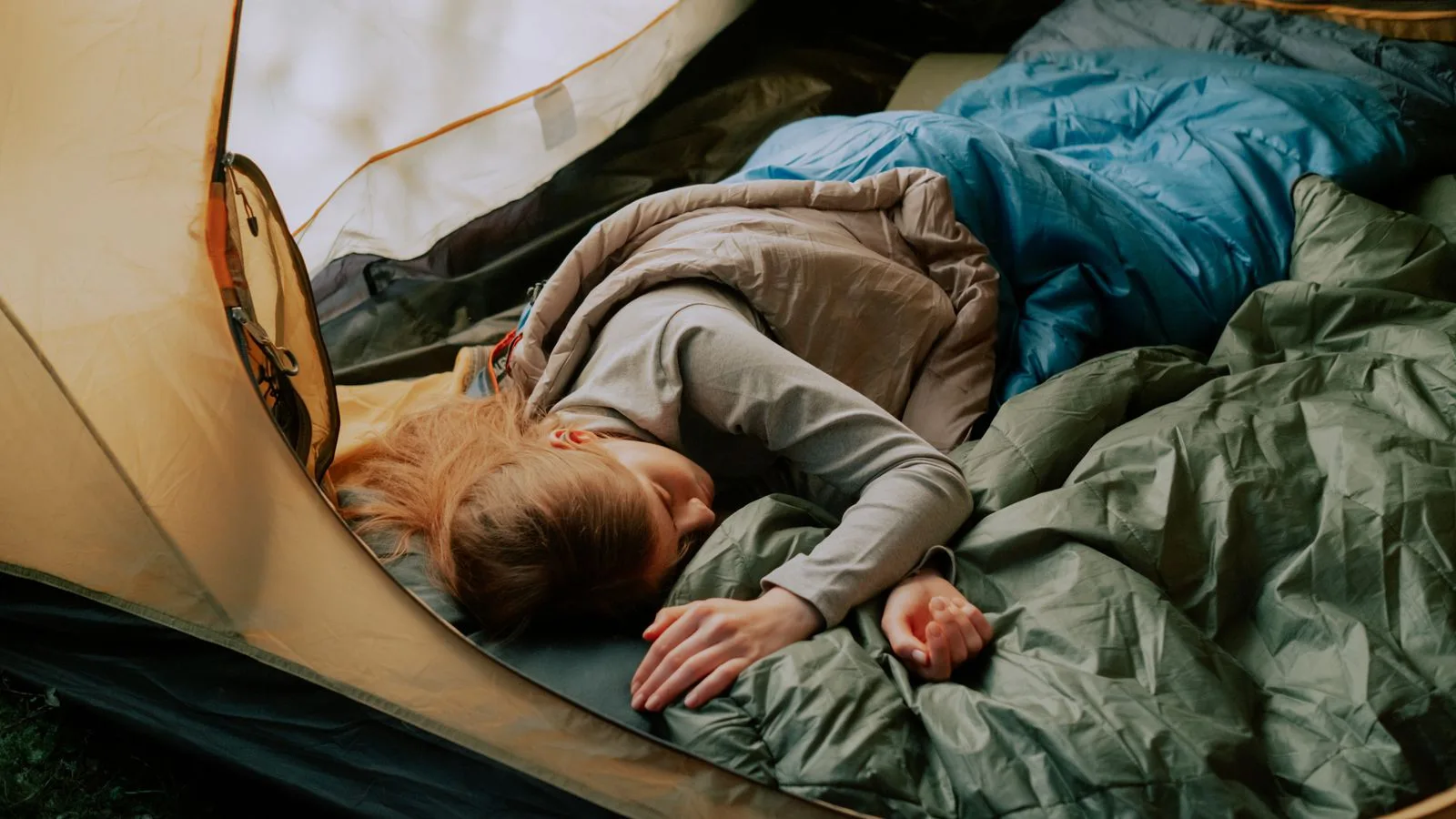
The numbers on a sleeping bag come from ISO 23537-1, which publishes four figures and lets retailers print one. The standard measures a heated manikin's heat loss — so it measures insulation, and its own test mat is R 4.8. Put the same bag on an R 1.5 pad and the heat leaving through your back more than triples.
Which standard, and when it changed
It is worth getting the lineage right, because a great deal of retail copy is still a decade out of date. The original European standard was EN 13537, published in 2002 and revised in 2012. In 2016 it was superseded internationally by ISO 23537-1, and that first edition was amended in 2018. The current text is ISO 23537-1:2022, a second edition published in March 2022 which, in its own words, cancels and replaces the 2016 edition and incorporates the 2018 amendment. It was prepared by ISO technical committee 83 in collaboration with the European standards body, and it is published in Europe as EN ISO 23537-1:2022. If a label or a product page still says EN 13537, it is quoting a standard that has been superseded twice.
The scope matters as much as the vintage. The standard applies to adult sleeping bags for sport and leisure with a limit temperature of −20 °C or higher. It explicitly does not apply to bags for military use or for expeditions in extreme climate zones, and it does not apply to children or babies — the 2016 edition notes that a prediction model for children cannot be developed, because the controlled sleep trials it would require are ethically impossible. So the whole apparatus of comfort, limit and extreme is silent on exactly the two cases where people most want reassurance: a very cold expedition, and a small child.
One point of unit hygiene before the numbers. ISO publishes the ratings in degrees Celsius, worldwide, including for bags sold in the United States. A bag advertised as 20 °F is a bag whose figure was computed as roughly −7 °C and then converted for the shelf, which is why American ratings cluster on odd-looking numbers like 19 °F and 28 °F once you look closely. Compare bags on the Celsius figure if you can find it; that is the number the laboratory actually produced.
Four numbers, and what each one actually says
The standard defines four temperatures, and the wording of the definitions is worth reading closely because it is far more careful than the marketing built on top of it. Comfort is the lower limit of the comfort range, down to which a user in a relaxed posture — the standard gives lying on one's back as the example — is globally in thermal equilibrium and at the threshold of feeling cold. Limit is the lower point at which a user in a curled-up posture is in thermal equilibrium and at the threshold of feeling cold. Extreme is defined as a very low temperature where the risk of health damage by hypothermia is possible, and the standard adds a note of its own: this is a point of danger that can lead to death. Maximum is the upper limit of the comfort range, up to which a partially uncovered user does not perspire too much.
One thing you will read almost everywhere deserves correcting, because it is not in the standard as written today. It is routinely said that comfort is defined for a standard woman and limit for a standard man. That framing comes from EN 13537 and survives in the physiological model behind the calculation and in shop copy; the normative definitions in the 2016 and 2022 editions of ISO 23537-1 distinguish comfort from limit by posture — relaxed versus curled up — and not by the sex of the user. The reference persons in the model are still there, and the woman is described as 25 years old, 1.60 m and 60 kg, but published summaries disagree about the reference man's mass, which is a fair signal of how far downstream that detail now sits. The practical reading is unchanged and simpler than the folklore: if you sleep cold, shop on comfort; if you sleep warm, limit is a reasonable target; nobody should shop on extreme.
What the laboratory actually does
A heated manikin about 1.70 m tall, built to a separate ISO standard, is dressed in a two-piece long-sleeved suit and knee-length socks whose material thermal resistance is specified between 0.040 and 0.060 m²·K/W. It goes into the bag on its back, zip closed, hood drawn as tight as the bag's own cords allow, in a climatic room held at 10 °C plus or minus 5. If the hood closes to under 120 mm across, a cold-protective mask goes on its face; if it does not, no mask. The bag is tumble-dried for fifteen minutes and conditioned for at least twelve hours before the test. Three separate runs are averaged. The result is a single thermal resistance, and a physiological model in an annex converts that resistance into the four temperatures on the label.
Read the specification for what is underneath the manikin and the article writes itself. The standard requires the manikin to lie on a foam mattress with a material thermal resistance of 0.85 plus or minus 0.06 m²·K/W, resting on a 20 mm plywood board held at least 100 mm above the floor so air can circulate beneath it. Convert that mattress into the R-value the outdoor trade uses and it is R 4.83, with the tolerance band running from R 4.49 to R 5.17. Compare it with the manikin's clothing, specified at 0.040 to 0.060 m²·K/W or roughly R 0.23 to R 0.34, and the mat carries fourteen to twenty-one times the thermal resistance of everything the manikin is wearing.
The ground is a separate path, and often the dominant one
The standard settles the question of whether the mat counts, and it settles it against the intuition most buyers bring. Its own definition of thermal resistance says the measured value includes the effects of the shell fabrics, the filling, the air inside the bag, the boundary air layer outside it, the mattress underneath the sleeping bag, and the garments worn by the user. The mat is not a variable the test controls for and sets aside. It is inside the measured quantity. Which means the rating on the label is a property of a system — bag plus specified clothing plus a mat of R 4.8 — and swapping the mat changes the thing that was measured, not merely the conditions it is used in.
The physics of why is simple. Heat leaves the sleeper by two routes: upward and sideways through lofted insulation, and downward through whatever is between the body and the ground. Under body weight the fill beneath you is crushed flat, and crushed insulation is barely insulation at all, so the downward path is essentially the mat and nothing else. Heat flow through any path is the temperature difference divided by the resistance, so the arithmetic is one division. Take a 20 °C difference between skin and ground: the ISO mat passes 24 watts per square metre of contact, an R 3.0 three-season pad passes 38, an R 2.0 passes 57, and an R 1.5 summer inflatable passes 76 — 3.2 times the loss the rating was computed against. The bag has not changed. The system has, and the system is what the number describes.
The pad's own number comes from its own standard: ASTM F3340, first issued in 2018, which clamps the mattress under constant compression between a hot plate at 35 °C and a cold plate at 5 °C and measures the power needed to hold the hot side steady. Before it existed, R-values were manufacturer claims measured however each manufacturer liked, and were not comparable across brands. They are now, which is the single most useful thing to have happened to sleeping systems in a decade — and it means the sentence to remember is not about the bag alone. Match the mat to the bag: if the label says the bag is good to −7 °C, the rating assumed R 4.8 underneath it, and anything much less than that is a different, colder night.
What the test cannot include, and why that is not a flaw
A manikin has no metabolism. It does not shiver, does not vary between people, does not go to bed dehydrated after a long day, has not just eaten or just failed to eat, is not menstruating, is not tired, does not toss and turn, and does not breathe moisture into its own insulation for eight hours. All of those change how cold a real person feels, and some of them change it a lot. The standard cannot include them without ceasing to be a repeatable measurement, and a repeatable measurement is precisely the thing that was missing before it existed. The right conclusion is not that the number is worthless. It is that the number is a comparison between bags, not a promise about a night.
Two omissions deserve special mention because they bite in opposite directions. Humidity and moisture accumulation are not in the test — the bag is conditioned dry and stays dry for the few hours of the run — whereas in the field down loses loft as it absorbs moisture across consecutive nights, which is why a bag that felt right on night one can feel thin on night four. And draught management is not really tested either: the manikin is still, so a bag's collar, zip baffle and hood cinch, which exist entirely to stop moving air, are being evaluated by something that never moves. Both of these mean the label flatters real use rather than penalising it.
How to actually use the numbers
Buy on comfort or limit, never extreme, and know which one the retailer printed — a bag advertised on limit will read about five degrees Celsius colder than the same bag advertised on comfort, and that difference is a labelling choice rather than a product difference. Then check the mat separately and match it: the rating was computed with R 4.8 underneath, so an R 2 pad is a downgrade of the whole system whatever the bag cost. Then add margin for the things the test cannot see. A reasonable habit is to treat the comfort figure as the coldest night you would plan for, not the coldest you could survive, and to carry the difference in clothing you can put on inside the bag.
| Pad R-value | SI thermal resistance (m²·K/W) | Heat through the ground path (W/m²) | Compared with the ISO test mat |
|---|---|---|---|
| R 1.0 | 0.176 | 114 | 4.8 times the tested loss — a summer foam pad on frozen ground |
| R 1.5 | 0.264 | 76 | 3.2 times — the classic ultralight summer inflatable |
| R 2.0 | 0.352 | 57 | 2.4 times — still well under what the rating assumed |
| R 3.0 | 0.528 | 38 | 1.6 times — a competent three-season pad, and still short |
| R 4.8 | 0.85 | 24 | This is the ISO test mat. Every published rating assumes it. |
| R 6.0 | 1.057 | 19 | 0.8 times — a winter pad buys you margin the rating never promised |
Frequently asked questions
- Is EN 13537 still the standard?
- No. EN 13537 was superseded internationally in 2016 by ISO 23537-1, and that first edition was itself cancelled and replaced by ISO 23537-1:2022, the current second edition, which also incorporates a 2018 amendment. In Europe it is published as EN ISO 23537-1:2022. In practice the difference matters less to a shopper than the vocabulary suggests, because comfort, limit and extreme still mean recognisably the same things. But a product page that still cites EN 13537 is quoting a document two revisions out of date, which tells you something about how recently the listing was checked.
- Can I use the extreme rating for a cold night?
- No, and the standard says so about as bluntly as a standard ever says anything. Extreme is defined as a very low temperature where the risk of health damage by hypothermia is possible, with an explicit note that this is a point of danger that can lead to death. It is not a rating for a cold night with poor sleep; it is a rating for surviving an unplanned one. A bag with a comfort figure of −2 °C and an extreme figure of −20 °C is a bag for nights around freezing, and the second number tells you what happens if something goes badly wrong rather than what to plan around.
- Why do I sleep colder than my partner in the same bag?
- Because everything the standard had to exclude to make the test repeatable is exactly what differs between two people. Body size and shape change the ratio of surface area to mass; body composition changes both insulation and heat production; the day's food and hydration change how much heat there is to lose; tiredness, illness and how much you moved before bed all matter. The standard's answer to this is the comfort-versus-limit pair, and it is a coarse but real one: the same bag has two numbers about five Celsius degrees apart, and cold sleepers should read the higher one. If you are consistently colder than the people you camp with, buy on comfort and add margin on top of it rather than assuming you will toughen up.
- What R-value pad do I actually need?
- At minimum, match what the bag's rating assumed: R 4.8. That is not a winter recommendation, it is simply the condition under which the number on your bag was produced. Below it you are using a colder system than the label describes, and the table above quantifies by how much — at R 2.0 the ground path loses 2.4 times as much heat as the tested configuration, and at R 1.5 it loses 3.2 times as much. Going above R 4.8 buys margin the rating never promised, which is worth having on snow, on wet ground, or for anyone who sleeps cold. The one thing not to do is spend heavily on a bag and then undo it with the cheapest pad in the shop.
- Does wearing more clothes inside the bag help?
- Yes, and the standard makes it precise. The manikin is dressed in a specified two-piece long-sleeved suit and knee-length socks, each with a material thermal resistance between 0.040 and 0.060 m²·K/W, and the standard's own definition confirms those garments are part of the measured resistance. So the label already assumes a base layer, and sleeping in nothing gives you less than the rating describes rather than the same. Adding a warm hat, dry socks and a light insulated jacket adds resistance on top of the tested configuration and is the cheapest cold-weather margin there is — provided the layers fit inside without compressing the bag's loft, because insulation you have squashed flat has stopped working.
Articles you may find interesting
All guides →Related tools
Planning arithmetic is not a safety margin. Every number on this page comes from an equation or a laboratory test, and neither knows your weather, your route, your fitness or how the day is actually going. Cold and an energy deficit make each other worse, and both blunt the judgement you would need to notice them. Carry more insulation and more food than the calculation says, leave your route with someone who will miss you, learn the early signs of hypothermia, and treat turning back as a normal outcome rather than a failure.
Sources
- International Organization for Standardization — ISO 23537-1:2022, Requirements for sleeping bags — Part 1: Thermal, mass and dimensional requirements for sleeping bags designed for limit temperatures of −20 °C and higher
- International Organization for Standardization — ISO 23537-1:2016 (first edition, cancelled and replaced by the 2022 edition)
- ASTM International — ASTM F3340-18, Standard Test Method for Thermal Resistance of Camping Mattresses Using a Guarded Hot Plate Apparatus
- International Organization for Standardization — ISO 11092, Textiles — Measurement of thermal and water-vapour resistance under steady-state conditions (sweating guarded-hotplate test)
- International Organization for Standardization — ISO 15831, Clothing — Measurement of thermal insulation by means of a thermal manikin
Spotted a mistake in this article?