How Many Moving Boxes You Need — and Why the Mix Beats the Total
Published 8/18/2026 · 11 min read · Real-estate calculators

Marco Bianchi — Home, DIY & motoring writer at OneKitly
Renovation · Materials
Checked against 2 sources
Press the 2-bedroom preset and the calculator returns 56 boxes, split 14 small, 21 medium, 12 large, 4 wardrobe and 5 dish, plus 4 rolls of tape, 6 bundles of packing paper and about 14 hours of packing. The other presets: a studio is 17 boxes, a 1-bedroom apartment 32, a 3-bedroom house 76, and a 4-bedroom family home packed heavy is 140. Note what it asks for and what it does not: seven room counters and one question about how much you own — nothing about how many people live there, which floor you are on, or when you move. The split is the part to act on. Those 56 boxes are five different objects. A small box is about 16 by 12 by 12 inches, roughly 1.3 cubic feet; a large is 18 by 18 by 24, about 4.5 cubic feet. Filled with books, that large box holds something like 140 pounds, which is well past what one person should lift, and it is the single commonest packing mistake. Small boxes take dense things — books, tools, tins, records. Large boxes take bulk with no weight: duvets, cushions, lampshades, coats. The 56 also carries no safety margin. The calculator's own note tells you to buy extras, which means the number on the screen is not the number to order. And it will not cover the last day, when what is left is everything that did not fit a category.
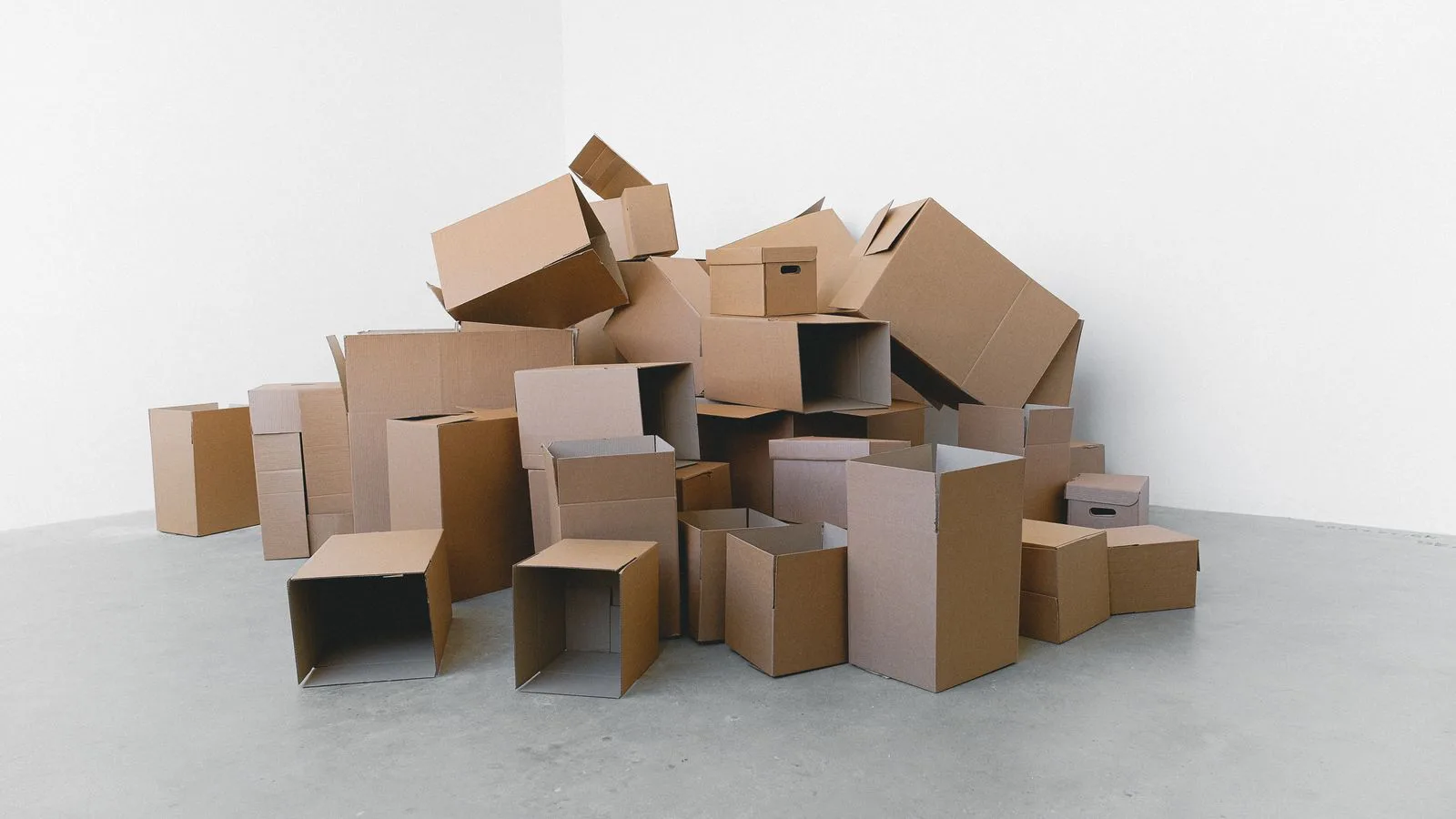
A two-bedroom home comes out at 56 boxes: 14 small, 21 medium, 12 large, 4 wardrobe, 5 dish. The total is the least useful number on the page — here is why the split matters, and what the count leaves out.
What the calculator asks — and the three things it never asks
The inputs are seven room counters — bedrooms, bathrooms, kitchen, living rooms, dining rooms, offices, garage or storage — and one three-way question about how much you own. Each room type carries a fixed set of boxes: a bedroom is 3 small, 4 medium, 2 large and 2 wardrobe; a kitchen is 2 small, 3 medium, 1 large and 3 dish; a living room is 2 small, 4 medium and 3 large. The calculator adds those up and multiplies by 0.7 if you say you have already decluttered, 1.0 for a typical household, or 1.4 if you are a heavy packer.
It never asks how many people live there. Two people in a three-bedroom house and five people in the same house get the same 76 boxes, because the model is a function of rooms, not of occupants — and rooms are the better proxy in one direction only. A spare bedroom used as a spare bedroom holds almost nothing; a spare bedroom used as the place everything goes holds more than the main one. It never asks about the floor or the lift, which is what actually decides how long carrying takes. And it never asks when you move, so nothing in it accounts for the last-day scramble.
The split is the answer: dense goes small, bulky goes large
A moving box is not a container, it is a weight budget. The five sizes the calculator counts are roughly 1.3, 3, 4.5, 5.25 and 12 cubic feet. Books pack at something like 30 pounds a cubic foot, so a large box full of them lands near 140 pounds and a small one near 40. That is the entire rule: the denser the contents, the smaller the box. Books, tools, tinned food, records, ceramic tiles, files — small. Duvets, pillows, cushions, coats, lampshades, soft toys, plastic storage tubs — large. Anything in between goes medium, which is why the medium count is always the biggest number in the list.
This is not a matter of taste. Manual-handling guidance across Europe and the United Kingdom works the same way: the safe weight for a two-handed lift falls sharply as the load moves away from the body, and falls again when it is lifted above the shoulders or below the knees — which is exactly what you do carrying a box down a stairwell. The British guidance puts the filter value for a two-handed lift performed seated at 5 kg for men and 3 kg for women, to give a sense of how fast those numbers drop once the ideal posture goes. A 60-kilo box does not become safe because two people take it; it becomes a box that two people cannot put down gently.
Where the estimate runs out: no margin, and a total that is not quite the sum
Two mechanical details are worth knowing. First, the multiplier is applied to each of the five sizes and then rounded up separately, so the printed total can sit up to four boxes above the underlying arithmetic — a 3-bedroom house on the minimalist setting prints 55 where the raw figure is 53.2. That is harmless, and it is the direction you want an error to point. Second, and less harmless: there is no safety margin at all. The tool's own footnote says to grab a few extra to be safe, which is an admission that the number on the screen is not the number to order.
The good news is that the tool already contains the margin, in the form of the third setting. The same 2-bedroom rooms give 41 boxes on minimalist, 56 on average and 80 on heavy packer. That spread is 95 percent from bottom to top, and 43 percent from the middle to the top. If you are unsure which you are, you are the heavier one: nobody has ever finished a move thinking they owned less than they had assumed. The cheapest way to buy a margin is to run the calculator once on your honest answer, once one notch up, and order the second list.
Tape, paper and hours: the three numbers underneath
Under the box counts the tool prints three derived figures, all straight fractions of the total: one roll of tape per 15 boxes, one bundle of packing paper per 10, and a quarter of an hour of packing per box. For the 2-bedroom preset that is 4 rolls, 6 bundles and 14 hours; for the 3-bedroom, 6 rolls, 8 bundles and 19 hours. The tape ratio is realistic if you tape the bottom and the top of each box and nothing else. It is not realistic if you are the kind of packer who runs a strip down every seam, in which case double it.
The packing-time figure is the weakest of the three, because it is flat: the same quarter of an hour is charged to a wardrobe box, which you fill by moving the hangers across in one motion, and to a dish box, which is one plate at a time in paper. Reweight it yourself. And the paper is counted in reams, which is a printing unit — 500 sheets of a given size. No removals supplier sells packing paper that way; it comes in bundles priced by weight, typically 5 or 10 kilograms. Read that line as bundles and buy by the kilo, allowing more than you think for anything that goes into the dish boxes.
The last day, and what to do about the overflow
Every packing estimate breaks in the same place: the last day. Up to then you were packing categories — books, kitchen, wardrobes — and each category filled a predictable number of boxes. On the last day what remains is the residue: the contents of the drawer nobody has a name for, the cables, the half-used cleaning products, the things that were in use until an hour ago. Residue does not sort into sizes, which is why it eats large boxes and why so many people finish a move short of exactly the size the calculator gave them most of.
Three things fix it, none of them a box. Keep two or three empty large boxes back, unassembled and flat, until the last morning. Use suitcases and holdalls for the last of the clothes and bedding rather than buying boxes you will use once — soft luggage is free and already in the flat. And put anything that must be findable on day one into a single labelled crate or open-topped box you carry yourself: kettle, mugs, phone chargers, toilet roll, a knife, medication, the tool that opens the boxes. That last one is not a packing tip, it is what stops the first night at the new address from becoming an archaeological dig.
| Size | Dimensions | Capacity | Put in it | 2-bed count |
|---|---|---|---|---|
| Small | 16 × 12 × 12 in | 1.3 cu ft | Books, tools, tins, records, files — anything dense | 14 |
| Medium | 18 × 18 × 16 in | 3 cu ft | The default: pans, toys, small appliances, shoes, folded clothes | 21 |
| Large | 18 × 18 × 24 in | 4.5 cu ft | Bulk without weight: duvets, cushions, coats, lampshades — never books | 12 |
| Dish | 18 × 18 × 28 in | 5.25 cu ft | Plates on edge, glasses upright, each one wrapped — the slowest box to fill | 5 |
| Wardrobe | 24 × 18 × 48 in | 12 cu ft | Hanging clothes moved across on their hangers — the fastest box to fill | 4 |
Worked with our own calculator
Moving boxes estimator
Given
- Number of rooms
- 8
Result
- Small boxes
- 64
- Medium boxes
- 40
- Large boxes
- 24
- Total boxes
- 128
These figures are produced by the calculator below, not typed in by hand — they are recomputed whenever the tool changes.
Run it on your own figures →Frequently asked questions
- How many boxes do I need for a 2-bedroom home?
- The calculator's 2-bedroom preset returns 56 boxes for an average household: 14 small, 21 medium, 12 large, 4 wardrobe and 5 dish. Set the same rooms to minimalist and it drops to 41; set them to heavy packer and it rises to 80. The preset assumes two bedrooms, one bathroom, a kitchen, a living room, a dining room and a garage — if you have no garage or no dining room, take a few off; if you have a loft, add.
- Why not just buy all large boxes?
- Because a box you cannot lift is not a box. A large box holds about 4.5 cubic feet; filled with books that is roughly 140 pounds, which no one should be lifting off a floor and carrying down stairs. All-large also wastes space in the van: a half-filled large box crushes under the one stacked on it, and crushed boxes are what turn a tidy load into a two-trip load. The right mix is roughly a quarter small, a third medium and a fifth large, which is close to what the calculator returns on its own.
- How much more should I buy than the calculator says?
- The count carries no margin of its own, so build one. The simplest method is to run the tool once on the setting you honestly believe describes you, then once on the setting above it, and order the higher list — that is 43 percent more between average and heavy packer, which is about the size of the gap people actually discover. If that feels like too many, add margin only to small and medium, which are the two sizes that run out first and the two you can most easily return unassembled.
- How long does packing actually take?
- The tool charges a flat quarter of an hour per box, so 56 boxes come out as 14 hours and 76 boxes as 19. Treat that as a floor rather than an estimate, for two reasons. It is flat across sizes, and a dish box takes several times what a wardrobe box takes. And it counts only the packing, not the sorting — the hours that disappear are the ones spent deciding whether to keep something, which is not a packing activity at all. Two evenings a week for three weeks is a more useful plan than one long weekend.
- How much space will all those boxes take in the van?
- Add the capacities up. The 56 boxes of the 2-bedroom preset come to roughly 210 cubic feet of boxed goods, and the 76 boxes of the 3-bedroom preset to about 280 — before a single piece of furniture, a mattress or a bicycle. That is the figure worth taking to a removals firm or a van hire desk, because it is the one both of them think in. Boxes are also the easy part of a load: they stack. It is the sofa and the wardrobe that decide whether everything goes in one trip.
Articles you may find interesting
All guides →Related tools
Both moving tools are estimators, not quotes. The box counts come from fixed per-room figures multiplied by how much you say you own, and the cost tool works from a home size and a country coefficient, not from your inventory — neither has seen your flat. Removal prices move with the region, the firm, the week and the state of the access, and the only number that binds anyone is the one a mover writes down after seeing the rooms. Use these figures to know whether a quote is in the right range and to work out what to ask about, then get the quote in writing.
Sources
Spotted a mistake in this article?