Baker's Percentage Explained: One Formula, Any Batch Size
Published 7/8/2026 · 7 min read · Everyday calculators

Marco Bianchi — Home, DIY & motoring writer at OneKitly
Renovation · Materials
Checked against 2 sources
In baker's percentage the total flour in a formula is always 100 percent, and every other ingredient is written as a percentage of that flour weight — not as a percentage of the whole dough. A common lean bread formula is 100 percent flour, 70 percent water, 2 percent salt, 1 percent instant yeast. Multiply by the flour weight you actually want and you have the recipe: 1 pound of flour gives 11.2 oz of water, 0.32 oz of salt and 0.16 oz of yeast; 2 pounds gives 22.4 oz, 0.64 oz and 0.32 oz; 3 pounds gives 33.6 oz, 0.96 oz and 0.48 oz. The ratios never change — that is the entire point of the notation. The percentages sum to 173 percent, which is not an error: the total dough weight is flour weight times 1.73, so to work backwards from a target you divide. Two 2-pound loaves means 64 oz of dough, so 64 ÷ 1.73 = 36.99 oz of flour, and the rest follows.
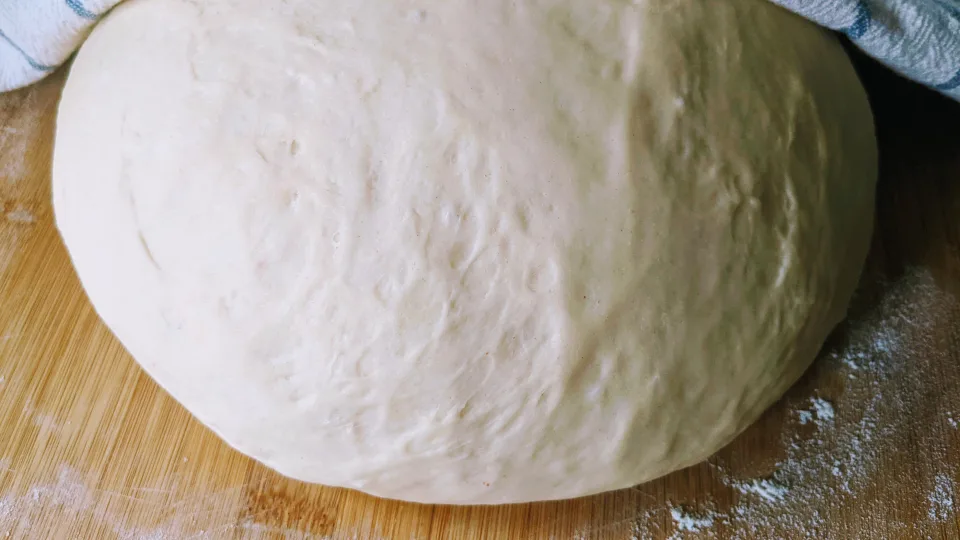
Flour is 100 percent and everything else is measured against it. That one convention lets the same recipe scale from a single loaf to a bakery batch without a single new calculation — and yes, the percentages are supposed to add up to more than 100.
Why the total goes past 100 percent, and why that is correct
This is the single thing that stops beginners cold, and almost no recipe page bothers to explain it. Ordinary percentages are shares of a whole and must add to 100. Baker's percentages are not shares of anything — they are ratios against one fixed reference, the flour. Water at 70 percent does not mean water is 70 percent of the dough; it means the water weighs 70 percent of what the flour weighs. Nothing forces the column to sum to 100, and for any real bread it will not: our lean formula totals 173 percent, and an enriched brioche with 50 percent butter, 40 percent egg, 15 percent sugar and 10 percent milk totals 219 percent.
That 173 is not a curiosity, it is the tool you use to work backwards. Total dough weight equals flour weight times the sum of all percentages divided by 100. So if you know the dough weight you want, you divide instead of multiplying. Want two 2-pound loaves? That is 64 oz of dough, and 64 ÷ 1.73 = 36.99 oz of flour, which then gives 25.9 oz of water, 0.74 oz of salt and 0.37 oz of yeast. Every scaling problem in bread — half a batch, a batch and a half, four loaves instead of one — is that same one division followed by four multiplications.
The percentages are the same in grams and in ounces — that is the whole point
A ratio has no units. 350 ÷ 500 and 11.2 ÷ 16 are both 0.70, so a formula written in baker's percentage crosses the Atlantic untouched: a French baker and an American baker reading 100 / 70 / 2 / 1 will produce the same dough, one in grams and one in ounces, without converting anything. Compare that with a recipe written as 3 cups of flour and 1 1/2 cups of water, which is not reproducible even in the kitchen next door, because a cup of flour weighs anywhere from 4 to 5.5 oz depending on how it was scooped.
The one practical wrinkle in ounces is precision. Salt at 2 percent of a pound of flour is 0.32 oz, and yeast at 1 percent is 0.16 oz — numbers most kitchen scales in ounce mode will round to a tenth and destroy. That is not an argument against the notation, it is an argument for switching the scale to grams for the small ingredients: 10 g of salt and 5 g of yeast are readable on any scale that costs more than a sandwich. Professional bakeries in the United States do exactly this, weighing flour in pounds and salt and yeast in grams, on the same formula sheet.
What the percentages actually tell you before you mix
Once a formula is in percentages you can read it like a diagnosis. Water tells you the handling: 60 to 65 percent is a firm dough you can knead on the bench, 70 to 75 percent is slack and wants folds instead of kneading, above 80 percent you are in ciabatta and focaccia territory and it will be sticky no matter how good you are. Salt lives between 1.8 and 2.2 percent in essentially every bread on earth — below 1.5 percent it tastes flat and ferments too fast, above 2.5 percent it drags the yeast. And yeast is where speed hides: 0.5 percent instant is a long slow rise, 1 percent is a few hours, 2 percent is a fast dough with less flavour.
One caution that trips people up when they start writing their own formulas: if a recipe uses a preferment — a poolish, a biga, a sourdough starter — the flour inside that preferment counts towards the 100 percent, and so does its water. A formula that says 20 percent starter at 100 percent hydration is quietly contributing 10 percent flour and 10 percent water to the total, and if you forget that, your real hydration is several points higher than the number on the page. Adding up total flour and total water from every source before dividing is the difference between a formula that scales and one that only works once.
| Ingredient | Baker's % | 1 lb flour | 2 lb flour | 3 lb flour |
|---|---|---|---|---|
| Flour | 100 % | 16 oz | 32 oz | 48 oz |
| Water | 70 % | 11.2 oz | 22.4 oz | 33.6 oz |
| Salt | 2 % | 0.32 oz | 0.64 oz | 0.96 oz |
| Instant yeast | 1 % | 0.16 oz | 0.32 oz | 0.48 oz |
| Total dough | 173 % | 27.7 oz | 55.4 oz | 83.0 oz |
| Check: water ÷ flour | 70 % | 11.2 ÷ 16 = 70 % | 22.4 ÷ 32 = 70 % | 33.6 ÷ 48 = 70 % |
Frequently asked questions
- Is hydration the same thing as the water percentage?
- Almost, and the gap is where mistakes live. Hydration is total liquid divided by total flour, so it includes the water hiding in a preferment, and strictly it should include milk, eggs and any other wet ingredient if you want to predict how the dough will feel. Most formulas quote hydration as water alone because that is the dominant term, which is fine for lean bread and misleading for brioche: a dough with 40 percent egg and 10 percent milk and no added water is not a 0 percent hydration dough.
- How do I convert a cup-based recipe into percentages?
- Weigh it once, then never use the cups again. Make the recipe as written but put every ingredient on a scale as it goes in and record the grams or ounces. Divide each number by the flour weight and multiply by 100 — that is the formula. From then on you own a version that scales to any size and reproduces exactly, and you have also learned something about your own scooping: the same recipe measured by three different people in cups can vary by 15 percent in flour, which is more than enough to change the bread.
- What flour weight do I need for a specific loaf size?
- Divide the dough weight you want by the sum of all percentages over 100. For the 100 / 70 / 2 / 1 formula that sum is 1.73, so a single 1.5-pound loaf needs 24 ÷ 1.73 = 13.9 oz of flour, and four of them need 96 ÷ 1.73 = 55.5 oz. Add 2 to 3 percent to the target dough weight if you want to be exact about the finished loaf, because that much water leaves as steam during the bake — a detail that only matters when you are selling bread by weight.
Articles you may find interesting
All guides →Related tools
Sources
Spotted a mistake in this article?