Gear Inches, Development, and Why Cyclists Argue About Ratios
Published 1/21/2026 · 13 min read · Sport calculators

A gear ratio is teeth over teeth: a 50-tooth chainring driving an 11-tooth sprocket gives 50/11 = 4.545 wheel turns per pedal turn. That number says nothing about how far you travel until you attach a wheel, which is why the trade uses two derived figures instead. Gear inches is the ratio multiplied by the drive wheel's diameter in inches — a survival from the penny-farthing, where the pedals turned the front wheel directly and its diameter was the gear. Development is the ratio multiplied by the wheel's circumference in metres, which is the distance one pedal revolution actually moves you. On a 700x25c tyre rolling out 2,105 mm the effective diameter is 670.0 mm, or 26.38 inches. So 50/11 is 119.9 gear inches and 9.57 metres of development, while a 34-tooth ring on a 34-tooth sprocket is 26.4 gear inches and 2.10 metres. The two figures are the same fact in different clothes: multiply gear inches by 0.0798 to get metres, or metres by 12.53 to get gear inches. And both exist to be multiplied by a cadence, because cadence times development is speed — which means every gear chart is really a cadence chart.
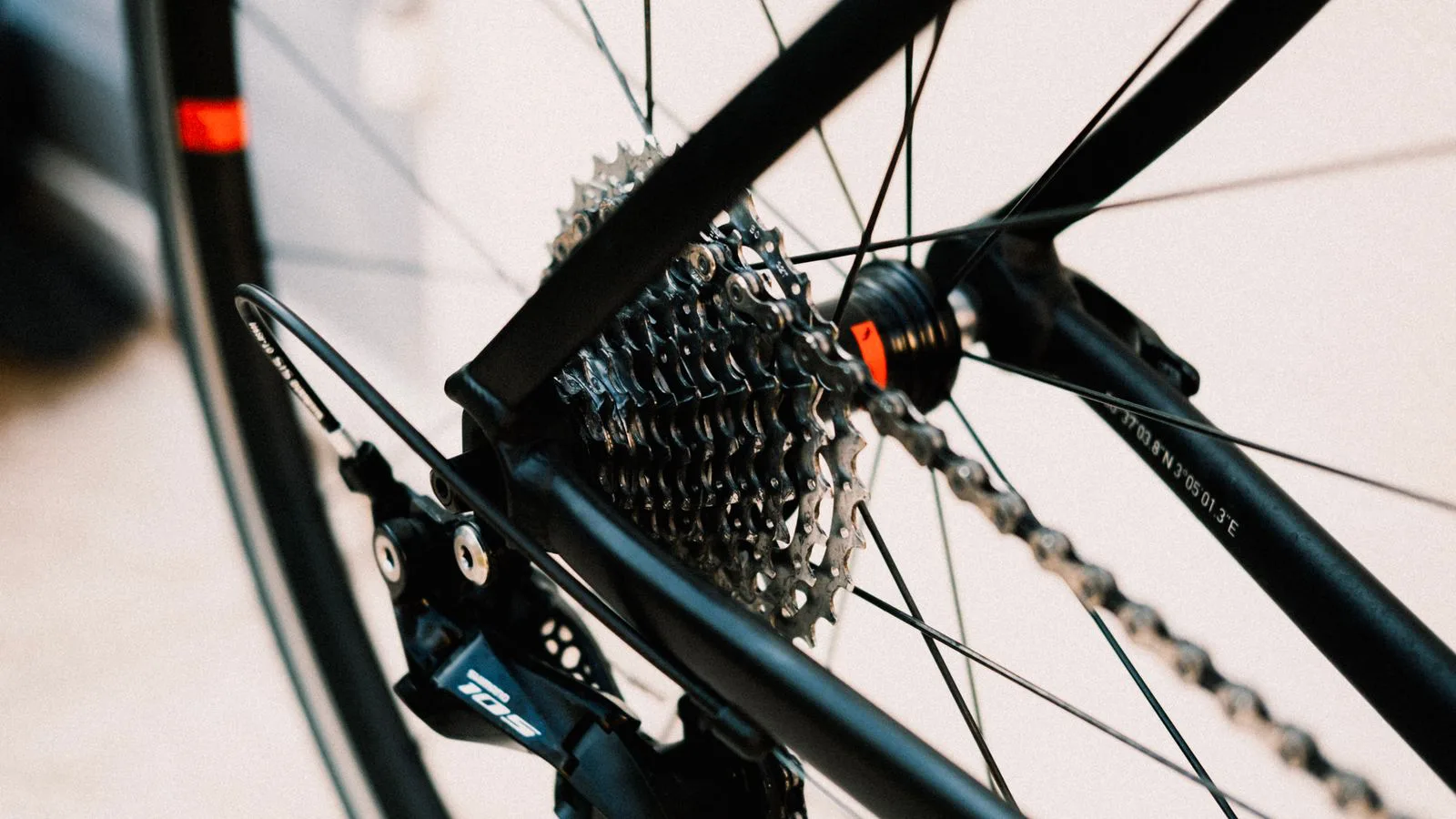
50/11 means nothing until you attach a wheel. Gear inches and metres of development, derived and converted, a full table for a real 12-speed drivetrain, and why the gear step between two sprockets decides whether you can hold a cadence.
A ratio is not a gear
Divide the chainring's teeth by the sprocket's and you have the ratio: 50/11 = 4.545, meaning the rear wheel turns four and a half times for every turn of the cranks. That is a true statement about the transmission and a useless one about the ride, because it contains no wheel. Put the same 4.545 on a folding bike with small wheels and on a road bike with 700c wheels and the two machines travel visibly different distances per pedal stroke, at visibly different speeds, for the same effort at the same cadence.
So the trade attaches the wheel to the ratio, and it does so twice, in two units, for two different reasons. Gear inches multiplies the ratio by the drive wheel's diameter in inches. Development multiplies it by the wheel's circumference in metres. One is a historical convention that produces comfortably large integers; the other is a physical distance you can pace out. Both are correct, both are still in daily use, and the argument between them is older than the derailleur.
Gear inches: the diameter of a wheel that no longer exists
Before the chain drive, the pedals were bolted straight to the front wheel, so the wheel's diameter was the gearing: a bigger wheel went further per pedal stroke, and the whole design of the penny-farthing was an attempt to make the front wheel as large as the rider's legs could straddle. When chains arrived, riders wanted to compare the new machines with the old ones, so they asked what size of direct-drive wheel would give the same distance per pedal stroke. Sheldon Brown states the formula in exactly those terms: the diameter of the drive wheel, times the front sprocket, divided by the rear.
You need a wheel diameter, and the honest way to get one is from the tyre's rolling circumference rather than from the nominal size printed on the sidewall. A 700x25c tyre rolls out about 2,105 mm, so its effective diameter is 2,105 / π = 670.0 mm, which is 26.38 inches. Multiply by 50/11 and the top gear is 119.9 gear inches. That is not a metaphor: a penny-farthing with a front wheel very nearly ten feet across — 119.9 inches is 9.99 feet — would move you the same distance per pedal stroke. Multiply by 34/34 and the bottom gear is 26.4 gear inches — which is, satisfyingly, just the wheel itself, because the ratio is 1.
Development: the distance one pedal stroke buys
Development skips the imaginary wheel and asks the question that matters on the road: how far does the bike go while the cranks go round once? It is the ratio multiplied by the tyre's rolling circumference in metres. With the same 2,105 mm tyre, 50/11 gives 4.545 x 2.105 = 9.57 metres and 34/34 gives exactly 2.105 metres, rounded to 2.10. The whole cassette lands between those two numbers, and every one of them is a distance you could measure on a road with a tape.
The two systems are one system, because circumference is diameter times π. Converting is a single constant: one gear inch is π x 0.0254 = 0.0798 metres of development, and one metre of development is 12.53 gear inches. Check it on the top gear: 119.9 x 0.0798 = 9.57, which is where we started. Sheldon Brown, who preferred neither, complained that development needlessly drags π into the arithmetic and leaves you with an awkward single digit and two decimals, while gear inches at least gives comfortable two- and three-figure numbers. He was right on both counts, which is why both survived.
Every gear chart is a cadence chart
Development is metres per pedal revolution and cadence is pedal revolutions per minute, so their product is metres per minute — a speed. That single multiplication is the reason gear charts exist. At 90 rpm on the drivetrain in the table, the top gear of 9.57 metres gives 32.1 mph, the cruising gear of 7.02 metres gives 23.5 mph, and the bottom gear of 2.10 metres gives 7.1 mph. Read the table the other way and it answers the question riders actually ask: at the speed I am going, which gear puts me at the cadence I want?
The relationship is exactly linear in cadence, which makes the whole table portable. If you habitually spin at 80 rpm rather than 90, multiply every speed by 80/90 = 0.889 and the chart is yours. If you push 100 rpm, multiply by 1.111. Nothing about the gearing changes; only the column of speeds moves. This is also why arguments about gearing are so often arguments about cadence in disguise: two riders with identical bikes will demand different bottom gears if one climbs at 60 rpm and the other at 85.
Range, and what a 1x trades away to get it
Range is the top gear divided by the bottom gear, and it is the same number whichever unit you use, because the wheel cancels. On the 50/34 with an 11-34 cassette it is (50/11) / (34/34) = 4.545, usually written as 455%. Put a 40-tooth single ring in front of a 10-44 twelve-speed cassette and the range is 44/10 = 4.40, or 440%. The two systems reach almost exactly the same span of gears. The 2x does it with two chainrings, a front derailleur and 24 chain lines; the 1x does it with one ring, no front derailleur and 12.
The bill arrives in the spacing. The twelve sprockets of the 11-34 road cassette step by 9.09%, 8.33%, 7.69%, 7.14%, 13.33%, 11.76%, 10.53%, 14.29%, 12.50%, 11.11% and 13.33% — an average of 10.83% and a worst case of 14.29%. The 10-44 cassette has to cover a comparable range with the same twelve sprockets and no second chainring to help, so its steps average 14.45% and reach 18.75%. That is not bad design. Spread 440% evenly over twelve sprockets and the mathematically ideal constant step is 14.42%; SRAM's spacing is within a tenth of a percentage point of optimal. The constraint is arithmetic, and it is the price of the missing chainring.
Overlap: why 24 combinations are not 24 gears
Two chainrings and twelve sprockets give 24 chain positions, and every marketing sheet counts them. Sort them by gear inches and the picture changes. The big ring's lowest gear, 50/34, is 38.8 gear inches. The small ring's highest, 34/11, is 81.5. Everything between those two figures is reachable on either ring, and 15 of the 24 combinations sit inside that band. The overlap is not waste — it is what lets you stay on one ring through a rolling road instead of shifting the front derailleur every ninety seconds — but it does mean the drivetrain has far fewer distinct gears than positions.
Some of them are not merely close but effectively identical. 50/19 is 69.4 gear inches and 34/13 is 69.0 — a difference of 0.6%, which is less than the error in your tyre pressure and far less than any rider can feel. 50/21 at 62.8 and 34/14 at 64.1 are 2.0% apart, another pair you would never distinguish blind. So a 24-position drivetrain offers about 22 gears a rider could tell apart, and if those 22 were spaced perfectly evenly across the 455% range the step would be 7.48%. They are not spaced evenly, which is the honest reason a 2x feels close-ratio in the middle of the cassette and coarse at the ends.
The gear step decides whether you can hold a cadence
A shift changes your cadence, not your speed. At the instant you move to the next sprocket up, the bike is still travelling at the same speed, so your legs must turn faster by exactly the percentage of the step. From 90 rpm, a 7.14% step lands you at 96.4 rpm — comfortable, and the reason the tight end of a road cassette exists. A 9.09% step gives 98.2. A 13.33% step gives 102.0. The 18.75% step on the wide 1x cassette throws you from 90 to 106.9 rpm, which for most riders is past the point of usefulness, so the real choice at that shift is to accept a jump in effort instead.
This is the whole reason the argument exists. Everyone agrees on the range they want, because the range is set by the steepest hill and the fastest descent on their roads. What they disagree about is how much of the cassette should be spent buying that range and how much should be spent keeping the steps small enough to stay in a comfortable cadence band. Adding a sprocket lets you improve one without giving up the other, which is why twelve-speed exists; adding a chainring does the same thing more cheaply and costs a front derailleur. Nothing about the choice is settled, and nothing about it is mysterious once the percentages are on the table.
| Chainring / sprocket | Ratio | Gear inches | Development (m) | Speed at 90 rpm (mph) | Note |
|---|---|---|---|---|---|
| 50 / 11 | 4.545 | 119.9 | 9.57 | 32.1 | Top gear — usable on a descent and almost nowhere else |
| 50 / 15 | 3.333 | 87.9 | 7.02 | 23.5 | The gear a fit rider actually cruises in on the flat |
| 50 / 19 | 2.632 | 69.4 | 5.54 | 18.6 | Duplicated by 34/13 below — the two are 0.6% apart |
| 50 / 34 | 1.471 | 38.8 | 3.10 | 10.4 | Bottom of the big ring, and the floor of the overlap band |
| 34 / 13 | 2.615 | 69.0 | 5.51 | 18.5 | The duplicate of 50/19 — two of your 24 combinations are one gear |
| 34 / 21 | 1.619 | 42.7 | 3.41 | 11.4 | A moderate climbing gear |
| 34 / 27 | 1.259 | 33.2 | 2.65 | 8.9 | A steep climbing gear |
| 34 / 34 | 1.000 | 26.4 | 2.10 | 7.1 | Bottom gear — one pedal turn, one wheel turn |
Frequently asked questions
- Why measure a metric bicycle in inches?
- Because the unit is the name of the thing. Gear inches were never a measurement of the bicycle you are riding — they are the diameter of the direct-drive front wheel that would give the same distance per pedal stroke, and those wheels were sized in inches in the 1880s. The convention survived because the numbers are convenient: a road drivetrain lands between roughly 26 and 120, which is a comfortable spread of two- and three-figure integers. Development in metres carries no such baggage, but it delivers small numbers with two decimals. Cyclists worldwide, metric countries included, use both.
- How do I convert gear inches into metres of development?
- Multiply by 0.0798, or divide by 12.53. The constant is π x 0.0254, because development is the circumference of the imaginary wheel whose diameter the gear inch figure gives, and 0.0254 metres is one inch. Worked on the top gear of the drivetrain in this article: 119.9 x 0.0798 = 9.57 metres, which is what the direct calculation gives. Going the other way, 9.57 x 12.53 = 119.9. This conversion is exact and universal — unlike the gear figures themselves, it does not depend on your wheel at all.
- Does changing tyre width change my gearing?
- Yes, a little, and by exactly the ratio of the rolling circumferences. Reference tables put a 700x25c tyre at about 2,105 mm and a 700x32c at about 2,155 mm, a difference of 2.4%. Every gear on the bike gets 2.4% taller: the 50/11 goes from 119.9 to 122.8 gear inches and from 9.57 to 9.80 metres of development, and its speed at 90 rpm rises from 32.1 to 32.9 mph. That is smaller than one step of any cassette, so it will not fix a gearing problem — but it is large enough to shift a computer's distance readout if you never update the wheel circumference setting.
- Is a 1x drivetrain really giving up range?
- Not much any more — it gives up spacing. A 40-tooth ring with a 10-44 twelve-speed cassette spans 440%, against 455% for a 50/34 with an 11-34, so the range gap is now small. The difference is in the steps: the road cassette averages 10.83% between sprockets and never exceeds 14.29%, while the wide cassette averages 14.45% and reaches 18.75%. At 90 rpm that worst step throws your cadence to 106.9. Whether that matters depends entirely on the riding. On a gravel course with irregular gradients it rarely does; on a fast group ride on the flat, where holding a precise cadence in a paceline is the whole job, it does.
- Why do two of my gears feel identical?
- Because on a double chainring they usually are. On the drivetrain worked through here, 50/19 is 69.4 gear inches and 34/13 is 69.0 — 0.6% apart, which no rider can detect. 50/21 at 62.8 and 34/14 at 64.1 differ by 2.0%, which is also below the threshold of feel. Out of 24 chain positions you have roughly 22 usable distinct gears. Sort your own drivetrain by gear inches once, mark the pairs that fall within a couple of percent, and you will have a much clearer idea of which shifts actually change something.
Articles you may find interesting
All guides →Related tools
Sources
- Sheldon Brown — Gain Ratios: gear inches, development and the case against both
- Sheldon Brown — Bicycle gearing reference and gear calculator
- Shimano — 105 CS-R7101 12-speed cassette sprocket, 11-34T
- SRAM — What is the tooth count of the XPLR 12-speed 10-44T cassettes?
- Cateye — Tyre circumference reference table (cycle computer documentation)
Spotted a mistake in this article?