Blood Sugar Units: mg/dL, mmol/L, and Why Both Exist
Published 12/25/2025 · 13 min read · Health calculators

Glucose is C6H12O6. Using the IUPAC conventional atomic weights — carbon 12.011, hydrogen 1.008, oxygen 15.999 — its molar mass is 6 x 12.011 + 12 x 1.008 + 6 x 15.999 = 72.066 + 12.096 + 95.994 = 180.156 g/mol. One millimole of glucose therefore weighs 180.156 mg, and one millimole per litre is 180.156 mg per litre, which is 18.0156 mg per decilitre. That is the whole conversion: multiply mmol/L by 18.016 to get mg/dL, divide by 18.016 to go back. The 18 you see quoted everywhere is that number rounded. Which unit you meet depends on geography, not on medicine: mg/dL is standard in the United States, Japan, Germany, Italy, Spain, Portugal and much of Latin America, mmol/L in the United Kingdom, Ireland, Canada, Australia, China and Scandinavia, and France reports in grams per litre, where 1 g/L is 100 mg/dL or 5.55 mmol/L. This is why a bare number is dangerous. A blood sugar of 7 in mmol/L is 126 mg/dL, exactly the fasting threshold at which the American Diabetes Association and the WHO diagnose diabetes. A blood sugar of 7 in mg/dL is 0.39 mmol/L, a value incompatible with consciousness. Always carry the unit.
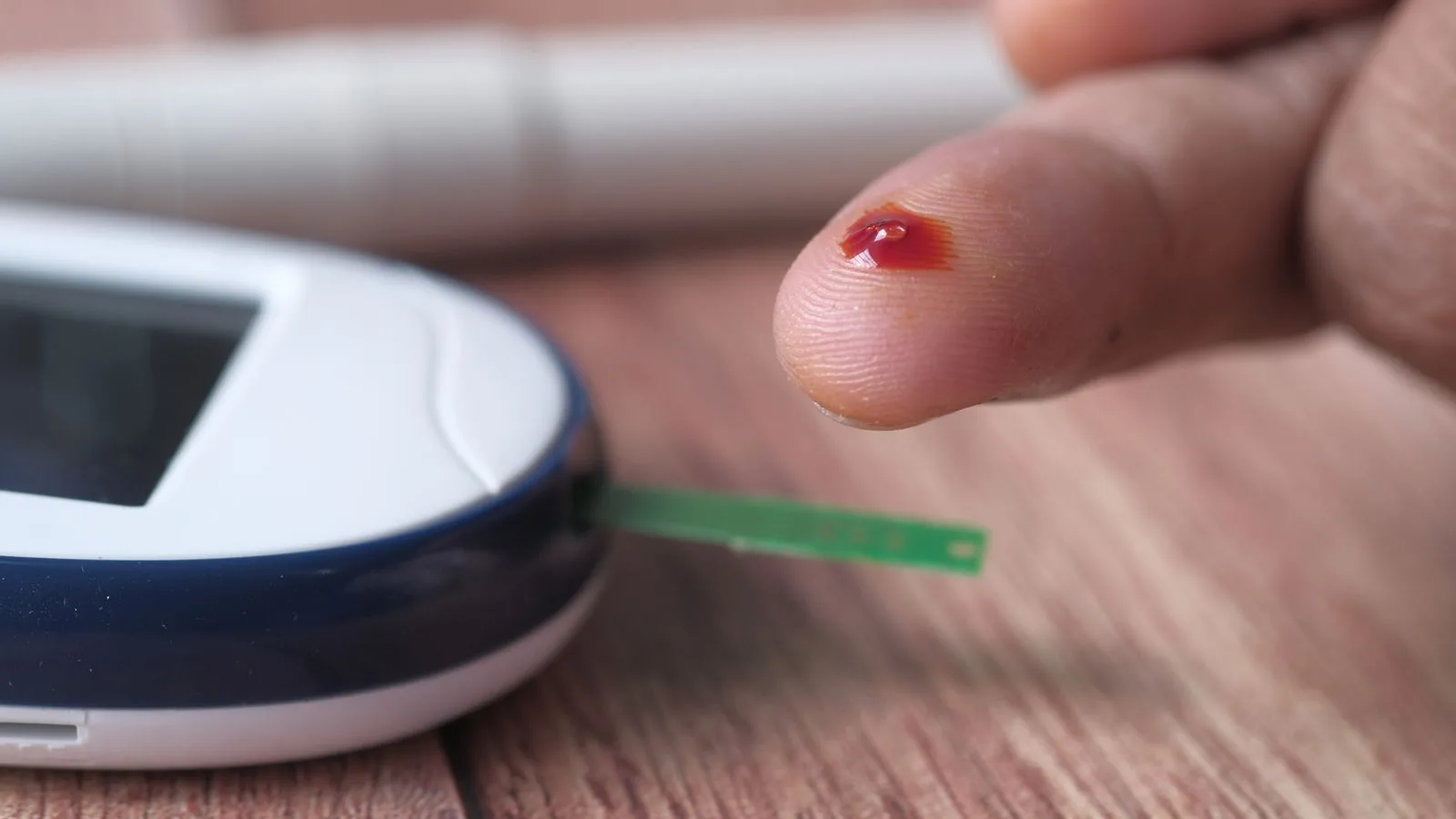
The conversion factor is not 18 — it is 18.016, and it is the molar mass of glucose divided by ten. Here is where it comes from, which countries use which unit, and every diagnostic threshold in both scales with the guideline it belongs to.
Where 18.016 actually comes from
A concentration in mg/dL is a mass per volume. A concentration in mmol/L is a count of molecules per volume. To turn one into the other you need to know what one of those molecules weighs, and nothing else. Glucose is C6H12O6: six carbons, twelve hydrogens, six oxygens. Take the IUPAC conventional atomic weights — 12.011 for carbon, 1.008 for hydrogen, 15.999 for oxygen — and the sum is 72.066 + 12.096 + 95.994 = 180.156 g/mol. That is the molar mass of glucose, and it is the only empirical input the conversion has.
Now put units on it. One millimole of glucose weighs 180.156 mg, so 1 mmol/L is 180.156 mg per litre. A decilitre is a tenth of a litre, so that is 18.0156 mg/dL. The factor is a molar mass divided by ten, and the 18 quoted in every clinic corridor is that number rounded to two significant figures. Rounding it costs you 0.09% — at the 126 mg/dL diabetes threshold, using 18 instead of 18.016 gives 7.000 instead of 6.994 mmol/L, which is why nobody minds. Knowing the derivation still matters, because it tells you the factor is specific to glucose. Cholesterol has its own molar mass and its own factor, creatinine another; there is no universal 18.
A number without a unit is not a result
Take the bare number 7. In mmol/L, 7 is 126.1 mg/dL — the exact fasting concentration at which both the American Diabetes Association and the WHO diagnose diabetes, a value a clinician would act on but would not panic about. In mg/dL, 7 is 0.39 mmol/L, roughly a twelfth of that, far below the 3.0 mmol/L (54 mg/dL) that the International Hypoglycaemia Study Group calls clinically significant hypoglycaemia, and a concentration at which nobody is conscious. Two readings, one digit, opposite emergencies. The same trap sits under 5 (90 mg/dL, unremarkable, versus 0.28 mmol/L, unsurvivable) and under 100 (5.55 mmol/L, normal fasting, versus 1,802 mg/dL, far beyond any glucose meter's range).
The split is historical and geographic, not scientific. Conventional mass units came first and stuck where laboratories standardised early; SI molar units were adopted through the 1970s and 1980s where health systems pushed for them. Today mg/dL is the reporting unit in the United States, Japan, Germany, Italy, Spain, Portugal and most of Latin America, while mmol/L is used in the United Kingdom, Ireland, Canada, Australia, New Zealand, China and the Nordic countries. France is the outlier worth remembering: French laboratories report glycaemia in grams per litre, so the diabetes threshold reads 1.26 g/L, which is 126 mg/dL and 6.99 mmol/L. If you travel, wear a meter set to the local unit or write the unit on anything you hand to a clinician.
The thresholds, and which guideline each one belongs to
Most glucose thresholds are agreed internationally. Fasting plasma glucose of 126 mg/dL (7.0 mmol/L) or more, a 2-hour value of 200 mg/dL (11.1 mmol/L) or more in a 75 g oral glucose tolerance test, and a random value of 200 mg/dL (11.1 mmol/L) with classic symptoms all diagnose diabetes in both the ADA Standards of Care and the WHO criteria. Impaired glucose tolerance is 140 to 199 mg/dL (7.8 to 11.0 mmol/L) at two hours in both. On the low side, the International Hypoglycaemia Study Group — a joint ADA and EASD group — defines a level 1 alert value below 70 mg/dL (3.9 mmol/L) and clinically significant level 2 hypoglycaemia below 54 mg/dL (3.0 mmol/L), with level 3 defined by needing another person's help rather than by any number.
One threshold is genuinely disputed, and it is worth knowing which. The ADA sets impaired fasting glucose at 100 to 125 mg/dL (5.6 to 6.9 mmol/L); the WHO keeps the older, narrower band of 110 to 125 mg/dL (6.1 to 6.9 mmol/L). The upper bound is identical because it is fixed by the diabetes threshold above it; only the lower cut-off differs, and the gap between 100 and 110 mg/dL is what separates the two definitions of prediabetes. That is a real disagreement about where to draw a line on a continuous risk gradient, not a conversion error — so if you see one range in one document and another in the next, check which body wrote it before assuming somebody made a mistake.
HbA1c is a third scale, and it has two units of its own
HbA1c does not measure a concentration at all. It measures the fraction of haemoglobin that has been glycated, which reflects average exposure over the lifespan of the red cells — roughly the previous two to three months. So no conversion factor connects it to a glucose reading; it is a different quantity. It nevertheless comes in two units, for the same historical reason as glucose. The DCCT/NGSP unit is a percentage, anchored to the assay used in the Diabetes Control and Complications Trial. The IFCC unit is mmol of glycated haemoglobin per mol of total haemoglobin, and it is the metrologically traceable one.
The two are linked by the NGSP/IFCC master equation, which is a straight line: NGSP % = 0.09148 x IFCC + 2.152, and inverted, IFCC mmol/mol = (NGSP % − 2.152) ÷ 0.09148, a slope of 10.931 mmol/mol per percentage point. Run the diagnostic values through it. The ADA's diabetes threshold of 6.5% gives 47.5 mmol/mol, printed as 48; the prediabetes band of 5.7% to 6.4% gives 38.8 to 46.4, printed as 39 to 47 because 47 is the last whole number below the diagnostic 48. A treatment target of 7% is 53.0 mmol/mol, 8% is 63.9 and 9% is 74.9. Where a rounded published figure and the raw equation differ by a unit, the published figure is the one guidelines act on.
eAG: a population regression wearing the clothes of a measurement
Because a percentage means nothing to most people, laboratories often print an estimated average glucose alongside the HbA1c. The formulas come from the ADAG study published in Diabetes Care in 2008: eAG in mg/dL = 28.7 x A1C − 46.7, and eAG in mmol/L = 1.5944 x A1C − 2.5944. An HbA1c of 7% gives 154 mg/dL or 8.6 mmol/L; 6% gives 126 mg/dL or 7.0 mmol/L; 8% gives 183 mg/dL or 10.2 mmol/L; 9% gives 212 mg/dL or 11.8 mmol/L. The two forms agree to a hundredth of a mmol/L when you convert one into the other through 18.016, which is the check that they are one regression expressed twice, not two findings.
Here is the part the printout does not say loudly enough. eAG is a regression line fitted across a study population; it is not a measurement of your average glucose. The published confidence interval makes the point: around an HbA1c of 7%, the estimate of 154 mg/dL carries a 95% interval of roughly 123 to 185 mg/dL, or 6.8 to 10.3 mmol/L. Two people with an identical HbA1c can genuinely sit at opposite ends of that band, because red-cell lifespan, anaemia, haemoglobin variants, chronic kidney disease and pregnancy all shift the relationship between average glucose and glycation. Treat eAG as a translation aid for a conversation, and treat continuous monitoring or a meter as the thing that actually measures glucose.
Converting without introducing an error
Three habits remove almost all of the risk. First, write the unit every single time, including in text messages, spreadsheets and logbooks — a column headed only glucose is a future incident. Second, convert once and keep the original: record 126 mg/dL (6.99 mmol/L), not a converted value alone, so that a later reader can check the arithmetic. Third, round to the precision the guideline uses. Clinical practice quotes mmol/L to one decimal and mg/dL to whole numbers, so 6.994 becomes 7.0 and 126.11 becomes 126; keeping four decimals implies a precision no glucose meter delivers.
One further caution that has nothing to do with units. A meter reading and a laboratory plasma glucose are not interchangeable even in the same unit, because meters are calibrated to plasma-equivalent values, sample capillary blood rather than venous, and carry their own accuracy specification. Diagnostic thresholds are written for laboratory venous plasma. So a converted home reading of exactly 7.0 mmol/L is not a diagnosis of diabetes, and no converter — including ours — changes that. Converting is a unit operation; diagnosing is a clinical one performed on a laboratory sample, usually repeated.
| What it marks | mg/dL | mmol/L | Source |
|---|---|---|---|
| Clinically significant hypoglycaemia (level 2) | under 54 | under 3.0 | International Hypoglycaemia Study Group (ADA/EASD) |
| Hypoglycaemia alert value (level 1) | under 70 | under 3.9 | International Hypoglycaemia Study Group (ADA/EASD) |
| Normal fasting plasma glucose | under 100 | under 5.6 | ADA Standards of Care |
| Impaired fasting glucose (prediabetes) | 100 to 125 | 5.6 to 6.9 | ADA Standards of Care |
| Impaired fasting glucose, WHO version | 110 to 125 | 6.1 to 6.9 | WHO/IDF definition and diagnosis |
| Diabetes, fasting | 126 or more | 7.0 or more | ADA and WHO agree |
| Normal 2-hour value in a 75 g OGTT | under 140 | under 7.8 | ADA and WHO agree |
| Impaired glucose tolerance | 140 to 199 | 7.8 to 11.0 | ADA and WHO agree |
| Diabetes, 2-hour or random with symptoms | 200 or more | 11.1 or more | ADA and WHO agree |
Frequently asked questions
- Is the conversion factor 18 or 18.016?
- 18.016 is the exact value and 18 is a rounding of it. The factor is the molar mass of glucose, 180.156 g/mol, divided by ten to move from a litre to a decilitre — so it is 18.0156 mg/dL per mmol/L. Using 18 instead introduces an error of 0.09%, which is invisible next to the accuracy of any glucose meter: at the 126 mg/dL diabetes threshold, 18 gives 7.000 mmol/L and 18.016 gives 6.994. For everyday reading, 18 is fine. The reason to know the exact figure is that it tells you the factor belongs to glucose specifically, being derived from its formula C6H12O6, and cannot be reused for cholesterol, creatinine or anything else.
- Can I convert an HbA1c into a blood sugar reading?
- Not in the way you can convert mg/dL into mmol/L. Those two are the same measurement in different units, so the conversion is exact. HbA1c is a different quantity — the proportion of haemoglobin that has been glycated over the previous two to three months — so any bridge between it and a glucose value is a statistical estimate. The ADAG regression gives eAG in mg/dL = 28.7 x A1C − 46.7 and eAG in mmol/L = 1.5944 x A1C − 2.5944, so 7% estimates 154 mg/dL or 8.6 mmol/L. But the published 95% interval around that estimate spans roughly 123 to 185 mg/dL (6.8 to 10.3 mmol/L), because red-cell lifespan and haemoglobin variants shift the relationship from person to person. Use it to make the percentage intelligible, not to predict what a meter will show.
- Why does my French laboratory report use g/L?
- Because France settled on grams per litre rather than on either of the two units the rest of the world argues about. It is still a mass concentration, exactly like mg/dL, only scaled differently: 1 g/L is 1,000 mg/L, which is 100 mg/dL, which is 5.55 mmol/L. So the diabetes threshold appears as 1.26 g/L in a French report, 126 mg/dL in a US one and 7.0 mmol/L in a British one, and all three are the same blood. To move between them, multiply g/L by 100 to get mg/dL, or by 5.551 to get mmol/L. The practical hazard is the decimal point: a French value of 1.26 misread as 126 in the wrong unit column is a factor of a hundred, so always transcribe the unit with the number.
- My meter is set to the wrong unit. Does that change the readings?
- It changes nothing about the measurement and everything about how you read it. The sensor measures the same blood either way; the display simply divides or multiplies by 18.016 before printing. The risk is entirely one of interpretation, and it is serious in both directions. Someone used to mmol/L who sees 95 on a meter switched to mg/dL may read a perfectly normal 5.3 mmol/L as an alarming number, while someone used to mg/dL who sees 4.2 on a meter switched to mmol/L may read a hypoglycaemia alert value as if it were 4 mg/dL and ignore it. Set the meter to the unit used where you are treated, check that any second device and any app match it, and tell anyone who might read your results for you which unit they are looking at.
- Which unit should I use when I write to a doctor abroad?
- Both, with the original first. Write what your own report said, then the conversion in brackets and the factor you used — for example: fasting glucose 126 mg/dL (6.99 mmol/L, converted at 18.016). That format survives every misreading. It shows the recipient what was actually measured, lets them recompute the conversion in one step, and makes the unit explicit rather than inferred from the size of the number. Do the same for HbA1c, giving both the DCCT percentage and the IFCC value: 7.0% (53 mmol/mol). If you are sending a series of readings, put the unit in the column header and repeat it in the caption, because column headers are the first thing lost when a table is copied into an email.
Articles you may find interesting
All guides →Related tools
This article is general information, not medical or dietary advice. Do not change your diet, your medication or your insulin doses on the basis of a web page — talk to your doctor, dietitian or diabetes team, who can see your own results and history.
Sources
- American Diabetes Association — Standards of Care in Diabetes — Diagnosis and Classification of Diabetes
- World Health Organization — Definition and diagnosis of diabetes mellitus and intermediate hyperglycaemia
- International Hypoglycaemia Study Group (ADA / EASD) — Glucose concentrations of less than 3.0 mmol/L (54 mg/dL) should be reported in clinical trials
- IFCC — IFCC reference system for the measurement of HbA1c
- NGSP — HbA1c conversion and the NGSP/IFCC master equation
- Diabetes Care (Nathan DM et al., 2008) — Translating the A1C assay into estimated average glucose values (ADAG study)
- IUPAC — Standard atomic weights of the elements
Spotted a mistake in this article?