Climbing Grade Conversions Are Not Conversions
Published 1/19/2026 · 15 min read · Sport calculators

A climbing grade conversion table is not arithmetic. French sport grades, the Yosemite Decimal System, the UIAA scale, the V-scale and Fontainebleau are ordinal scales: they rank climbs from easier to harder, but there is no underlying unit, so the gap from 6a to 6b is not a measured quantity and cannot be compared with the gap from 8a to 8b. What a table records is a historical alignment between climbing communities, negotiated by guidebook writers over decades and revised whenever the consensus moves. Parts of it are genuinely tight: French 6a was defined as UIAA VI+ when the Roman scale was renumbered into Arabic figures in the late 1980s, and below that point the two are one scale in two notations. Above it they drift, and published tables disagree by half a grade at French 7a+ and again at 9a. Boulder scales are worse, because they rate a short sequence of hard moves rather than a sustained pitch: entry-level Font 4 / V0 has been published as anywhere from YDS 5.9 to 5.10c depending on the table. And the trad systems that grade danger as well as difficulty — the British adjectival grade, the Australian Ewbank number — cannot be mapped onto a sport grade at all.
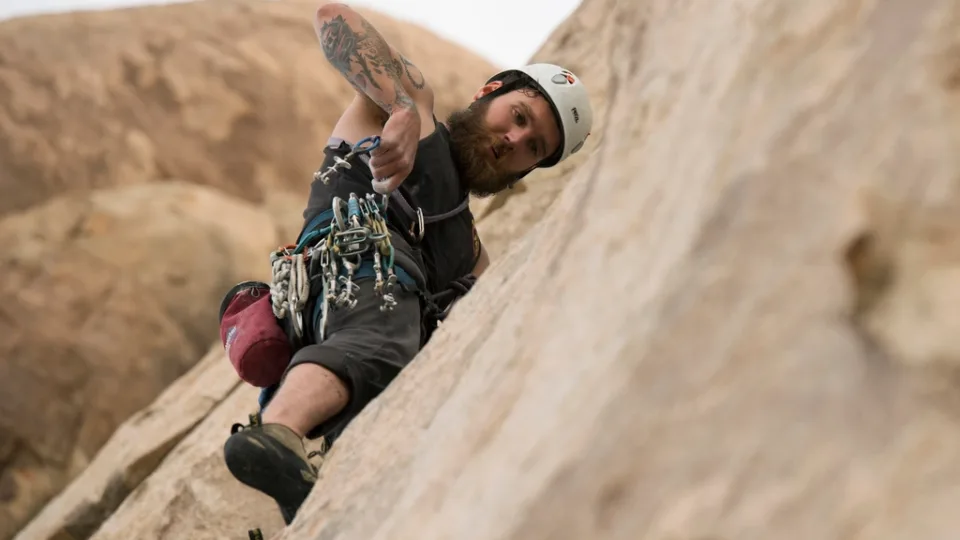
French, YDS, UIAA, V-scale and Font are ordinal scales with no underlying unit. A conversion table is a negotiated alignment between climbing communities — and published tables disagree by half a grade at the top and by four letter-grades at the bottom of the boulder scales.
An ordinal scale is not a measurement
A measurement has a unit behind it. Two kilograms is twice one kilogram because the kilogram exists independently of the things being weighed, and that is what makes conversion possible: pounds and kilograms are two ways of counting the same physical quantity, so a fixed factor moves you between them exactly and forever. A climbing grade has nothing of the kind behind it. It is a rank. It says this route is harder than that one, and nothing more precise. There is no quantity of difficulty that 6b contains more of than 6a.
Three consequences follow immediately, and all three are routinely ignored. You cannot average grades: the mean of 6a and 8a is not 7a in any defensible sense, because the steps are not equal in size and nobody ever claimed they were. You cannot subtract them: the difference between 6a and 6b and the difference between 8c and 9a are both written as one step and are not the same amount of work. And you cannot convert them, because conversion requires a shared unit. What a table between French and YDS gives you is an alignment — an agreement, reached by people, that these two labels tend to be applied to routes of comparable difficulty by their respective communities.
Where the numbers came from
The oldest of the systems still in use is the Roman-numeral scale that Willo Welzenbach compressed into shape in 1923 and that the UIAA formally adopted in 1967, running I to VI with a plus or minus refining each numeral. It was closed at VI, on the theory that VI was the limit of what a human could climb. In 1978 the UIAA added VII, and in 1985 it declared the scale open-ended, which is the single most important fact about every modern grading system: nobody knows where the top is, so the top is always the newest and least tested part of the scale.
The French numerical scale was published at the end of the 1980s by the guidebook author François Labande, and it was not invented from scratch: it replaced the UIAA Roman numerals with Arabic figures, and it did so by setting French 6a equal to UIAA VI+. That is why the low end of the two scales tracks so well — it was defined to. The Yosemite Decimal System grew out of the Sierra Club's class 1 to 5 terrain classification, with climbers at Tahquitz Rock adding a decimal to class 5 in the 1950s and the letters a to d appearing after 5.9 in the 1960s. The Ewbank scale was created in Australia in 1967 as a deliberate alternative to the British system. The V-scale reached print in 1991, in John Sherman's Hueco Tanks guidebook, and the Fontainebleau grades go back to the boulders themselves, at least to 1960. Five scales, five countries, five different decades, five different kinds of rock.
Reading the alignment table honestly
The table above is drawn from the standard published charts — the Rockfax grade table, the crag databases, the American Alpine Journal's international comparison chart — and it deliberately shows the Ewbank scale twice, once as used in Australia and New Zealand and once as used in South Africa. That is the cleanest available demonstration of the problem. It is the same scale, the same numbers, the same rules. Two communities have been applying it independently for decades. At French 5a the two columns agree exactly. At 6a they are one apart. From 7a+ upward they are two apart, and they stay two apart all the way to the top. Nothing drifted except the people.
The second disagreement in the table is between the UIAA and the conversion charts. When the French Arabic scale and the UIAA Roman scale were aligned in the so-called Plaisir tables, French 7a+ was set against UIAA VIII and French 9a against UIAA XI. The comparison charts that most climbers actually consult put those same two grades at VIII+ and XI+. Half a grade, in the same place, twice — and the honest response is not to pick a winner but to record that the alignment above French 6a is a range, not a value. Any converter that returns a single UIAA grade for a French input above 6a is hiding an argument it did not settle.
The top of the scale is the loosest part
An alignment is only as good as the number of routes anchoring it. Around French 6a there are hundreds of thousands of ascents in the world's databases, by climbers of every build and background, on limestone, granite, sandstone and gritstone; the consensus is heavy and it moves slowly. Around 9c there are a handful of routes in existence and a handful of people who have climbed them. The grade of the hardest route in the world is, by construction, one person's proposal, waiting for a second ascent to confirm or downgrade it. That is not a criticism of the climbers involved. It is a statement about sample size.
This is what open-endedness costs. A closed scale, like the UIAA's before 1978, can be calibrated once and left alone; every route in the world fits somewhere inside it. An open scale grows at the top, one route at a time, and each new step is added by whoever climbed the thing first. Downgrades happen — a grade proposed after a first ascent and then repeated by three other people frequently settles half a notch lower — and every downgrade shifts a row of every conversion table beneath it. The practical rule is simple: the further you are from the middle of the scale, the wider the honest error bar on any conversion, and the top two or three grades of every system should be read as provisional.
Boulder scales and route scales measure different things
A boulder grade prices a short sequence of very hard moves, done with a mat below and no rope, where the whole problem may last eight seconds. A route grade prices a full pitch, where the hardest move matters but so does whether there are forty of them in a row and whether you can shake out between them. Font and the V-scale rate the first thing; French and YDS rate the second. When a table places Font 7A opposite YDS 5.12c, it is not saying the two are the same experience — it is saying that climbers who can do one tend, on average, to be able to do the other, which is a statement about people rather than about rock.
The published disagreement here is much wider than half a grade. The entry-level boulder grade, Font 4 or V0, has been aligned with French 6a to 6a+, with UIAA VI to VII−, and with YDS 5.9 to 5.10c, depending on which chart you open — a four-letter span in the American system. Even between Font and the V-scale, which describe the same discipline, the fit is only exact above Font 7C and V9. Below that, Font runs 6A, 6A+, 6B, 6B+, 6C, 6C+, 7A, 7A+, 7B, 7B+, 7C, which is eleven steps, and the V-scale covers the same territory in V3 to V9, which is seven. Eleven onto seven means four of those Font grades have no V-grade of their own, and the boundary you draw is a matter of taste.
The subdivisions are not the same subdivisions
Every scale refines its whole numbers differently, and the refinement decides how much of the world a single symbol covers. The French system splits each number six ways: 6a, 6a+, 6b, 6b+, 6c, 6c+. The YDS splits each number four ways above 5.9 and not at all below it: 5.12a to 5.12d, but 5.8 is just 5.8. The UIAA splits each Roman numeral three ways with a minus, a bare numeral and a plus: VIII−, VIII, VIII+. The British technical grade uses letters with no plus, so three ways: 6a, 6b, 6c. The Ewbank scale does not subdivide at all — the number is the number.
Six, four, three, three, one. Five scales, five different resolutions, and a conversion table has to squeeze them all into one grid of rows. That is why the tables are full of ranges and blanks, why an Ewbank number sometimes faces two YDS letters, and why rounding is unavoidable in one direction and not the other. There is also a trap in the notation itself: the French plus and the UIAA plus do not mean the same thing, since the French plus separates 6a from 6b while the UIAA plus separates VI from VII−. And a lowercase letter in one system is a different animal in another — British technical 5c is French 6b+, not French 5c, which is the single most common misreading in the whole subject.
Trad grades measure danger, which is why they do not convert
The British system gives a route two grades because it is answering two questions. The technical grade names the hardest single move, and it behaves roughly like a French grade. The adjectival grade — Severe, Very Severe, Hard Very Severe, E1 and upward — names the overall seriousness of the undertaking: how sustained it is, how strenuous, how exposed, how good the rock is, and above all how likely a fall is to hurt you. The British Mountaineering Council sets out the typical pairings that go with a route of ordinary risk: Severe with 4a, Hard Severe with 4b, Very Severe with 4c, Hard Very Severe with 5a, E1 with 5b, E2 with 5c.
The information lives in the gap between the two. Hold the technical grade fixed at 6a and walk the adjectival grade upward: E3 6a is a route with excellent gear, E4 6a is normal, E5 6a means a fall will hurt, E6 6a means it will probably injure you badly, and E7 6a means there is effectively nothing between you and the ground. Four routes, one identical hardest move, four completely different propositions — and a single sport grade has no slot in which to put that difference. The American system bolts a partial answer onto the side, with an R suffix for poor protection and an X for none, a convention introduced in 1980. The Ewbank scale takes the opposite route and folds exposure, length, rock quality and protection into the one number, which is why an Ewbank 21 on a runout slab and an Ewbank 21 on a bolted wall are not the same climb and the guidebook is expected to explain which is which.
| French sport | YDS | UIAA | Ewbank (Aus/NZ) | Ewbank (South Africa) | Where the sources disagree |
|---|---|---|---|---|---|
| 5a | 5.7 | V+ | 14–15 | 14–15 | Nothing material. Below French 6a the French and UIAA scales are one scale in two notations. |
| 6a | 5.10a | VI+ | 18 | 19 | The calibration point: 6a was defined as UIAA VI+. Yet the two Ewbank columns already differ by one. |
| 7a+ | 5.12a | VIII+ | 24 | 26 | The UIAA's own Plaisir alignment puts French 7a+ at UIAA VIII — half a grade below the VIII+ of the conversion tables. |
| 7c+ | 5.13a | IX+ | 28 | 30 | The British technical grade opposite this row is 6c — and British 6c is not French 6c. The two notations look alike and are not. |
| 8b+ | 5.14a | X+ | 32 | 34 | The two Ewbank columns are now two full grades apart — one scale, two communities, no drift correction. |
| 9a | 5.14d | XI+ | 35 | 37 | Same half-grade split as at 7a+: the Plaisir alignment says UIAA XI, the conversion tables say XI+. |
| 9c | 5.15d | XII+ | 39 | 41 | A handful of ascents in the world anchor this row. It is a proposal awaiting repeats, not a calibration. |
Frequently asked questions
- Is there an exact conversion between French and YDS grades?
- No, but this is the pair that aligns best. Both scales grade the hardest movement on a bolted route and ignore risk, both are open-ended, and both have been applied to the same routes by travelling climbers for forty years, which is a large and self-correcting sample. Above about French 7a+ the published tables agree on almost every row. Below that the fit is looser, because the YDS does not subdivide at all under 5.10 while the French scale keeps its six-way split all the way down, so several French grades have to share one YDS number.
- Why is British technical 5c not French 5c?
- Because the two scales were built independently and happen to use the same symbols. British technical grades run 4a, 4b, 4c, 5a, 5b, 5c, 6a and upward with no plus sign, so each whole number holds three steps; French grades hold six. The scales also start in different places and were calibrated on different rock by different people. Published tables put British technical 5c at French 6b+ — nearly three French steps above the label that looks identical. British climbers write an f in front of French grades for exactly this reason, and outside Britain the safest habit is to name the system every time you quote a number.
- Is Font 7A a V6 or a V7?
- Most published charts put Font 7A opposite V6 and Font 7A+ opposite V7, and that is the alignment used in the table above. But the two scales only fit exactly above Font 7C and V9. Below that, Font has eleven steps where the V-scale has seven, so four Font grades have no V-grade of their own and every chart has to decide where to double up. Add the fact that Fontainebleau grades were calibrated on sandstone with a slippery, friction-dependent style and the V-scale on the coarse rock of Hueco Tanks, and one notch of disagreement between charts is the expected outcome, not an error.
- Can I convert an E-grade into a sport grade?
- Not meaningfully, and this is the one place where a converter should refuse to answer. The adjectival grade is a judgement about seriousness — protection, exposure, rock quality, commitment — and a sport grade contains no such dimension, because a bolted route has removed the question. You can convert the technical half, since that names the hardest move and behaves like a French grade, but doing so throws away the information the British system exists to carry. E3 6a and E6 6a share a technical grade and are not remotely the same climb. If you must translate, translate the technical grade and quote the adjectival grade untouched alongside it.
- Why does the same grade feel harder at one crag than another?
- Because a grade is a local consensus before it is anything else. It is set by the first ascensionist, argued over by the regulars, printed in a guidebook and then inherited by everyone who follows, and none of that process is coordinated between valleys. Rock type changes what difficulty even means: a slab that rewards balance, a crack that rewards technique, a limestone roof that rewards finger strength. Era matters too, since a crag graded in 1985 was graded against 1985 expectations. Style matters, and so does your build. This is why a table is a starting point and the honest way to arrive somewhere new is to climb two or three grades below your limit until you have recalibrated.
- Which system should I use to record my own climbs?
- Record the grade in the system the guidebook used, and record which system it was. That single habit removes most of the confusion, because it keeps the original judgement intact and lets any later comparison be made explicitly rather than silently. If you want one internal yardstick for tracking your own progress, pick the scale of the discipline you climb most — French or YDS for routes, Font or V for boulders — and convert everything else into it once, in one direction, noting that you did. What you should never do is convert twice. A grade pushed from Font to YDS and back rarely comes home.
Articles you may find interesting
All guides →Related tools
Grades are opinions, not measurements. They vary between countries, between crags a valley apart, and between guidebooks for the same crag, and a conversion table only ever gives you the middle of a wide spread. No table tells you how good the protection is, how far apart the bolts are, what the rock is doing after rain or whether the route suits your height and your style. Get instruction, learn to judge a route from the ground, climb well within your margin when you are somewhere new, and treat every grade you read as a rumour until you have touched the rock.
Sources
- UIAA — Rock Climbing: grades and standards
- British Mountaineering Council — A brief explanation of UK traditional climbing grades
- American Alpine Club — International Grade Comparison Chart (American Alpine Journal)
- Club Alpino Italiano — G. Mandelli & A. Angriman, Scales of Difficulty in Climbing (Central School of Mountaineering, for the UIAA, 2016)
- Rockfax — Grade Conversions
- Sports Technology — Draper et al., Comparative grading scales, statistical analyses, climber descriptors and ability grouping (2015)
Spotted a mistake in this article?