What a Steel Plate, Bar or Tube Weighs — And What the Number Is For
Published 8/14/2026 · 13 min read · Real-estate calculators

Marco Bianchi — Home, DIY & motoring writer at OneKitly
Renovation · Materials
Checked against 2 sources
Mass = cross-sectional area × length × density, and everything else is the area formula for your profile. Take a 4 × 8 ft sheet of 3/8 in plate: 48 in wide by 0.375 in thick is 18 in² of section, over 8 ft that is exactly one cubic foot, and at 490 lb/ft³ the steel weight calculator returns 490.1 lb. A 20 ft length of 2 × 2 × 1/8 in square tube: 2² − 1.75² = 0.9375 in², 3.190 lb/ft, 63.8 lb for the stick. A 20 ft L2×2×1/4 angle: t(a + b − t) = 0.9375 in² and 3.190 lb/ft again — which happens to land exactly on AISC's tabulated 3.19 lb/ft for that angle, though AISC's tabulated area is 0.944 in² rather than 0.9375, because the tool works in sharp corners and the rolled section has fillets. On grades: the tool offers one carbon-steel density, 7 850 kg/m³, and every carbon and low-alloy grade lands on it — A36, A572, S235, S355, 4140, the lot. That is correct, not lazy. Real carbon-steel densities span roughly 7 800 to 7 870 kg/m³, under a per cent, and both AISC's 490 lb/ft³ and Eurocode 1's 77 kN/m³ are the same 7 850 figure by rule. What DOES change with grade is strength, by a factor of two or more, and this calculator says nothing about it. It does separate the alloy families that genuinely differ: austenitic stainless at 8 000, ferritic 430 at 7 700, cast iron 7 200, aluminium 2 700, titanium 4 510, lead 11 340 — and it takes a custom density if you have the mill certificate.
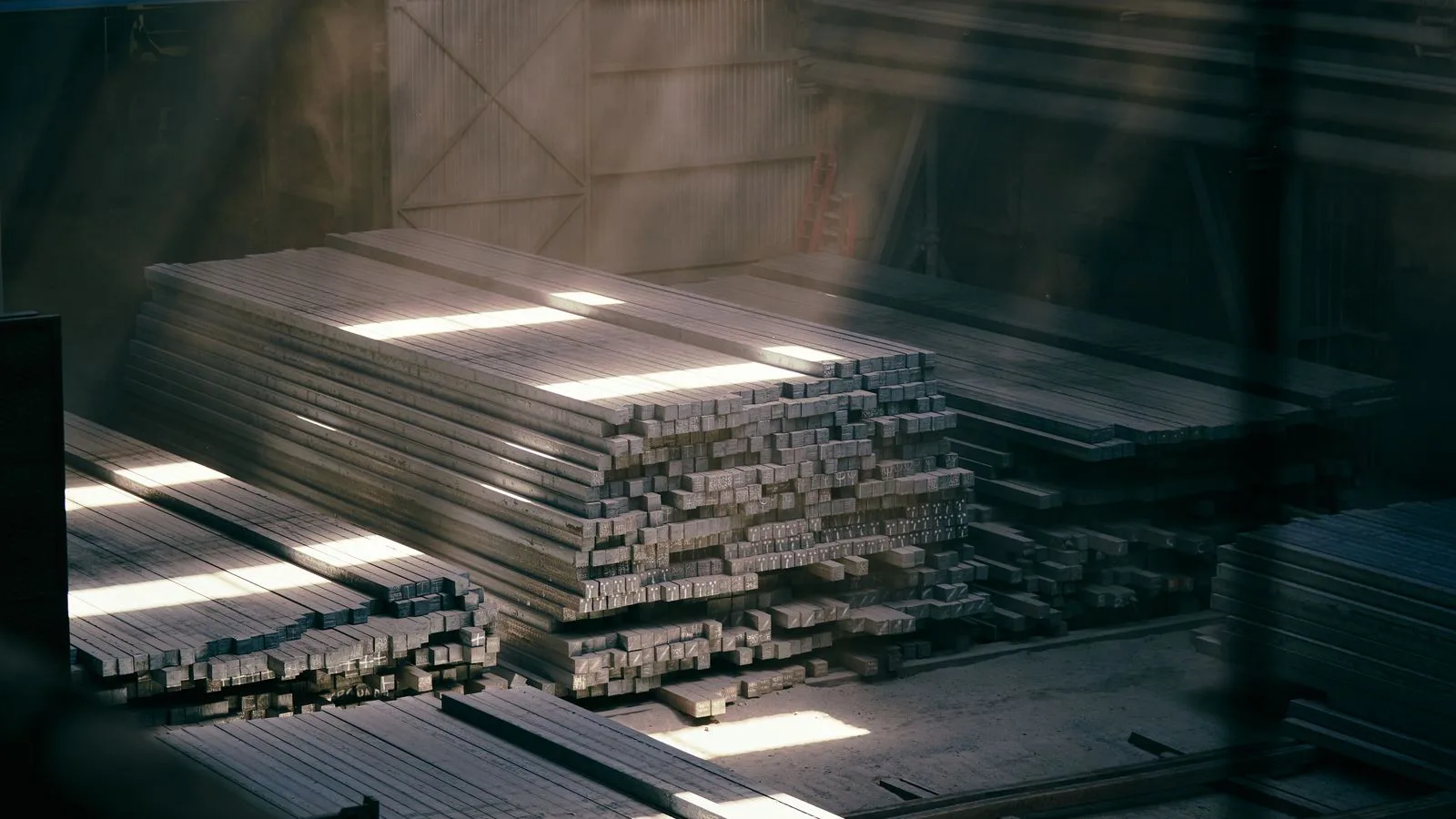
Section area times length times density, for nine profiles and fourteen metals. What the calculator returns, why one figure covers every carbon-steel grade, and the two places its geometry is not the merchant's geometry.
Why one density covers every steel grade
Steel grades differ by a few tenths of a per cent of carbon, a little manganese, sometimes a trace of vanadium or niobium. None of that changes how tightly iron atoms pack, so density barely moves. Across the whole carbon and low-alloy range the spread is roughly 7 800 to 7 870 kg/m³ — under one per cent, which is inside the rolling tolerance on the thickness of the plate you are weighing. Both major design frameworks therefore fix a single nominal figure: AISC uses 490 lb/ft³, and EN 1991-1-1 Table A.4 gives structural steel 77 kN/m³. Divide 77 by 9.81 and you get 7 849 kg/m³. They are the same number, and it is the number the calculator uses.
The corollary is the thing to carry away: a mass calculator tells you nothing about strength. Two identical sections in S235 and S355 weigh exactly the same and one carries half again as much. If what you actually want to know is whether a section will hold something up, weight is the wrong output entirely — that question belongs to a beam check, which needs the section modulus, the modulus of elasticity and an allowable stress, none of which appear here.
Where the tool does distinguish materials, the differences are real and worth knowing. On the same 50 × 50 × 3 square tube, 6 m long: mild steel 26.56 kg, austenitic stainless 27.07 kg, ferritic 430 stainless 26.06 kg, brass 28.76 kg, copper 30.32 kg, titanium 15.26 kg and aluminium 9.14 kg. Aluminium is roughly a third of steel and titanium a little over half, which is the whole reason either is ever specified for a part someone has to carry.
Sharp corners: where the formula and the catalogue part company
Every area formula in the tool assumes perfectly sharp corners. A pipe is π/4 × (D² − (D − 2t)²). A square tube is a² − (a − 2t)². An angle is t × (a + b − t), which subtracts the corner overlap that would otherwise be counted twice. A hexagon is measured across the flats and comes to (√3/2) × f², which is 13.4 % less than a square of the same size across. All of these are exact for an idealised section and slightly wrong for a real one, in a direction that depends on how the section was made.
A hot-rolled section has a fillet where the legs or the web meet the flange, and that fillet adds metal the formula does not count. A cold-formed hollow section has rounded outside corners, and those remove metal the formula does count. The tool's own notes put the discrepancy at one to two per cent — small enough not to matter for a lift plan, large enough to matter on an invoice for ten tonnes. Where a catalogue mass exists, use the catalogue: it is what you will be billed on, and the formula is for the sections that are not in one.
A worked instance of both halves at once. For an L2×2×1/4 angle the tool returns 0.9375 in² and 3.190 lb/ft. AISC's own tabulated nominal weight for that angle is 3.19 lb/ft — a dead match — while its tabulated area is 0.944 in², about 0.7 % more than the sharp-corner figure. So the mass agrees and the area does not, which is exactly what you would expect from a table that lists a nominal weight rounded to the same two decimals the formula lands on. If you are using the area for anything structural, take it from the section table, not from here.
One outright defect to know about. If you give a hollow section a wall thicker than half its outside dimension, the tool silently treats it as a solid bar rather than refusing. A 2 in square tube with a 1 in wall returns 4.00 in², which is the solid section; a 1.5 in wall returns 4.00 in² as well. There is no warning. In practice you will only hit it by typing a diameter into the wall field, but that is precisely the typo that produces a plausible number.
Three questions the number actually answers
Can two people lift it? A 4 × 8 ft sheet of 1/4 in plate weighs 326.7 lb. That is not a two-person lift under any reading of any manual-handling guidance; it is a forklift or a vacuum lifter. A 20 ft length of 2 × 2 × 1/8 square tube weighs 63.8 lb and a 20 ft #4 rebar 7.5 lb, both of which one person carries. The threshold worth remembering is that manual-handling rules in most jurisdictions turn on a risk assessment rather than a fixed limit, but the guideline figures cluster around 25 kg for a two-handed lift close to the body and drop sharply once the load is away from the trunk, at floor level or above shoulder height. A plate is all three of those at once.
Will the floor take it? Convert the mass to a pressure over the footprint. One square metre of 10 mm plate is 78.5 kg, which is 0.77 kN/m². A domestic floor designed to EN 1991-1-1 category A carries an imposed load of about 1.5 to 2.0 kN/m², so two sheets stacked flat already use the whole allowance and five sheets — 393 kg on a square metre, 3.85 kN/m² — are twice it. The same sum in US customary: a 4 × 8 ft sheet of 3/8 in plate is 490 lb over 32 ft², which is 15.3 psf against a 40 psf residential live load; three sheets stacked pass 40 psf. Steel is dense enough that a modest-looking stack in a garage or on a mezzanine is a genuine structural question, and the fact that it looks small is exactly why nobody asks it.
What will it cost to ship? Freight is priced on the greater of actual and volumetric weight, and steel is never the volumetric one — a pallet of plate is dense enough that the actual weight always wins. That makes the calculator's mass output the number the carrier quotes against, and it makes the quantity field worth using: enter the number of pieces and the tool multiplies before you get to the total, so you are quoting on the consignment rather than on one stick. The price field takes a rate per unit mass and switches basis with the unit system — per kilogram in metric mode, per pound in imperial — so check which one you are in before you read the cost.
Reading the units field carefully
The one place the tool will let you make a silent error is the mix of scales. Cross-sectional dimensions are entered in the small unit — inches in imperial mode, millimetres in metric — while the LENGTH is entered in the big one: feet or metres. That is the right convention, because it is how stock is described, but it means a plate is entered as "48 wide, 0.375 thick, 8 long" with two different units in the same row of fields. Get it backwards and the answer is out by a factor of twelve or a thousand, and it will still look like a number.
Two sanity checks catch it. First, the mass per unit length that the tool prints beside the total: for structural steel it is around 8 kg per metre for every 1 000 mm² of section, so if you know roughly how many square millimetres you have, you know roughly what the per-metre figure should be. In US customary the equivalent shortcut is 3.4 lb per foot for every square inch of section. Second, the volume figure, which is small and easy to picture: a cubic metre of steel is 7.85 tonnes and a cubic foot is 490 lb, so a 4 × 8 ft sheet of 3/8 in plate is exactly one cubic foot and weighs exactly 490 lb — a coincidence worth remembering because it makes every other plate thickness a simple ratio from it.
| Profile | Area formula | Worked section | Area | Mass per length |
|---|---|---|---|---|
| Round bar | π/4 · d² | Ø1 in | 0.7854 in² | 2.673 lb/ft |
| Square bar | a² | 1 in | 1.000 in² | 3.403 lb/ft |
| Hex bar (across flats) | (√3/2) · f² | 1 in AF | 0.8660 in² | 2.947 lb/ft |
| Flat bar | w · t | 2 × 1/4 in | 0.5000 in² | 1.702 lb/ft |
| Plate | w · t (× length) | 48 × 3/8 in | 18.00 in² | 61.257 lb/ft |
| Round tube | π/4 · (D² − (D − 2t)²) | 2 in OD × 1/8 in | 0.7363 in² | 2.506 lb/ft |
| Square tube | a² − (a − 2t)² | 2 × 2 × 1/8 in | 0.9375 in² | 3.190 lb/ft |
| Rectangular tube | a·b − (a − 2t)(b − 2t) | 4 × 2 × 1/8 in | 1.438 in² | 4.892 lb/ft |
| Angle | t · (a + b − t) | L2 × 2 × 1/4 in | 0.9375 in² | 3.190 lb/ft |
Frequently asked questions
- Does the calculator know the difference between A36 and A572, or S235 and S355?
- No, and it does not need to. There is a single "mild / carbon steel" entry at 7 850 kg/m³ and every carbon and low-alloy grade lands on it. Density is set by the crystal structure of iron, which those grades share; the alloying that separates them amounts to a fraction of a per cent by mass and moves the density by less than the mill's thickness tolerance moves the mass of the plate. If you have a mill certificate with a specific density on it, the custom-density field takes it. What you must not do is read anything about strength off this page — the two grades weigh the same and one carries half again as much load.
- Why does my supplier's figure differ from the calculator's by about one per cent?
- Corners, and sometimes tolerance. Every area formula here treats the section as though it had perfectly sharp corners. A hot-rolled section has a fillet at each internal junction, which adds metal; a cold-formed hollow section has rounded outside corners, which removes it. The tool's own notes put that at one to two per cent, and the direction depends on the process. On top of that, mills roll to a thickness tolerance, so two plates of the same nominal thickness genuinely differ in mass by a couple of per cent. Where a published catalogue mass exists, it is the authority — it is what the invoice is calculated on.
- How do I weigh an I-beam or a channel with this?
- You do not, and you should not try. There is no I-section or channel profile in the list, and building one out of three rectangles gives you the sharp-corner area without the root fillets, which on a rolled I-section are a meaningful fraction of the metal. Rolled sections all have a published mass per unit length in the section tables — that is the whole point of the tables — so take it from there and multiply by your length. This calculator is for the things that are not in a table: plate, flat, round, hex, tube and angle cut to a size you chose.
- Is stainless heavier than mild steel?
- Slightly, and only the austenitic ones. The 300 series — 304 and 316, the A2 and A4 you see on fasteners — carries enough nickel to reach about 8 000 kg/m³, roughly 2 % more than mild steel. Ferritic 430 goes the other way at about 7 700, roughly 2 % less. On the same 50 × 50 × 3 tube of 6 m that is 27.07 kg for 304 against 26.56 for mild and 26.06 for 430: a difference you would never feel and would notice on a container load. Cast iron at 7 200 is a genuine 8 % lighter, which surprises people who associate it with heaviness — cast components are heavy because they are thick, not because the metal is dense.
- What is the fastest mental check that a result is in the right ballpark?
- Steel is 490 lb per cubic foot, and a cubic inch weighs 0.284 lb. So one square inch of section, one foot long, is 3.4 lb — remember that single number and you can check any bar or flat in your head: a 2 × 1/4 in flat is half a square inch, so 1.7 lb/ft, which is what the tool returns. For plate, remember that a 4 × 8 ft sheet of 3/8 in plate is exactly one cubic foot and therefore exactly 490 lb; every other thickness scales from it linearly, so 3/16 in is 245 lb and 3/4 in is 980 lb. Anything more than about five per cent off one of those is a typo, not a surprise.
Articles you may find interesting
All guides →Related tools
These are material estimates produced by running the calculator, not a bill of quantities and not a substitute for a supplier's take-off. Counts assume a rectangular, obstruction-free job; every corner, opening, curve and change of level adds pieces the calculator cannot see. Sizes, stock lengths and grading rules differ by country and by merchant, so check the actual section and length your supplier stocks before you order. Measure the site yourself, twice, before spending money on the numbers on this page.
Sources
- SCI / BCSA (steelconstruction.info) — Steel material properties — modulus of elasticity 210 000 N/mm², and the specified minimum yield strengths that separate S235 from S355 at identical density
- SCI / BCSA (steelconstruction.info) — Design codes and standards — which EN 10025, EN 10210 and EN 10219 grades BS EN 1993-1-1 covers
Spotted a mistake in this article?