How Much Lumber a Project Needs — And Why a 2×4 Isn't One
Published 8/11/2026 · 13 min read · Real-estate calculators

Marco Bianchi — Home, DIY & motoring writer at OneKitly
Renovation · Materials
Checked against 3 sources
Count pieces, not volume. For a 16 × 12 ft deck with 5/4×6 decking on 2×8 joists at 16 in centres and a ¼ in gap, the lumber calculator with 10 % waste returns 29 decking boards of 16 ft, 15 joists of 12 ft and 3 rim boards of 16 ft: 47 pieces, 692 linear feet, 594.00 board feet, 34.94 ft³ of actual wood. Before waste those counts are 26, 13 and 2. Take the piece counts to the yard — that is what gets loaded on the truck. The trap sits between the last two numbers. A board foot is 1 in × 12 in × 1 ft = 144 in³, and the trade computes it on the NOMINAL size, so a 2×4 is billed at 0.6667 BF per foot. Its actual surfaced-dry size is 1½ × 3½ in, which is 0.4375 BF of real wood per foot: 34.4 % of what you pay for went out as sawdust and water. That is normal, it is written into PS 20, and every merchant in North America does it — but the strength of the joist is in the 1½ × 3½, not in the 2 × 4, so never size a beam off the nominal number. On the deck above, 594 board feet billed corresponds to 34.94 ft³ delivered, 29 % less. Waste of 10 % is a floor, not a rule: use 15 % for diagonal decking or a non-rectangular room, and note the calculator rounds each line up on its own, so the 2 rim boards become 3.
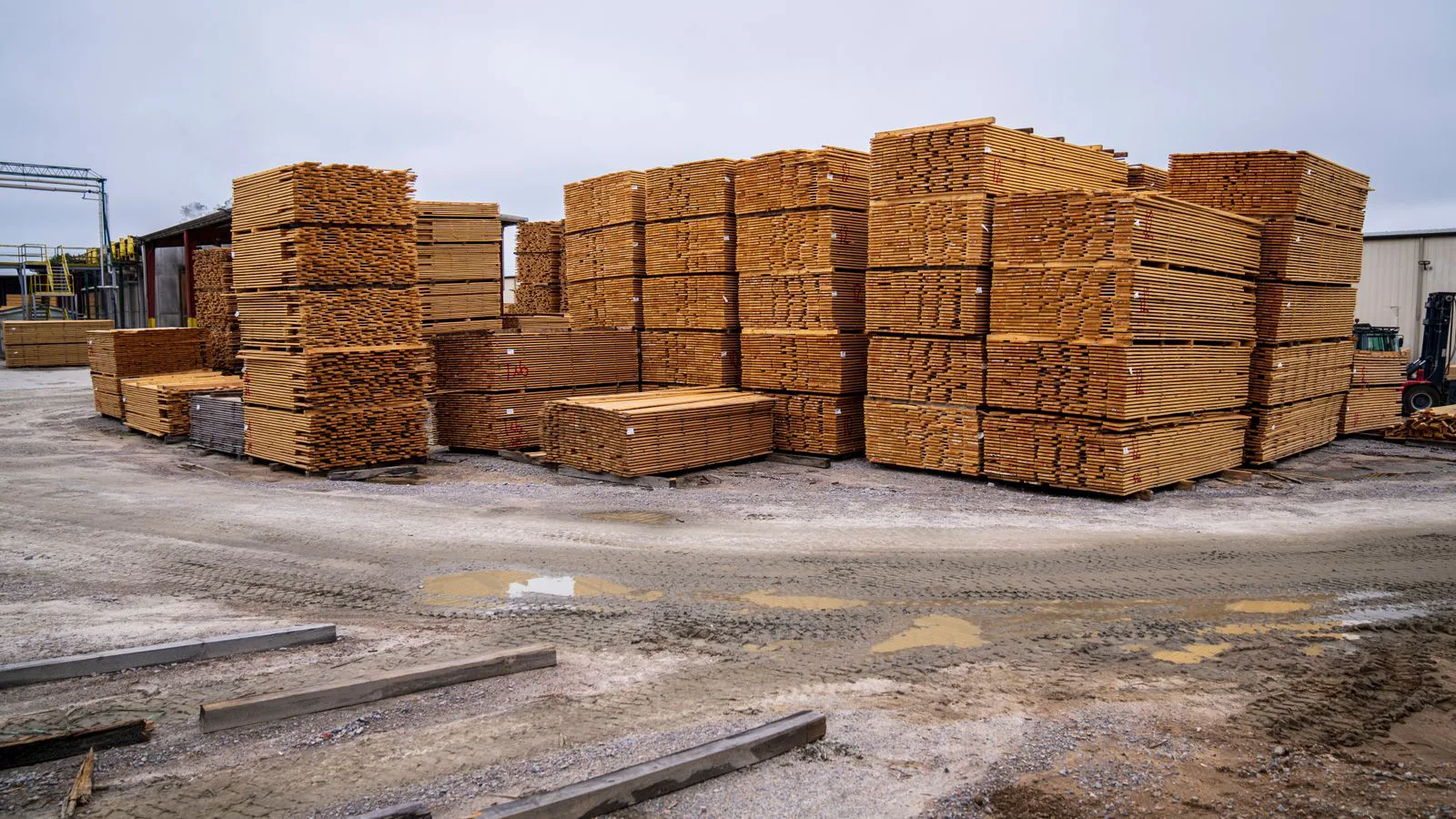
Count pieces first, then linear feet, then board feet. A 2×4 measures 1½ × 3½ inches but is billed on the full 2 × 4 — 34 % of what you pay for is sawdust. Worked from the calculator's real output, with the waste rule it actually applies.
Count pieces first, volume last
A yard sells you pieces of a given length. It does not sell you 34.94 cubic feet. So the only number that ends the trip in one visit is a list that reads "29 boards of 5/4×6 at 16 ft, 15 of 2×8 at 12 ft, 3 of 2×8 at 16 ft" — which is exactly the bill of materials the calculator prints under the totals. Volume is the sanity check and the price basis; it is never the order.
The calculator has two modes. "Pieces" is for when you already know what you need: size, length, quantity, waste. "Project" derives the list for you from four shapes — deck, fence, shelving, wall framing. The project mode is where the arithmetic lives, and it is worth knowing what it assumes. For a deck it lays decking across the short direction (rows = ceil(width × 12 / (actual board width + gap))), puts joists at your chosen centres along the length (floor(length × 12 / spacing) + 1) and adds exactly two rim boards. For a wall it counts floor(length × 12 / spacing) + 1 studs, adds three for the corner and end assemblies and four more per opening, plus three plates and one run of blocking.
Two things that arithmetic does not do: it never lays decking diagonally, and it never accounts for a stair, a post penetration or a bay window. Those are the reasons the waste percentage exists.
Nominal versus actual: three sizes for one board
A 2×4 is not two inches by four. It is 1½ × 3½ inches — 38.1 × 88.9 mm — once it has been dried and surfaced on four sides. This is not a merchant taking liberties; it is written into PS 20, the American Softwood Lumber Standard, which NIST publishes and which the calculator implements literally. The rule has four branches: boards under 2 in nominal thickness lose ¼ in, dimension lumber from 2 to 4 in loses ½ in, widths under 7 in lose ½ in while 7 in and over lose ¾ in, and timbers whose least nominal dimension is 5 in or more lose ½ in both ways. That is why a 2×8 is 1½ × 7¼ and a 6×6 is 5½ × 5½.
Where it bites: the board foot is computed on the nominal size, the strength is in the actual one. A 2×4 is billed at 2 × 4 × 1 / 12 = 0.6667 BF per foot. The wood you receive is 1.5 × 3.5 × 12 / 144 = 0.4375 BF per foot. You pay for 34.4 % more wood than arrives. Meanwhile the joist you are about to load carries what a 1½ × 3½ section can carry — the second moment of area of the actual section, which is what a beam calculator wants. Feed a beam check the nominal 2 × 10 and you overstate its stiffness by 80 %; feed it the real 1.5 × 9.25 and you get 98.9 in⁴, which is the honest figure.
The calculator prints both, which is the point of using it: the board-foot column is nominal, and the volume column beside it is computed on the actual section. On the 16 × 12 ft deck, 594.00 board feet billed corresponds to 0.9894 m³ of wood in the truck. Multiply the board feet by 0.00236 and you get 1.402 m³ — the volume you are paying for. The difference, 0.41 m³, is the planer's.
Waste: 10 % is a floor, and the calculator rounds every line up
Ten per cent is what a straight, rectangular, single-level job costs you in offcuts. Anything that is not that costs more: 15 % for decking laid diagonally or a room that is not square, 15 to 20 % for a fence following an uneven grade, more again for short pieces cut from long stock. The reason is geometric, not sloppy — waste is the offcut you cannot use anywhere else, and a job made of many short members generates more of it than a job made of few long ones.
How the calculator applies it is worth watching, because it is not what most people assume. The percentage is applied to each line of the bill of materials separately, and each line is then rounded up to a whole piece. That is right for a big line and violent for a small one. On the 16 × 12 ft deck, 26 decking boards become 29 and 13 joists become 15 — both sensible. But the 2 rim boards become 3, a 50 % overshoot, and on the wall framing the single run of blocking becomes 2, a 100 % overshoot. Read the bill of materials line by line and cut the small lines back by hand.
The other half of the waste question is stock length. The calculator gives you the length each piece needs to be; it does not round that up to a length the yard sells. A 3.2 m rafter comes out of a 4 m stick and you throw 0.8 m away — that is 20 % waste on that line before you have cut anything wrong. Plan the cutting list against the lengths your merchant stocks, and pick the stock length that leaves the smallest tail.
If your drawing is in millimetres
The lumber calculator is imperial only. It has no metric entry mode — the board-foot calculator does, and the rebar calculator does, but this one does not, in any of the six languages it ships in. If you type 45 × 95 meaning millimetres it reads inches and returns 10 687.50 board feet for ten pieces, then helpfully applies the PS 20 planing deduction to give you an "actual" 44.5 × 94.5. Convert before you type, or use the board-foot calculator, which accepts millimetres and metres directly.
The deeper point is that the nominal-versus-actual problem does not exist in the same form outside North America. A European section quoted as 45 × 95 mm is 45 × 95 mm: the number on the label is the number you measure. Sizes and permitted deviations for structural timber are set by EN 336 and EN 1313, both paid standards — this article describes what merchants stock, not the wording of the standards, which we did not read. What does move is moisture: structural timber is specified at a reference moisture content, and a section measured wetter or drier than that reference has swollen or shrunk. That is a millimetre or two on a 45 mm face, not the 12 mm a planer takes off a North American 2×.
Pricing works the same way but stops one mode short. The price field offers per board foot, per linear foot and per piece — no per-cubic-metre mode, which is how structural sections are quoted across most of Europe. At $4.20 the board foot the deck above comes to $2,494.80, and the same wood priced per piece at $23 a stick comes to $1,081, which tells you how far apart those two bases can sit until you pin down the length. If you are comparing against a metric quote, take the volume the calculator prints in m³ — 0.9894 m³ for that deck — and multiply it yourself, because that figure is the planed volume, not the nominal one the board feet describe.
Three sanity checks before you order
First: does the piece count divide sensibly by the stock length you can actually buy? Forty-four 8 ft 2×4s is forty-four sticks; twenty-two 16 ft sticks cut in half is the same wood with half the handles and usually a better price per foot. The calculator will not suggest that swap.
Second: is any member in the list carrying a load? Decking, pickets, cleats and blocking are not. Joists, rafters, headers, beams and posts are, and for those the section has to be checked against the span, not chosen from a table someone posted online. Take the ACTUAL dimensions — 1.5 × 9.25 in for a 2×10, 38 × 235 mm for a European 2× equivalent — into the beam load calculator and look at deflection, which is what fails first on a floor.
Third: does the volume figure look right against the price? A cubic metre of softwood weighs roughly 450 to 550 kg air dried. If the calculator says 0.99 m³ and the quote is for four tonnes of timber, one of the two is wrong, and it is worth finding out which before the truck arrives.
| Nominal | Actual (in) | Actual (mm) | Billed BF per ft | Real wood BF per ft | Lost to planing |
|---|---|---|---|---|---|
| 1×4 | 0.75 × 3.5 | 19.0 × 88.9 | 0.3333 | 0.2188 | 34.4 % |
| 1×6 | 0.75 × 5.5 | 19.0 × 139.7 | 0.5000 | 0.3438 | 31.3 % |
| 1×8 | 0.75 × 7.25 | 19.0 × 184.1 | 0.6667 | 0.4531 | 32.0 % |
| 2×4 | 1.5 × 3.5 | 38.1 × 88.9 | 0.6667 | 0.4375 | 34.4 % |
| 2×6 | 1.5 × 5.5 | 38.1 × 139.7 | 1.0000 | 0.6875 | 31.3 % |
| 2×8 | 1.5 × 7.25 | 38.1 × 184.1 | 1.3333 | 0.9063 | 32.0 % |
| 2×10 | 1.5 × 9.25 | 38.1 × 234.9 | 1.6667 | 1.1563 | 30.6 % |
| 4×4 | 3.5 × 3.5 | 88.9 × 88.9 | 1.3333 | 1.0208 | 23.4 % |
| 6×6 | 5.5 × 5.5 | 139.7 × 139.7 | 3.0000 | 2.5208 | 16.0 % |
Frequently asked questions
- Why is a 2×4 not two inches by four inches?
- Because the nominal size is the size of the piece when it left the saw, green and rough. Drying shrinks it and surfacing on four sides planes it down further. PS 20 fixes what is left: dimension lumber from 2 to 4 in nominal thickness loses ½ in, so 2 becomes 1½ and 4 becomes 3½. The name survived the process. A 2×4 has been 1½ × 3½ for longer than anyone reading this has been buying lumber, and every North American span table, hanger and code provision already assumes it.
- Am I being overcharged when board feet are billed on the nominal size?
- No — you are being charged consistently, which is different. Every mill and every yard in North America quotes on the nominal size, so the comparison between two quotes is fair. What the nominal number does not tell you is how much wood you get, and that is where it misleads. If you are comparing a North American quote in board feet with a European one in cubic metres, convert on the ACTUAL section, not the nominal one, or you will overpay by about 30 %. The calculator prints both figures side by side precisely so you can do that.
- How much waste should I actually add?
- Ten per cent on a rectangular, single-level job with long runs. Fifteen on diagonal decking, a room out of square, or a fence following grade. Twenty when the members are short relative to the stock length, because every cut leaves a tail. Add a separate allowance for the pieces you will ruin: on a first deck, two or three boards. And remember the calculator applies your percentage to each line of the bill separately and rounds up, so a two-piece line already carries a 50 % cushion — you do not need to add more on top of that.
- Can I enter millimetres?
- Not in this calculator. The lumber calculator is imperial only — thickness and width in inches, length in feet — and it has no unit toggle in any language. Typing 45 × 95 gets read as 45 × 95 inches, and the tool then applies the PS 20 planing rule to it, so you get a plausible-looking but meaningless "actual" size of 44.5 × 94.5. If you need millimetres, use the board foot calculator, which has a millimetres/metres mode, and convert with 1 in = 25.4 mm and 1 ft = 0.3048 m.
- Which number do I take to the merchant: pieces, linear feet or board feet?
- Pieces, with their size and length — that is what gets picked and loaded, and it is the only form in which the order can be wrong in a way you will notice at the counter. Linear feet is the cross-check: divide by the stock length and you should get roughly your piece count. Board feet is the price basis for hardwood and for anything sold rough; ask which basis the quote uses, because a price per board foot and a price per piece are not comparable until you know the length. For an order in cubic metres, use the volume figure the calculator prints — it is the real, planed volume, not the nominal one.
Articles you may find interesting
All guides →Related tools
These are material estimates produced by running the calculator, not a bill of quantities and not a substitute for a supplier's take-off. Counts assume a rectangular, obstruction-free job; every corner, opening, curve and change of level adds pieces the calculator cannot see. Sizes, stock lengths and grading rules differ by country and by merchant, so check the actual section and length your supplier stocks before you order. Measure the site yourself, twice, before spending money on the numbers on this page.
Sources
- NIST — Voluntary Product Standard PS 20-20, American Softwood Lumber Standard — the surfaced-dry size table the calculator implements
- USDA Forest Service, Forest Products Laboratory — Wood Handbook: Wood as an Engineering Material (FPL-GTR-190) — shrinkage, moisture content and species density
- American Wood Council — Tutorial for Understanding Loads and Using Span Tables — how a section becomes a span
Spotted a mistake in this article?